Can AI Summarize Crypto News Accurately? What the Research Shows
In This Article
Introduction
AI can summarize crypto news usefully, but not reliably enough to trust blindly. The research so far is clear on that. When journalists have tested popular AI assistants on news questions, a large share of answers came back with real problems: wrong facts, altered quotes, missing context, or claims traced to the wrong source.
That doesn't make AI summaries useless. It means the way a summary is produced matters a great deal, and you need to know which kinds of crypto news AI handles well and where it reliably goes wrong.
What the Research Found
The BBC, February 2025. The BBC asked ChatGPT, Microsoft Copilot, Google Gemini and Perplexity questions about the news, pointing them to BBC articles as sources. BBC journalists judged 51% of the answers to have significant issues. 19% of answers that cited BBC content introduced factual errors, such as wrong numbers, dates or statements, and 13% of quotes attributed to BBC articles had been altered or didn't appear in the article at all.
The EBU and BBC, October 2025. A larger follow-up study coordinated by the European Broadcasting Union had journalists from 22 public broadcasters in 18 countries review more than 3,000 AI answers in 14 languages. 45% of answers had at least one significant issue. The biggest single problem was sourcing, with serious sourcing problems in 31% of answers, and 20% had major accuracy problems such as invented details or outdated information.
Apple, January 2025. Apple paused AI-generated summaries of news notifications on iPhones after they produced false headlines, including one wrongly attributed to the BBC.
One important caveat: these studies tested general-purpose AI assistants answering news questions, drawing on whatever they found online or already knew. That's a different and harder job than summarizing a fixed set of articles you hand them. The difference turns out to be the key to using AI well.
Why Crypto Is Especially Hard for AI
Crypto news has several features that trip up AI summaries more than most topics:
- Numbers go stale in minutes. A price, a market cap or an ETF flow figure that was right this morning can be wrong by lunch. An AI working from older material will state it confidently anyway.
- Rumors outnumber facts. Crypto social media is full of unconfirmed claims. An AI that draws on the open web can repeat a rumor as if it were reported fact. (See how to spot fake crypto news.)
- Similar names. Many projects have near-identical names and tickers. Mixing them up is easy, for people and for AI.
- Opinion dressed as news. Much crypto content is commentary and price predictions. The BBC study found AI assistants often struggled to tell opinion from fact.
- Partnership claims. "Company X partners with famous bank" is common, and often exaggerated. An AI summarizing the hype rather than the original announcement will pass the exaggeration on.
What AI Summaries Are Actually Good At
None of that means you should avoid AI. Used well, it's genuinely helpful for:
- Condensing long content. Turning a 40-minute video or a long article into the five points that matter is where AI saves the most time.
- Covering many sources quickly. Reading what eight sources said today and showing where they agree and disagree.
- Spotting what changed. Pulling out the new information in a story you've already been following.
- Consistent format. Giving you the same structure every day, so it's easy to scan.
What Makes an AI Summary Trustworthy
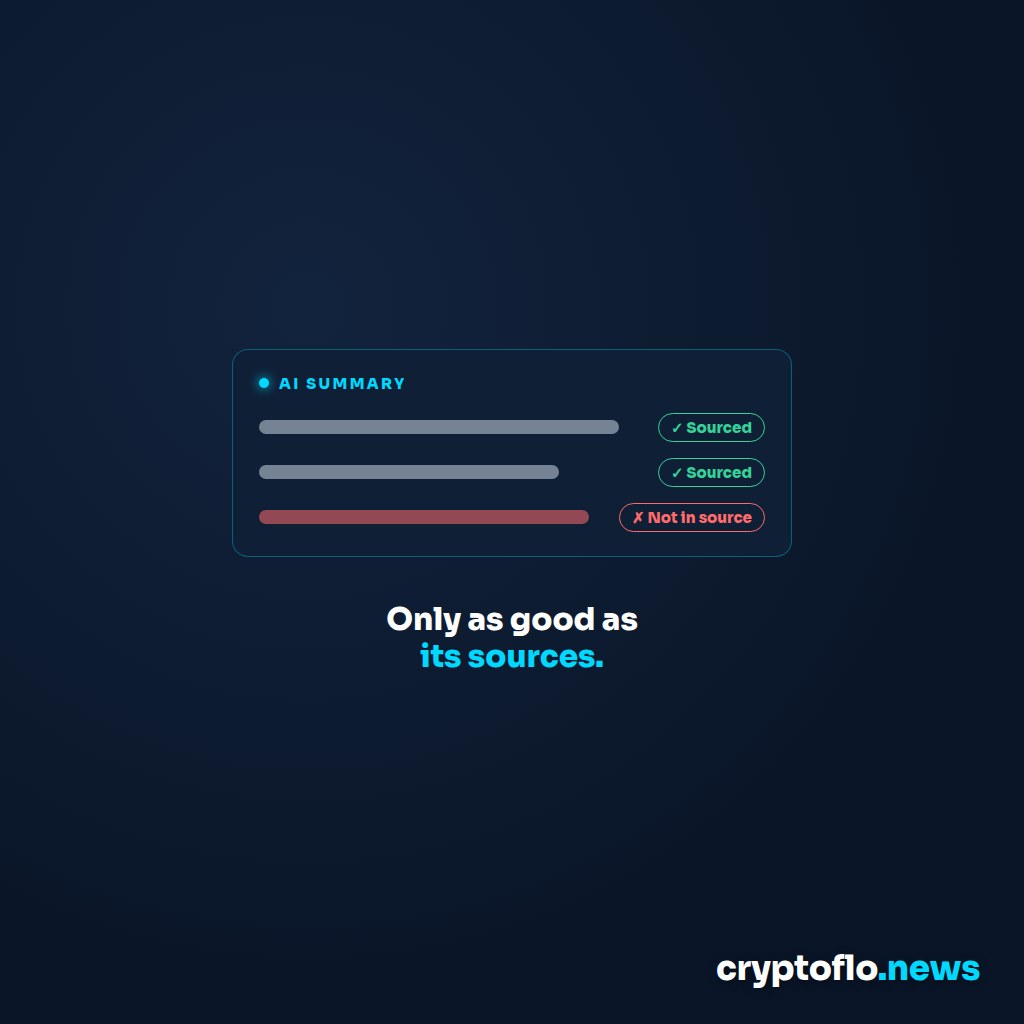
The single biggest factor is where the information comes from. An AI summarizing a fixed set of sources you chose is working on a much easier and more checkable task than one answering from the open web or its own memory. Look for:
- Grounded in named sources. It should summarize specific sources, not general knowledge.
- Clear attribution. You should be able to tell which source said what, especially for claims and predictions.
- Dates on everything. A number or event without a date is a number you can't check.
- No predictions of its own. A summary should report what sources said, not add its own price calls.
- Easy to check. If something matters, you should be able to go straight to the original.
How to Use AI Crypto Summaries Safely
1. Choose the sources first. A summary can only be as good as what goes into it. Our guide to choosing crypto news sources you can trust covers how.
2. Treat numbers as "check before acting." Prices, flows and percentages are where errors hurt most.
3. Go to the original for anything you'd act on. Use the summary to decide what to read, not as a replacement for reading it.
4. Watch for missing context. If a summary makes something sound dramatic, the original may explain why it isn't.
5. Keep a human in the loop. You decide what matters. AI just gets you there faster. (Our 15-minute routine shows how this fits into a day.)
Where Crypto Flo Fits
Crypto Flo is built around the grounding principle above. Crypto Flo is a personalized AI crypto intelligence platform that turns the coins you follow and the sources you choose into a daily audio or text briefing.
You choose your sources for each coin from a vetted library of at least 10 YouTube channels and 10 news outlets, and the AI writes each brief from what those specific sources published, rather than from general knowledge or the open web. When a source makes a price call, the brief reports it as that source's view, and Crypto Flo doesn't make predictions of its own. Grounding reduces errors; it can't eliminate them, so anything you plan to act on is still worth checking at the source. See how Crypto Flo works.
Frequently Asked Questions
Q: Can AI summarize crypto news accurately?
A: Often, but not reliably enough to trust blindly. Studies by the BBC and the European Broadcasting Union found that 45–51% of AI assistants' answers to news questions had significant issues. Accuracy improves a lot when the AI summarizes a fixed set of named sources instead of answering from the open web.
Q: What did the BBC study on AI news summaries find?
A: In February 2025, the BBC found that 51% of answers from ChatGPT, Copilot, Gemini and Perplexity to news questions had significant issues, 19% of answers citing BBC content introduced factual errors, and 13% of quotes were altered or missing from the cited article.
Q: Why do AI tools get crypto news wrong?
A: Crypto prices and figures change by the minute, rumors spread widely online, many projects have similar names, and much crypto content is opinion presented as news. AI drawing on the open web can repeat stale numbers, rumors or hype as fact.
Q: Is it safe to rely on AI crypto news summaries?
A: For staying informed, yes, if the summary is grounded in sources you trust and clearly attributes what each one said. For anything you'll act on, especially numbers, check the original source first.
Q: What makes an AI news summary more reliable?
A: Summarizing a fixed set of named sources rather than general knowledge, attributing claims to each source, putting dates on numbers and events, and avoiding predictions of its own.
Q: Does Crypto Flo use AI to summarize crypto news?
A: Yes. Crypto Flo's AI writes each daily brief only from the sources you chose for each coin, from a vetted library, rather than from general knowledge. That reduces errors but can't eliminate them, so important details are still worth checking at the source.
The Bottom Line
AI can save you hours on crypto news, but the research is clear that it isn't reliable on its own. The answer isn't to avoid it. It's to use it the right way: grounded in sources you chose, with claims attributed and dated, no predictions of its own, and a quick check at the source before you act. A good AI summary tells you where to look. It doesn't replace looking.
This content was created with AI assistance and may contain errors, always verify before acting. Not financial advice. Always do your own research before making any investment decisions.
Frequently Asked Questions
Can AI summarize crypto news accurately?
Often, but not reliably enough to trust blindly. Studies by the BBC and the European Broadcasting Union found that 45–51% of AI assistants' answers to news questions had significant issues. Accuracy improves a lot when the AI summarizes a fixed set of named sources instead of answering from the open web.
What did the BBC study on AI news summaries find?
In February 2025, the BBC found that 51% of answers from ChatGPT, Copilot, Gemini and Perplexity to news questions had significant issues, 19% of answers citing BBC content introduced factual errors, and 13% of quotes were altered or missing from the cited article.
Why do AI tools get crypto news wrong?
Crypto prices and figures change by the minute, rumors spread widely online, many projects have similar names, and much crypto content is opinion presented as news. AI drawing on the open web can repeat stale numbers, rumors or hype as fact.
Is it safe to rely on AI crypto news summaries?
For staying informed, yes, if the summary is grounded in sources you trust and clearly attributes what each one said. For anything you'll act on, especially numbers, check the original source first.
What makes an AI news summary more reliable?
Summarizing a fixed set of named sources rather than general knowledge, attributing claims to each source, putting dates on numbers and events, and avoiding predictions of its own.
Does Crypto Flo use AI to summarize crypto news?
Yes. Crypto Flo's AI writes each daily brief only from the sources you chose for each coin, from a vetted library, rather than from general knowledge. That reduces errors but can't eliminate them, so important details are still worth checking at the source.
Get daily intelligence on the coins you track
Personalized AI briefings built from the sources you choose. Starting at $5.99/month.
Start with Crypto Flo