The $116 Million Coldcard Hack: What Happened, and What Self-Custody Bitcoiners Need to Do Now
In This Article
Introduction
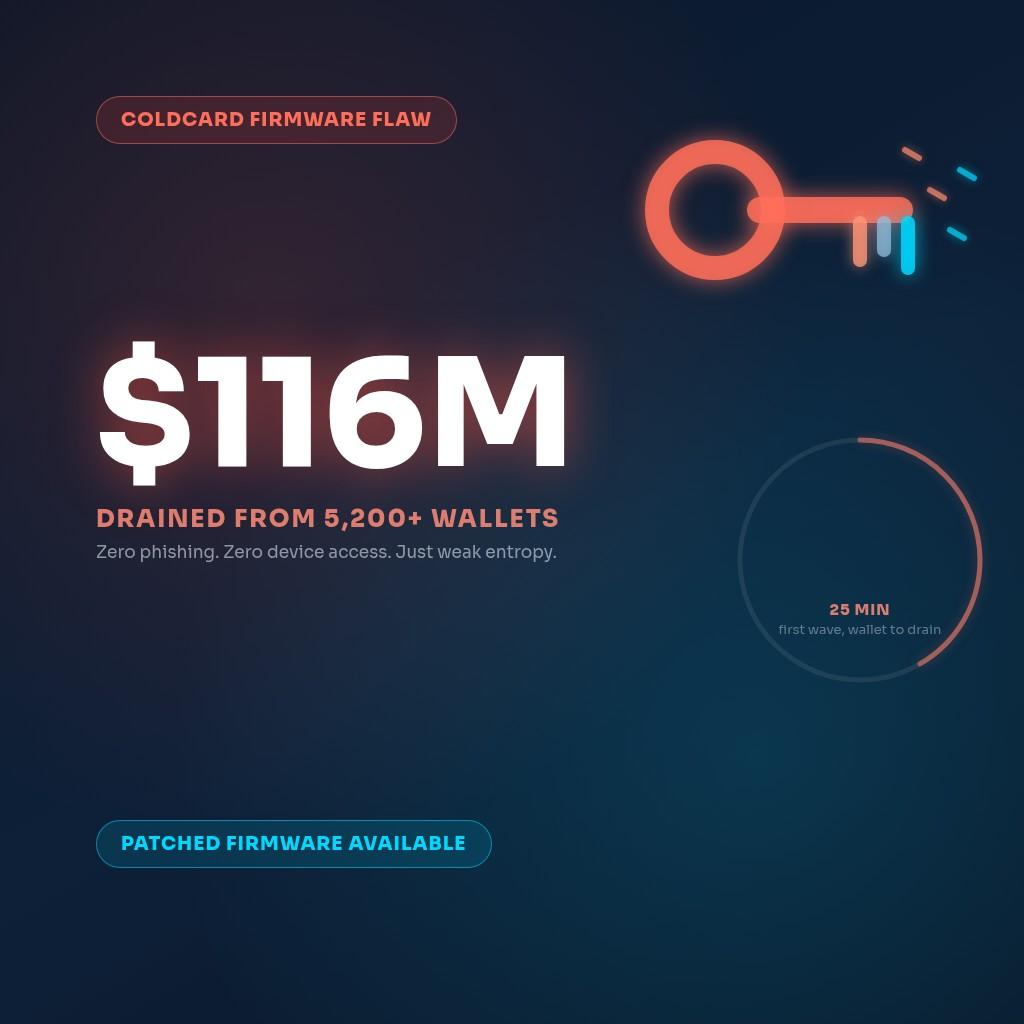
"Not your keys, not your coins" is the oldest piece of advice in Bitcoin. This week it got complicated. Since July 30, an attacker has drained roughly 1,816 BTC, close to $116 million, from more than 5,200 wallets, and the wallets weren't hacked exchanges or phishing victims. They were Coldcard hardware wallets, one of the most trusted names in cold storage, compromised not by anyone touching the device, but by a flaw baked into the firmware five years ago.
If you've ever generated a seed phrase on a Coldcard, this is worth ten minutes of your time today.
What Actually Happened
The first wave hit fast. On July 30, roughly 594 BTC, about $38 million at the time, moved out of around 500 wallets into a single consolidation address in under 25 minutes. That's not a slow leak, that's an attacker who already knew exactly which wallets to hit before they started. Three more waves followed over the next several days, and Galaxy Research's running tally now sits near $116 million from over 5,200 addresses.
Coinkite, the company behind Coldcard, moved quickly once the pattern was confirmed, pushing emergency patched firmware within 24 hours. But the patch only stops the bleeding going forward. It can't undo what already happened to wallets created before it.
The Root Cause: A Five-Year-Old Build Flag
Here's the part that makes this different from a typical hack. Nobody touched anyone's device. There was no phishing link, no malware, no physical theft. The flaw traces back to a firmware release from March 2021, where a build configuration error caused the wallet to fall back on a weaker software random number generator instead of pulling entropy from the device's dedicated hardware source when generating a new seed phrase.
Entropy is just randomness, and randomness is the entire security model behind a private key. A properly generated Bitcoin seed is supposed to carry 128 bits of entropy, a number so large that brute-forcing it is not a real-world threat. The flawed builds silently cut that down. Mk3 devices running the affected firmware dropped to roughly 40 bits of effective entropy. Mk4, Mk5, and Q devices on affected versions dropped to roughly 72 bits. Both numbers sound abstract until you realize what they mean in practice: with modern computing power, an attacker doesn't need your device, your seed phrase, or your PIN. They can generate candidate private keys directly and check each one against the public blockchain for a match. That's exactly what happened here, at scale.
Who's Actually At Risk
This doesn't affect every Coldcard, and it doesn't affect every Bitcoin wallet. It affects a specific window:
- Mk3 devices on firmware 4.0.1 through 4.1.9
- Mk4 and Mk5 devices on firmware below 5.6.0
- Q devices on firmware below 1.5.0Q
If your seed phrase was generated on a Coldcard running any of those firmware versions, between March 2021 and the July 31 patch, the funds behind that seed should be treated as compromised, whether or not you've noticed anything wrong yet. The attacker doesn't need to touch your specific wallet before you notice. They just need time.
What To Actually Do About It
This is the part that matters more than the technical explanation. Updating your firmware alone does not fix this.
- Update your firmware immediately to the patched version for your model: v4.2.0 for Mk3, v5.6.0 for Mk4/Mk5, or v1.5.0Q for Q. This stops the device from ever generating a weak seed again, but it does nothing for a seed that already exists.
- Generate a brand-new seed phrase on the now-patched firmware. Do not reuse or re-derive from the old one.
- Move all funds from any wallet whose seed was created during the vulnerable window into the new wallet. Do this even if nothing looks wrong. The whole danger of this exploit is that an attacker can hold a compromised key for weeks before using it.
- Double check the date, not just the firmware version you're currently running. What matters is when the seed was originally generated, since updating firmware later doesn't retroactively fix an old seed.
If you're not sure when your seed was generated or which firmware version was on the device at the time, the safe move is to treat it as compromised and migrate anyway. A wasted afternoon moving coins that were never at risk costs you nothing. Guessing wrong the other way costs you everything in that wallet.
What This Does, and Doesn't, Say About Self-Custody
This exploit has reignited a familiar debate about whether self-custody is worth the risk compared to letting an exchange or ETF hold your Bitcoin for you. It's worth being precise about what actually happened here, because the honest answer cuts against the easy headline.
This wasn't a failure of self-custody as an idea. Self-custody means nobody but you controls your keys, and that held true here right up until the moment the keys themselves were generated wrong. This was a supply chain failure, a flaw in the tool used to generate those keys, not a flaw in the concept of holding your own coins. A cold wallet is designed to be immune to remote attacks on a device that's working correctly. This attacker never needed remote access to a device at all, they needed a predictable key, and the predictability came from the manufacturer's build process, not from anything the user did wrong.
That distinction matters, but it doesn't make the lesson smaller. Self-custody puts the full weight of verification on you. There's no support line to catch a firmware bug on your behalf. If anything, this is an argument for treating your hardware wallet's firmware version and seed generation date as something worth actually tracking, the same way you'd track anything else guarding six figures.
Frequently Asked Questions
Q: Does this affect all Coldcard wallets?
A: No. Only devices that generated a seed phrase on specific firmware versions between March 2021 and the July 31, 2026 patch. Mk3 on 4.0.1-4.1.9, Mk4/Mk5 below 5.6.0, and Q below 1.5.0Q.
Q: I already updated my firmware. Am I safe now?
A: Updating firmware stops the device from generating new weak seeds. It does not fix a seed phrase that was already created before the update. If your existing seed was generated during the vulnerable window, you still need to move funds to a newly generated seed.
Q: How did the attacker actually steal the funds without touching the device?
A: The flaw reduced the randomness behind seed generation so severely that an attacker could generate candidate private keys directly and check them against known Bitcoin addresses on the public blockchain, no access to the physical device, PIN, or seed phrase required.
Q: Does this mean hardware wallets are less safe than exchanges?
A: Not as a general rule. This was a specific, patched firmware flaw at one manufacturer, not a structural weakness in hardware wallets or self-custody as a category. It is a strong argument for verifying firmware and seed generation dates rather than assuming a device is safe by default.
The Bottom Line
A $116 million theft that required no phishing, no malware, and no physical access is a genuinely rare kind of failure, and it's exactly the kind that's easy to miss if you're not paying close attention to firmware version numbers. If you own a Coldcard, the ten minutes it takes to check your model and firmware history is the cheapest insurance you'll buy all year. If you don't, it's still worth understanding, because "the hardware wallet itself was compromised" is a different and more useful lesson than the headline number suggests.
This content was created with AI assistance and may contain errors, always verify before acting. Not financial advice. Always do your own research before making any investment decisions.
Frequently Asked Questions
Does this affect all Coldcard wallets?
No. Only devices that generated a seed phrase on specific firmware versions between March 2021 and the July 31, 2026 patch. Mk3 on 4.0.1-4.1.9, Mk4/Mk5 below 5.6.0, and Q below 1.5.0Q.
I already updated my firmware. Am I safe now?
Updating firmware stops the device from generating new weak seeds. It does not fix a seed phrase that was already created before the update. If your existing seed was generated during the vulnerable window, you still need to move funds to a newly generated seed.
How did the attacker actually steal the funds without touching the device?
The flaw reduced the randomness behind seed generation so severely that an attacker could generate candidate private keys directly and check them against known Bitcoin addresses on the public blockchain, no access to the physical device, PIN, or seed phrase required.
Does this mean hardware wallets are less safe than exchanges?
Not as a general rule. This was a specific, patched firmware flaw at one manufacturer, not a structural weakness in hardware wallets or self-custody as a category. It is a strong argument for verifying firmware and seed generation dates rather than assuming a device is safe by default.
Model your DCA strategy before committing real money
Crypto Flo's DCA Planner shows what your position looks like at any future price scenario.
Try the DCA Planner