How to Build a Personal Crypto Research Routine
In This Article
- Introduction
- What a Research Routine Is (and Isn't)
- Step 1: Write Down Why You Hold Each Coin
- Step 2: Build a Small Source List for Each Coin
- Step 3: Set a Weekly Review (30 Minutes)
- Step 4: Do a Monthly Deep Dive on One Coin
- Step 5: Keep a Research Log
- Step 6: Decide in Advance What Would Make You Act
- Common Research Mistakes
- Where Crypto Flo Fits
- Frequently Asked Questions
- The Bottom Line
Introduction
"Do your own research" (DYOR) is the most repeated advice in crypto, and the least explained. Most people hear it and end up doing one of two things: watching videos until something feels convincing, or giving up and following whoever sounds most confident.
Research doesn't have to be either. A personal research routine is a simple, repeatable way to learn what matters about the coins you hold or are considering, without spending your evenings on it. This guide shows you how to build one: what to look at, how often, and how to keep track of what you learn.
What a Research Routine Is (and Isn't)
A research routine isn't the same as keeping up with daily news. Daily news tells you what happened today. Research answers bigger questions:
- What does this project actually do, and who uses it?
- What could make it succeed or fail over the next year or two?
- What would have to happen for me to change my mind?
You need both, but they run on different clocks. News is daily and short. Research is weekly or monthly and deeper. (For the daily side, see our 15-minute routine.)
Step 1: Write Down Why You Hold Each Coin
Before you research anything, write one or two sentences for each coin you hold or are watching: why you own it, and what you expect to happen. For example: "I hold this because I think its network will keep growing in real-world payments over the next two years."
This is your thesis. It turns research from endless browsing into a focused question: is my reason still true? It also makes it much harder for a single scary headline or exciting video to push you around, because you can check it against what you actually believe and why.
Step 2: Build a Small Source List for Each Coin
For each coin, pick a handful of sources that cover different angles:
- Official sources: the project's own blog, announcements and developer updates. The original record of what's actually happening.
- Data sources: a block explorer and a data site, so you can check claims yourself instead of taking anyone's word for it.
- Analysts and YouTube creators: people who follow the coin closely and explain what developments mean. The best ones show their data and reasoning, separate news from their own view, and disclose sponsorships. They're often the fastest way to understand context you'd otherwise miss.
- An established newsroom: for verified reporting on what happened.
- A skeptic: someone who regularly argues the other side, so you hear the bear case too.
Our guide to choosing crypto news sources you can trust explains how to judge each one, and our coin guides for Bitcoin, Ethereum, XRP and HBAR name specific sources.
Step 3: Set a Weekly Review (30 Minutes)
Once a week, sit down with your list and work through the same short checklist:
1. What changed this week? Upgrades, partnerships, regulation, security incidents, big changes in usage or ETF flows.
2. Does it affect my thesis? Most weeks, the honest answer is no. That's fine.
3. What are the analysts I trust saying, and why? Look at their reasoning, not just their conclusions.
4. What's the best argument against my position this week? Find it on purpose.
5. Write two or three lines in your notes.
Thirty minutes a week is enough for most people holding a few coins.
Step 4: Do a Monthly Deep Dive on One Coin
Once a month, pick one coin and go deeper:
- Read the project's latest official update or roadmap in full, not just the headlines about it.
- Check the on-chain picture yourself: activity, holders, staking, or whatever matters most for that coin.
- Watch or read one longer piece of analysis from someone who explains their reasoning.
- Read one well-argued critical take.
- Revisit your thesis. Update it, strengthen it, or decide it no longer holds.
Rotating through your coins one at a time keeps this manageable.
Step 5: Keep a Research Log
A simple notes file, document or spreadsheet is enough. For each entry, record the date, the coin, what you learned, where it came from, and whether it changed your view.
Over time, the log becomes surprisingly valuable. It shows which sources were right and which weren't, stops you re-researching the same questions, and makes it obvious when you're reacting to noise instead of new information.
Step 6: Decide in Advance What Would Make You Act
The point of research is better decisions, not more activity. For each coin, write down what would make you buy more, sell some, or exit completely: a failed upgrade, a key partner leaving, a security problem, a change in regulation. If nothing on that list has happened, a dramatic headline usually isn't a reason to act.
Common Research Mistakes
- Only reading the bull case. If every source you follow agrees with you, you're not researching, you're collecting reassurance.
- Confusing price with progress. A coin going up doesn't mean the project is succeeding, and a coin going down doesn't mean it's failing.
- Trusting confidence over evidence. Prefer people who show their work.
- Never writing anything down. Without notes, you'll forget why you made a decision and repeat the same research.
- Researching only after a big move. By then, emotion is doing most of the thinking. A regular routine keeps you ahead of it.
Where Crypto Flo Fits
Crypto Flo is a personalized AI crypto intelligence platform that turns the coins you follow and the sources you choose into a daily audio or text briefing. For each coin it maintains a vetted library of at least 10 YouTube channels and 10 news outlets, and you choose which of them brief you. That takes care of the daily layer, so your weekly review and monthly deep dive can focus on thinking rather than catching up. See how Crypto Flo works.
Frequently Asked Questions
Q: What does "do your own research" mean in crypto?
A: It means understanding why you hold a coin and checking claims yourself, rather than relying on hype or a single source. In practice, that's a short list of sources covering different angles, a regular review, and notes on what you learn.
Q: How much time should crypto research take?
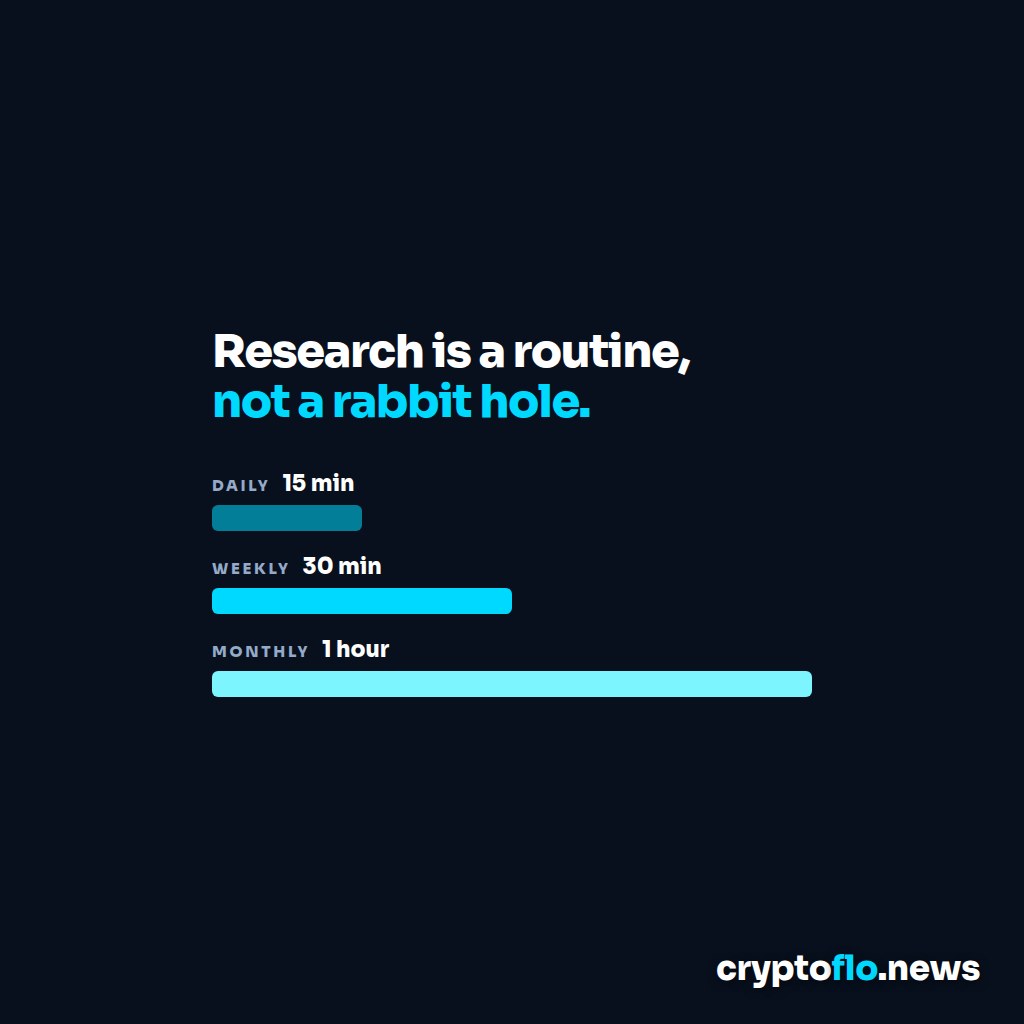
A: For most people holding a few coins, about 15 minutes a day for news, 30 minutes a week for a review, and an hour or so a month for a deeper look at one coin is plenty.
Q: What sources should I use for crypto research?
A: A mix: the project's official sources, a data source or block explorer, one or two analysts who show their reasoning, an established newsroom, and at least one skeptic who argues the other side.
Q: What is an investment thesis in crypto?
A: A short written reason for holding a coin and what you expect to happen. It turns research into a clear question, whether your reason is still true, and makes you less likely to react to every headline.
Q: Should I keep notes on my crypto research?
A: Yes. A simple log of what you learned, where it came from and whether it changed your view shows which sources prove reliable over time, and stops you repeating the same research.
Q: How does Crypto Flo fit into a research routine?
A: Crypto Flo handles the daily layer, a briefing built from the sources you choose for each coin from its vetted library, so your weekly and monthly research time can go into deeper thinking.
The Bottom Line
A personal research routine is simpler than it sounds: write down why you hold each coin, follow a small set of sources that cover every angle, review weekly, go deep monthly, keep notes, and decide in advance what would make you act. It takes a little discipline to start, and then it saves you time, stress and bad decisions for as long as you hold crypto.
This content was created with AI assistance and may contain errors, always verify before acting. Not financial advice. Always do your own research before making any investment decisions.
Frequently Asked Questions
What does "do your own research" mean in crypto?
It means understanding why you hold a coin and checking claims yourself, rather than relying on hype or a single source. In practice, that's a short list of sources covering different angles, a regular review, and notes on what you learn.
How much time should crypto research take?
For most people holding a few coins, about 15 minutes a day for news, 30 minutes a week for a review, and an hour or so a month for a deeper look at one coin is plenty.
What sources should I use for crypto research?
A mix: the project's official sources, a data source or block explorer, one or two analysts who show their reasoning, an established newsroom, and at least one skeptic who argues the other side.
What is an investment thesis in crypto?
A short written reason for holding a coin and what you expect to happen. It turns research into a clear question, whether your reason is still true, and makes you less likely to react to every headline.
Should I keep notes on my crypto research?
Yes. A simple log of what you learned, where it came from and whether it changed your view shows which sources prove reliable over time, and stops you repeating the same research.
How does Crypto Flo fit into a research routine?
Crypto Flo handles the daily layer, a briefing built from the sources you choose for each coin from its vetted library, so your weekly and monthly research time can go into deeper thinking.
Get daily intelligence on the coins you track
Personalized AI briefings built from the sources you choose. Starting at $5.99/month.
Start with Crypto Flo