How to Read a Crypto Project Announcement (Without Getting Fooled)
In This Article
- Introduction
- Step 1: Who Actually Made the Announcement?
- Step 2: What Exactly Is Being Announced?
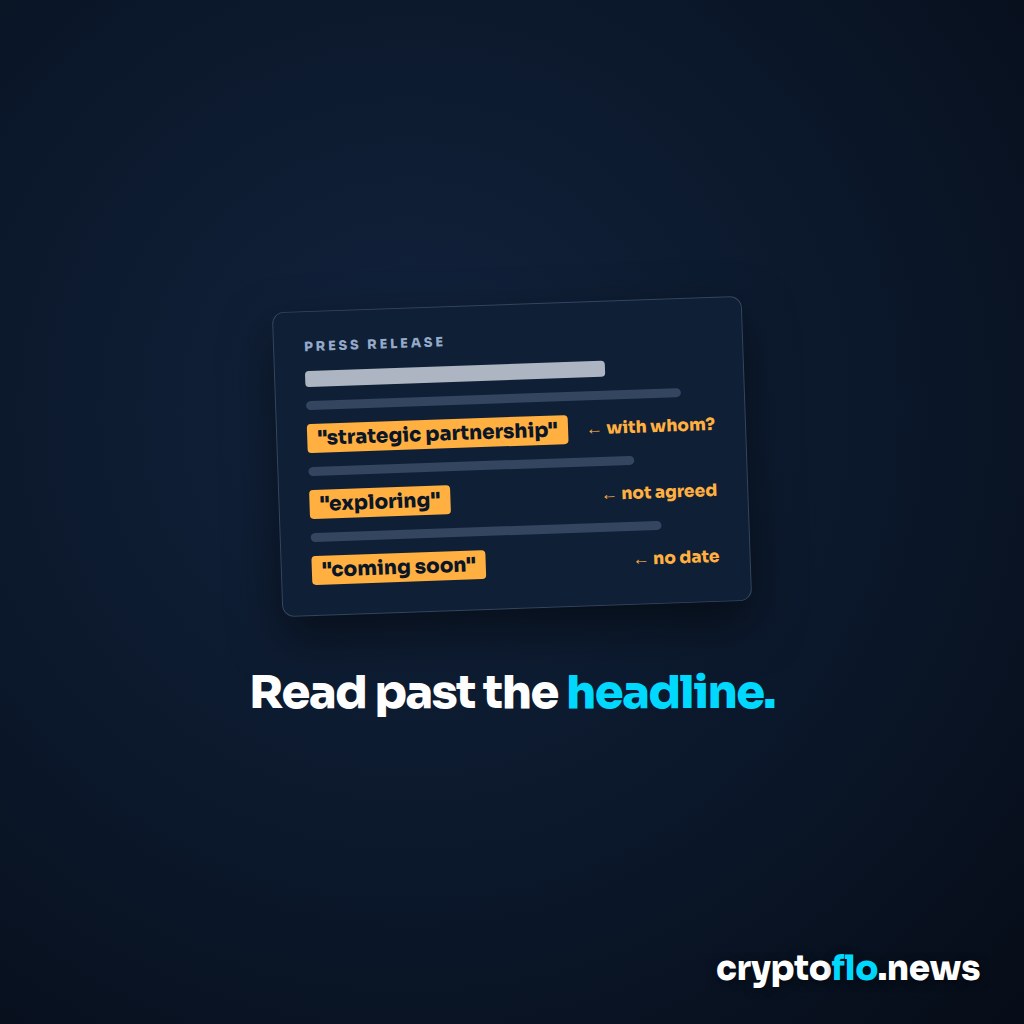
- Step 3: Translate the Buzzwords
- Step 4: Does It Involve the Token?
- Step 5: Check the Fine Print and the Numbers
- Step 6: Look for Independent Confirmation
- A Real Example of a Misread Announcement
- A Five-Minute Checklist
- Where Crypto Flo Fits
- Frequently Asked Questions
- The Bottom Line
Introduction
A crypto project announcement can move a price within minutes, often before anyone has read past the headline. "Major partnership." "Mainnet launch." "Integration with a global bank." Some of these are genuinely big news. Many are smaller than they sound. And a few aren't real at all.
Reading an announcement properly takes about five minutes once you know what to look for. This guide walks through the questions to ask, the phrases that tend to mean less than they suggest, and a few real examples of announcements that were misread.
Step 1: Who Actually Made the Announcement?
Before reading a word of the content, check the source:
- Is it on the project's official channels? The project's own blog, website or verified X account. Not a screenshot, a Telegram forward or "a source close to the team."
- If a partner is named, has the partner said it too? A big company that is genuinely working with a crypto project will usually announce it on its own newsroom or blog. If only the crypto side is talking about it, treat the partnership as unconfirmed.
- Is the account real? Impersonator accounts and hacked accounts are common. In January 2024, the SEC's own X account was hacked and used to post a false approval of Bitcoin ETFs. (More in how to spot fake crypto news.)
Step 2: What Exactly Is Being Announced?
Strip the announcement down to one plain sentence: who is doing what, starting when? If you can't write that sentence, the announcement is probably vaguer than it looks.
Then work out which of these it actually is:
- A live product: something people can use today.
- A launch on a test network: real progress, but not the same as the main network. Ethereum's Glamsterdam upgrade, for example, was scheduled for the Sepolia testnet on October 6, 2026, with no mainnet date set at the time.
- A pilot or proof of concept: a limited trial that may or may not continue.
- A plan, roadmap or "exploration": an intention, not a result.
- A listing or integration: a product added to a marketplace, exchange or app store.
All of these can matter. They just matter very differently.
Step 3: Translate the Buzzwords
Some phrases appear in almost every announcement. Here's roughly what they usually mean:
- "Partnership": could be anything from a multi-year commercial deal to one company using the other's software, or a shared webinar. Look for specifics: money, users, dates.
- "Exploring" or "in talks": nothing has been agreed.
- "Integration": one product now connects to another. Ask whether anyone is using the connection.
- "Strategic": usually adds no information.
- "Up to" or "potential": the number is a ceiling or an estimate, not a result.
- "Mainnet coming soon": no date has been committed.
Step 4: Does It Involve the Token?
This is the question most announcements quietly skip. A project's company can sign a deal that never touches the token you hold.
- XRP: many banks that work with Ripple use its payments software without holding or using XRP. (See our XRP sources guide.)
- HBAR: a company sitting on Hedera's governing council isn't the same as that company adopting HBAR. In late September 2026, a Hedera-based identity platform was listed in the IBM Cloud Catalog. HBAR jumped about 27% on the news and gave back about 16% the next day. The listing was real, but it wasn't IBM itself adopting HBAR. (See our HBAR sources guide.)
Ask directly: does this create demand for the token, change its supply, or change how the network works? If the answer is no, it may still be good news for the company, but it's a different kind of news.
Step 5: Check the Fine Print and the Numbers
- Dates: when does it actually start? Is there a date at all?
- Numbers: are they live figures or targets? Who measured them?
- Conditions: does it depend on regulatory approval, a vote, or a partner's decision?
- Old news: is this a new announcement, or an old one being recirculated?
Step 6: Look for Independent Confirmation
Before acting on any announcement, look for at least one of these:
- The partner's own statement
- Coverage from an established newsroom that links to the original
- On-chain evidence, such as transactions, contract deployments or activity you can check on a block explorer
- Analysts you trust explaining what it means and why. The best ones put announcements in context, separate what's real progress from marketing, and show their reasoning. That's often the fastest way to understand whether an announcement matters.
Our guide to choosing crypto news sources you can trust covers how to build a short list of sources for exactly this.
A Real Example of a Misread Announcement
In April 2024, HBAR more than doubled after an announcement about tokenizing a BlackRock money market fund on Hedera. Many readers took it as a BlackRock partnership. BlackRock itself wasn't part of the project. The announcement was real, but the headline most people heard wasn't what it said. Steps 1 and 4 would have caught it in a couple of minutes.
A Five-Minute Checklist
1. Is it from the project's official channel, and has any named partner confirmed it?
2. Can I write it as one plain sentence: who, what, when?
3. Is it live, a test, a pilot, or a plan?
4. Does it involve the token itself?
5. Are there real dates and real numbers?
6. Has anyone independent confirmed or explained it?
Where Crypto Flo Fits
Crypto Flo is a personalized AI crypto intelligence platform that turns the coins you follow and the sources you choose into a daily audio or text briefing. For each coin it maintains a vetted library of at least 10 YouTube channels and 10 news outlets, and you choose which of them brief you. When a project makes an announcement, your briefing shows how the sources you chose are covering it, so you can see context alongside the headline. See how Crypto Flo works.
Frequently Asked Questions
Q: How do I know if a crypto partnership is real?
A: Check that it's on the project's official channels, then look for the partner company's own announcement on its newsroom or blog. If only the crypto project is talking about it, treat the partnership as unconfirmed.
Q: What does "partnership" mean in crypto announcements?
A: It can mean almost anything, from a multi-year commercial deal to one company using another's software. Look for specifics: what's being built, who is using it, how much money is involved, and when it starts.
Q: Does a big-company partnership mean the token will go up?
A: Not necessarily. Many deals involve a project's company or software without touching the token. Ask whether the announcement creates demand for the token, changes its supply, or changes how the network works.
Q: What's the difference between a testnet and a mainnet launch?
A: A testnet is a practice network used to test changes safely. A mainnet launch is when the change goes live on the real network. Testnet progress is real, but it isn't the same as the main launch.
Q: How can I tell if a crypto announcement is old news?
A: Check the date on the original source, not the date on the post sharing it. Old announcements are often recirculated as if they were new.
Q: How long should it take to check an announcement?
A: About five minutes: check who announced it, write it as one plain sentence, see whether it's live or planned, check whether it involves the token, and look for one independent confirmation.
The Bottom Line
Most crypto announcements aren't lies, but many say less than their headlines suggest. Check who made it, reduce it to one plain sentence, work out whether it's live or planned, ask whether it touches the token, and look for independent confirmation. Five minutes of reading will save you from most of the hype, and help you spot the announcements that really matter.
This content was created with AI assistance and may contain errors, always verify before acting. Not financial advice. Always do your own research before making any investment decisions.
Frequently Asked Questions
How do I know if a crypto partnership is real?
Check that it's on the project's official channels, then look for the partner company's own announcement on its newsroom or blog. If only the crypto project is talking about it, treat the partnership as unconfirmed.
What does "partnership" mean in crypto announcements?
It can mean almost anything, from a multi-year commercial deal to one company using another's software. Look for specifics: what's being built, who is using it, how much money is involved, and when it starts.
Does a big-company partnership mean the token will go up?
Not necessarily. Many deals involve a project's company or software without touching the token. Ask whether the announcement creates demand for the token, changes its supply, or changes how the network works.
What's the difference between a testnet and a mainnet launch?
A testnet is a practice network used to test changes safely. A mainnet launch is when the change goes live on the real network. Testnet progress is real, but it isn't the same as the main launch.
How can I tell if a crypto announcement is old news?
Check the date on the original source, not the date on the post sharing it. Old announcements are often recirculated as if they were new.
How long should it take to check an announcement?
About five minutes: check who announced it, write it as one plain sentence, see whether it's live or planned, check whether it involves the token, and look for one independent confirmation.
Get daily intelligence on the coins you track
Personalized AI briefings built from the sources you choose. Starting at $5.99/month.
Start with Crypto Flo