NUSD Just Froze Redemptions: What Synthetic Dollars Are (and Why They're Not the Same as USDC)
In This Article
Introduction
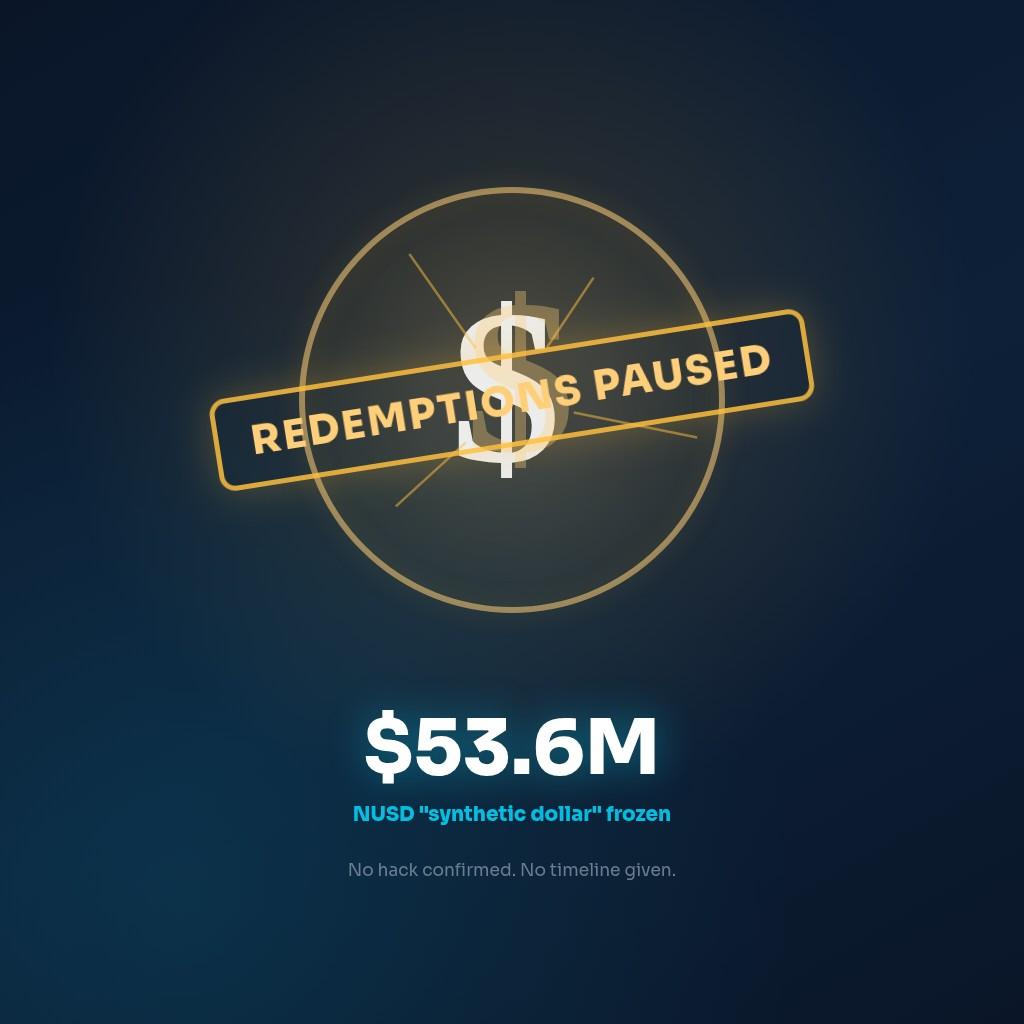
A protocol just froze $53.6 million in a token designed to always be worth exactly one dollar, and it can't yet say why. Neutrl, the team behind the synthetic dollar NUSD, suspended both minting and redemptions this week after what it's calling a reserve issue, without naming the affected asset, without confirming a loss, and without giving a timeline for when things reopen. That vagueness isn't a communications failure so much as a symptom of what NUSD actually is, and understanding that distinction matters a lot more than this one incident.
What Actually Happened
Neutrl paused NUSD minting and redemptions this week after identifying what it describes only as a reserve issue. The company hasn't named the affected asset or counterparty, hasn't confirmed whether reserves suffered a realized loss, and hasn't said when normal operations might resume. It has said what this isn't: no smart-contract exploit has been identified, and there's no evidence of an unauthorized mint.
The scale is real but contained. About $53.6 million in NUSD is currently in circulation. Strata, a structured-yield protocol that builds products on top of Neutrl's market, followed by pausing minting, redemptions, and related functions for its own NUSD-linked contracts, a reminder that DeFi protocols rarely fail in isolation once they're wired into each other.
Despite all of that, NUSD is still trading close to its dollar peg, around $0.998. Hold that number for a minute, it matters less than it sounds like it should.
What NUSD Actually Is
Here's the part that gets flattened in a lot of coverage: NUSD is not a stablecoin in the way USDC or USDT are stablecoins, and calling it one obscures exactly what's at risk right now.
USDC and USDT are backed by simple, boring assets: cash and short-term Treasury bills sitting in custody. When people ask "are the reserves really there," the answer is a bank statement and an attestation, not a trading strategy.
NUSD is a synthetic dollar, built by packaging several market-neutral trading strategies into one token instead of holding dollars directly:
- OTC arbitrage. Buying locked or vesting tokens at a discount, often 30-70% below market price, in private deals, then taking an offsetting short position in the futures market to cancel out price exposure while pocketing the discount.
- Perpetual futures funding. Capturing funding-rate payments in perpetual futures markets while holding a hedged, market-neutral position.
- Yield-bearing collateral. Putting the underlying collateral to work in staking and similar activities for an additional layer of return, again while keeping the price risk hedged.
NUSD itself is the non-yielding, fully backed base token. A second token, sNUSD, is what you get by staking NUSD, and it's designed to passively collect the yield generated by all of that trading activity underneath it.
Why This Is Genuinely Different From a USDC Problem
This is the actual reason Neutrl can't just say what happened yet, and it's not evasiveness so much as the nature of the backing.
If a fiat-backed stablecoin has a reserve problem, the question is usually simple: is the money in the account or not. If NUSD has a reserve problem, the honest answer requires untangling which of potentially dozens of live positions, OTC deals with vesting schedules, futures hedges across multiple venues, staked collateral, actually has an issue, and whether that issue is a paper loss, a realized loss, a counterparty problem, or something else entirely. More moving parts means a real investigation takes longer, and it means "reserve issue" can mean several very different things depending on which piece broke.
That's not a knock on the model, market-neutral yield strategies are a legitimate and increasingly common way to generate returns in DeFi. It's a reason to understand that a token promising "stable value plus yield" is making a more complicated promise than a token just promising "stable value," and the complexity is exactly where things get harder to verify quickly when something goes wrong.
The Part That Should Actually Worry You: The Price Hasn't Moved
NUSD trading near $0.998 sounds like reassurance. It isn't, and here's why: a peg price only means something when people can actually act on it. Redemptions are frozen right now, which means the one mechanism that normally keeps a token's market price anchored to its target, arbitrageurs redeeming an undervalued token for the underlying dollar and pocketing the difference, is switched off. What's left is thin secondary-market trading, and a quiet market can sit near a stable price for reasons that have nothing to do with whether the backing is actually fine.
A steady quote during a freeze isn't the same signal as a steady quote during normal, liquid trading. Treat it as an open question, not a green light.
What This Means If You Hold Yield-Bearing "Stable" Assets
The lesson here isn't "avoid synthetic dollars." It's "know which kind of promise you're holding." A few questions worth asking about any token marketed as stable-plus-yield:
- Is the yield coming from something simple and verifiable, like short-term Treasuries, or from active trading strategies you'd need a research report to fully understand?
- What happens to redemptions specifically if one piece of a multi-strategy backing runs into trouble?
- Does the yield rate itself look higher than a plain-vanilla stablecoin would offer? Higher yield in this category usually means more strategies stacked underneath it, which means more places for something to go wrong quietly.
None of that makes synthetic dollars a bad idea. It makes them a different risk category than the stablecoins most people picture when they hear the word, and this week is a live example of why that difference isn't academic.
Frequently Asked Questions
Q: Did Neutrl get hacked?
A: The company says it hasn't identified a smart-contract exploit or unauthorized mint. As of now, this is being described as a reserve issue, not a confirmed hack.
Q: Is NUSD the same kind of stablecoin as USDC or USDT?
A: No. USDC and USDT are backed by cash and short-term Treasuries. NUSD is a synthetic dollar backed by a mix of OTC token arbitrage, hedged perpetual futures positions, and staking yield, a fundamentally different and more complex backing structure.
Q: Why hasn't the price of NUSD dropped if there's a problem?
A: Redemptions are currently paused, which removes the main mechanism that normally keeps a token's price anchored to its peg. A steady price during a freeze, with thin trading volume, isn't the same reassurance as a steady price under normal, liquid conditions.
Q: How much money is affected?
A: About $53.6 million in NUSD is currently in circulation and subject to the redemption freeze.
The Bottom Line
The specific cause of Neutrl's reserve issue isn't public yet, and speculating on it isn't useful. What is useful right now is the reminder underneath the headline: not everything called a "stable" asset holds its value the same way, and the more complex the machinery generating your yield, the longer it can take to get a straight answer when something breaks. That's true whether or not this particular situation ends up being serious.
This content was created with AI assistance and may contain errors, always verify before acting. Not financial advice. Always do your own research before making any investment decisions.
Frequently Asked Questions
Did Neutrl get hacked?
The company says it hasn't identified a smart-contract exploit or unauthorized mint. As of now, this is being described as a reserve issue, not a confirmed hack.
Is NUSD the same kind of stablecoin as USDC or USDT?
No. USDC and USDT are backed by cash and short-term Treasuries. NUSD is a synthetic dollar backed by a mix of OTC token arbitrage, hedged perpetual futures positions, and staking yield, a fundamentally different and more complex backing structure.
Why hasn't the price of NUSD dropped if there's a problem?
Redemptions are currently paused, which removes the main mechanism that normally keeps a token's price anchored to its peg. A steady price during a freeze, with thin trading volume, isn't the same reassurance as a steady price under normal, liquid conditions.
How much money is affected?
About $53.6 million in NUSD is currently in circulation and subject to the redemption freeze.
Let AI summarize these channels for you daily
Pick your favorite crypto YouTube channels and news sites. Get a 5-minute AI brief every morning.
Choose Your Sources