Strategy Sold 1,690 Bitcoin This Week: What's Actually Happening
In This Article
Introduction
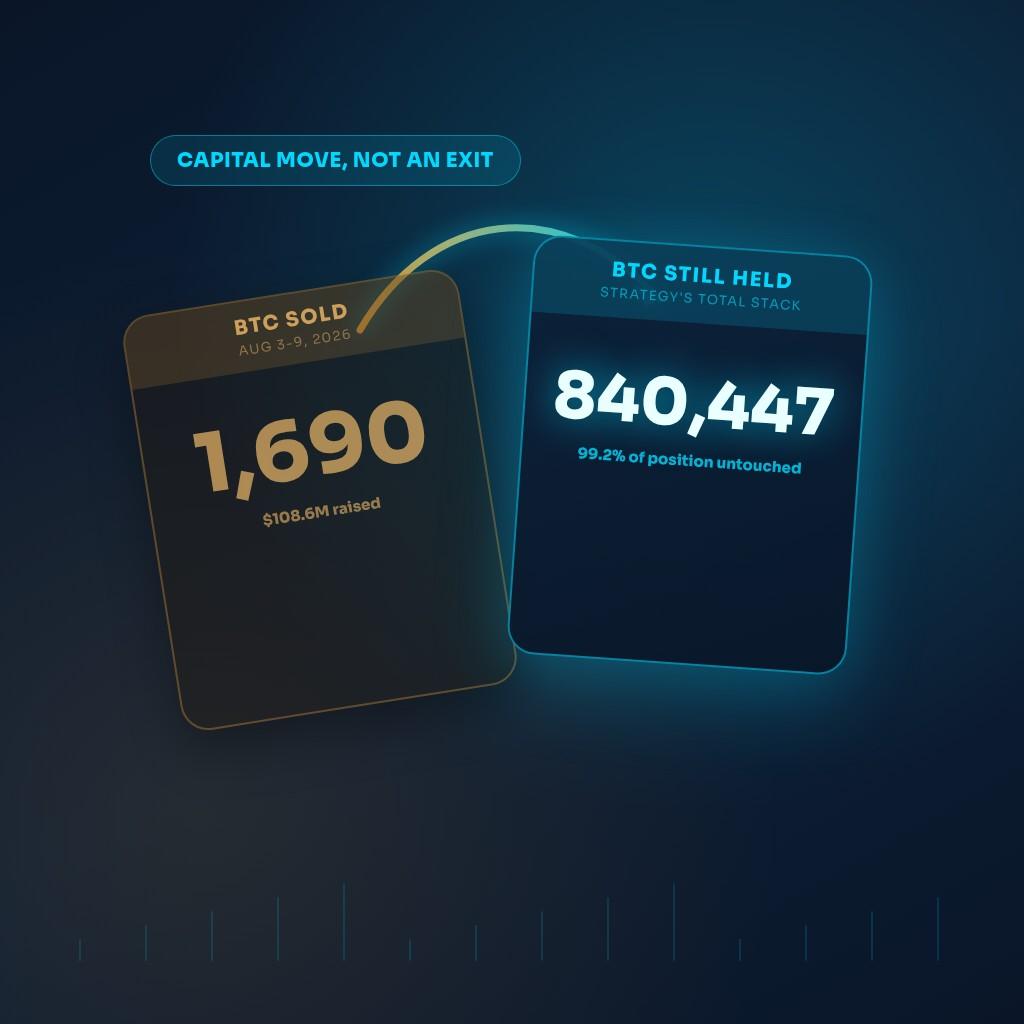
For years, Michael Saylor's Strategy (formerly MicroStrategy) has run on one unbroken rule: buy Bitcoin, never sell. That rule just cracked. Between August 3 and August 9, the company sold 1,690 BTC, roughly $108.6 million worth, and the headlines wrote themselves. But the number that actually matters didn't move much: Strategy still holds 840,447 Bitcoin. This wasn't an exit. It was a plumbing problem in a completely different part of the business, and understanding the difference is worth five minutes.
What Actually Happened
Strategy sold 1,690 BTC over that six-day window at an average price of $64,262 per coin, raising about $108.6 million. It's the latest in a string of sales throughout 2026 that now total 6,948 BTC sold this year, against a total holding of 840,447 BTC. Do the math and that's roughly 0.8% of the position, sold, not liquidated.
The proceeds didn't go toward operating expenses or a change of strategy. They went toward two specific things: funding dividend payments on Strategy's preferred stock, and buying back shares of one preferred stock class in particular, called STRC.
The Real Reason: A Preferred Stock Problem, Not a Bitcoin Problem
Strategy doesn't just hold Bitcoin, it also runs a fairly complex capital structure built on several classes of preferred stock, an unusual playbook that layers debt-like obligations on top of a Bitcoin balance sheet. STRC, nicknamed "Stretch," is the newest and most popular of these: a variable-rate perpetual preferred share with a stated value of $100 and a dividend yield around 11.5%.
The plan only works cleanly when STRC trades at or above that $100 par value, because that's what makes issuing new STRC shares an efficient way to raise fresh cash. The problem: STRC has traded below $100, recently around $95, since early May. Issuing new shares at a discount to raise money stops making sense once that happens.
CEO Phong Le said the company would hold off on buying additional Bitcoin while STRC trades below its $100 par value. That's the actual headline hiding underneath the scarier one. Strategy didn't decide to sell Bitcoin. It decided to pause buying more until one specific financial instrument recovers, and it's using existing Bitcoin holdings to manage the obligations that instrument created in the meantime.
Why Buying Back STRC Below Par Actually Makes Financial Sense
This is the part that's easy to misread as desperation and is closer to the opposite. When a company buys back its own preferred shares below their $100 stated value, retiring a $100 obligation for roughly $95, it's a profitable trade on its own terms. Every share retired this way permanently removes that share's future dividend obligation from the books.
Put together, the sale accomplishes three things at once: it offsets the realized loss on the Bitcoin sold at $64,262 (well under what most of Strategy's holdings cost to acquire), it generates a real, permanent reduction in future dividend payments, and it deleverages the balance sheet without touching the core Bitcoin position in any meaningful way. Strategy also used part of the proceeds to extend the average duration of its USD reserves from 143 days to 2.7 years, moving cash into longer-term holdings for more predictable yield, and grew that cash reserve to $4.65 billion in the process.
The Numbers That Actually Matter
Strip away the framing and this is the actual scoreboard:
- 840,447 BTC still held, essentially unchanged as a position
- 6,948 BTC sold across all of 2026, about 0.8% of total holdings
- $4.65 billion in USD cash reserves, up $650 million from this move
- 143 days to 2.7 years — how much longer that cash is now positioned to earn yield before it needs to be redeployed
None of those numbers describe a company abandoning its Bitcoin thesis. They describe a company actively managing a preferred-stock obligation it created for itself, using a small, deliberate slice of a very large position.
What This Does, and Doesn't, Say About Strategy's Bitcoin Thesis
It's worth being honest about both sides of this. "We're pausing new Bitcoin purchases until STRC recovers" is a real, meaningful statement, not nothing. It means the growth engine of the position, the part that made Strategy's stock a leveraged bet on Bitcoin's price, is genuinely on hold. That's a real signal worth tracking, and it's different from business as usual.
But pausing new buying and selling under 1% of an 840,000-Bitcoin position to service a preferred stock class are both a long way from "Strategy is exiting Bitcoin." The distinction that matters here isn't optimism versus pessimism, it's reading the actual mechanism instead of the headline number. A stock buyback funded by a small asset sale is a capital structure decision. It says something about STRC's price, not about whether Saylor still believes in the position that makes up nearly all of the company's balance sheet.
Frequently Asked Questions
Q: Is Strategy selling off its Bitcoin holdings?
A: No. The company sold 1,690 BTC, about 0.2% of its 840,447 BTC position, and has sold 6,948 BTC total in 2026, under 1% of holdings. The vast majority of the position is untouched.
Q: Why did Strategy sell Bitcoin instead of just holding?
A: To fund dividend payments and buy back its STRC preferred stock, which has traded below its $100 par value since early May. Buying back shares below par is a profitable move on its own terms, separate from the Bitcoin sale itself.
Q: Is Strategy still buying Bitcoin?
A: CEO Phong Le said the company will hold off on new Bitcoin purchases while STRC trades below $100. That's a real pause, not a permanent policy change, and it's tied to one specific instrument's price rather than a shift in the company's overall Bitcoin thesis.
Q: What is STRC?
A: STRC ("Stretch") is a variable-rate perpetual preferred stock Strategy issued with a $100 stated value and roughly an 11.5% dividend yield. It's one of several preferred stock classes Strategy uses to raise capital alongside its Bitcoin holdings.
The Bottom Line
"Saylor sold Bitcoin" and "Strategy is managing a preferred stock obligation with a small slice of a massive Bitcoin position" are two very different stories, and only one of them is actually true this week. The real thing to watch isn't the sale, it's whether STRC climbs back above $100, because that's the number that decides when new Bitcoin buying resumes.
This content was created with AI assistance and may contain errors, always verify before acting. Not financial advice. Always do your own research before making any investment decisions.
Frequently Asked Questions
Is Strategy selling off its Bitcoin holdings?
No. The company sold 1,690 BTC, about 0.2% of its 840,447 BTC position, and has sold 6,948 BTC total in 2026, under 1% of holdings. The vast majority of the position is untouched.
Why did Strategy sell Bitcoin instead of just holding?
To fund dividend payments and buy back its STRC preferred stock, which has traded below its $100 par value since early May. Buying back shares below par is a profitable move on its own terms, separate from the Bitcoin sale itself.
Is Strategy still buying Bitcoin?
CEO Phong Le said the company will hold off on new Bitcoin purchases while STRC trades below $100. That's a real pause, not a permanent policy change, and it's tied to one specific instrument's price rather than a shift in the company's overall Bitcoin thesis.
What is STRC?
STRC ("Stretch") is a variable-rate perpetual preferred stock Strategy issued with a $100 stated value and roughly an 11.5% dividend yield. It's one of several preferred stock classes Strategy uses to raise capital alongside its Bitcoin holdings.
Let AI summarize these channels for you daily
Pick your favorite crypto YouTube channels and news sites. Get a 5-minute AI brief every morning.
Choose Your Sources