Trump Is Weighing a Capital Gains Tax Cut, the First Since 2003. Here's What It Would Mean for Crypto.
In This Article
Introduction
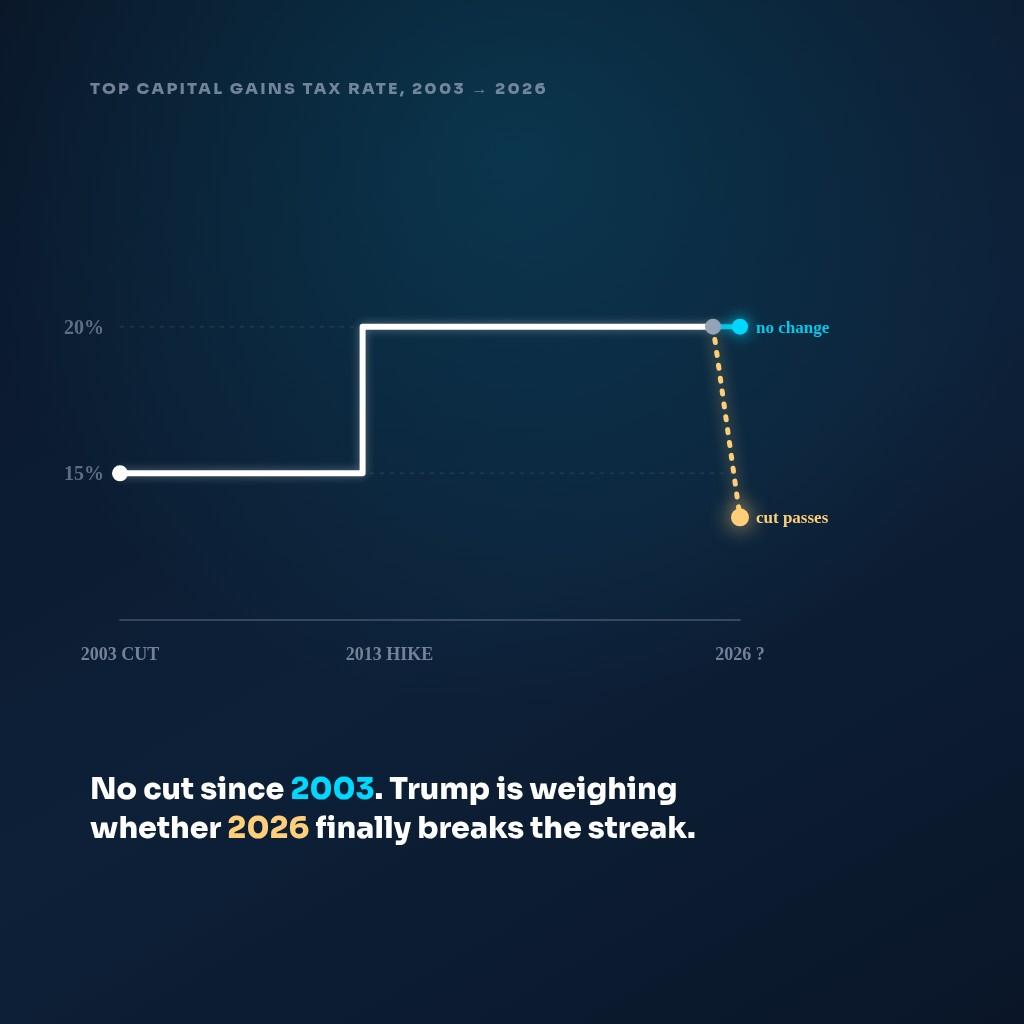
Capital gains tax rates in the US haven't seen a major cut since 2003. That's not a typo, it's 23 years of the same basic structure surviving multiple administrations, a financial crisis, and a pandemic. This week, Bloomberg reported that President Trump is weighing whether to call on Congress to change that ahead of the midterms. Nothing has passed. Nothing has even been formally proposed as legislation yet. But if it happens, it would directly touch how every crypto investor's gains get taxed, because crypto doesn't get its own tax rules. It rides on whatever the general capital gains rules say.
What's Actually Being Considered
Two different ideas are floating around the White House right now, and it's worth keeping them separate because they work in genuinely different ways.
The first is an outright cut to capital gains tax rates, the kind of change that hasn't happened since 2003. This is the version that would be the bigger deal, and it's also the version that most clearly needs Congress to act, not just the White House.
The second is capital gains indexing, an idea former economic advisor Larry Kudlow has floated: adjusting an asset's cost basis for inflation before calculating the taxable gain. This doesn't touch the tax rate itself. It shrinks the amount of gain that gets taxed in the first place, which has a similar effect on your final bill without technically being a "rate cut."
A third, more targeted idea, a capital gains exemption for home sales under $2 million, is also on the table but doesn't touch crypto directly, so it's not the focus here.
National Economic Council Director Kevin Hassett has said the goal is to give voters more reasons to back Republicans in November. That framing matters: this is being discussed as a campaign pledge right now, not a bill with a vote scheduled.
Why "First Cut Since 2003" Is the Real Headline
Capital gains rates aren't frozen because nobody's touched the tax code, they've actually moved, just never downward. The last real cut came in 2003, when the top long-term rate dropped to 15%. Since then, the direction has only gone the other way: 2013 brought the top rate back up to 20% for higher earners, and the Affordable Care Act layered an additional 3.8% net investment income tax on top for many investors. The three-tier 0%/15%/20% structure currently in place, including under the tax law Trump signed in 2025, has held steady through all of that.
That's the context that makes this genuinely notable rather than routine political noise. A real reversal of that 23-year trend would be a structural change, not an adjustment.
How This Would Actually Affect Crypto
Here's the detail that gets lost in most coverage of this: there is no proposal on the table that specifically targets crypto's tax treatment, and there doesn't need to be one. The IRS classifies cryptocurrency as property, the same category as stocks or real estate for tax purposes. Whatever the general capital gains rules say, crypto gains get taxed the same way automatically. No separate carve-out, no special crypto provision required.
That cuts both ways. It means crypto investors would benefit from either version of this proposal exactly as much as any other investor holding an appreciated asset, no more, no less. It also means crypto gets no say in the matter, this entire conversation is happening in the context of stocks and real estate, and digital assets are just along for the ride.
What Indexing Would Actually Look Like for a Crypto Holder
The rate-cut version is simple to picture: you'd owe a smaller percentage on the same taxable gain. The indexing version is worth walking through with real numbers, because it's the idea that's gotten more serious traction so far.
Say you bought Bitcoin for $20,000 and later sold it for $80,000, a $60,000 nominal gain. If cumulative inflation over your holding period came to roughly 20%, indexing would raise your cost basis to about $24,000. Your taxable "real" gain drops to $56,000 instead of $60,000. It's not a dramatic swing on any single trade, but for long-term holders sitting on gains built up over years of inflation, particularly through 2021 and 2022's higher inflation stretch, indexing shrinks the tax bill in a way that compounds the longer you've held.
Why This Might Not Actually Happen
There's a real gap between "the White House is weighing this" and "this becomes law," and it's worth taking seriously.
An actual rate cut needs Congress, and Republican Senators Ted Cruz and Tim Scott have already floated an indexing bill of their own, one estimated to reduce federal revenue by roughly $200 billion. That's a hard number for a Congress already staring at a federal deficit the Congressional Budget Office put at $1.8 trillion for the first ten months of 2026 alone.
There's also a shortcut some in the administration have examined before: indexing capital gains through Treasury regulation instead of a new law, which Trump's first administration also looked at without acting on it. Legal experts widely expect that route would draw immediate court challenges if attempted, since it sidesteps Congress entirely.
And the distributional numbers invite obvious political pushback. A Congressional Research Service analysis found that roughly 90% of the benefit from capital gains indexing would flow to the top 1% of earners, with about 60% going to just the top 0.1%. That's the kind of statistic that shows up in every Democratic response to this story, and it's accurate.
Frequently Asked Questions
Q: Has Congress actually voted on a capital gains tax cut?
A: No. As of this week, this is being described as an idea the White House is weighing, floated ahead of the midterms, not a bill with a scheduled vote.
Q: Would this create a special tax break for crypto?
A: No. Crypto is taxed as property under existing IRS rules, so it would automatically follow whatever general capital gains treatment applies to any asset. There's no crypto-specific provision being discussed.
Q: What's the difference between a capital gains rate cut and indexing?
A: A rate cut lowers the percentage you pay on a taxable gain. Indexing adjusts the cost basis of the asset for inflation first, which shrinks the taxable gain itself without changing the tax rate.
Q: When was the last time capital gains tax rates were actually cut?
A: 2003. Every change since then, including a rate increase in 2013 and an added investment income surtax under the Affordable Care Act, has moved in the other direction.
The Bottom Line
This is a real idea with real numbers behind it, not just a rumor, but it's still a political trial balloon ahead of an election, not pending legislation. If either version passes, crypto investors get the same benefit as anyone else holding an appreciated asset, automatically, with no special rules needed. The thing actually worth watching isn't crypto-specific news at all, it's whether Congress, facing a $1.8 trillion deficit, is willing to move on either version before November.
This content was created with AI assistance and may contain errors, always verify before acting. Not financial or tax advice. Always do your own research and consult a tax professional before making any financial decisions.
Frequently Asked Questions
Has Congress actually voted on a capital gains tax cut?
No. As of this week, this is being described as an idea the White House is weighing, floated ahead of the midterms, not a bill with a scheduled vote.
Would this create a special tax break for crypto?
No. Crypto is taxed as property under existing IRS rules, so it would automatically follow whatever general capital gains treatment applies to any asset. There's no crypto-specific provision being discussed.
What's the difference between a capital gains rate cut and indexing?
A rate cut lowers the percentage you pay on a taxable gain. Indexing adjusts the cost basis of the asset for inflation first, which shrinks the taxable gain itself without changing the tax rate.
When was the last time capital gains tax rates were actually cut?
2003. Every change since then, including a rate increase in 2013 and an added investment income surtax under the Affordable Care Act, has moved in the other direction.
Let AI summarize these channels for you daily
Pick your favorite crypto YouTube channels and news sites. Get a 5-minute AI brief every morning.
Choose Your Sources