Crypto Taxes: What Actually Triggers a Tax Bill
In This Article
- Introduction
- The one rule that explains almost everything
- What is actually taxable
- What is not taxable
- The expensive mistake, with real numbers
- Lever one: how long you hold
- Lever two: losses, and the rule crypto does not have
- What is changing: Form 1099-DA
- Keeping records without hating your life
- Frequently Asked Questions
- The Bottom Line
Introduction
There is a whole genre of advertising built on the phrase "the IRS is coming for your crypto gains." It works because it is half true, and because most people genuinely do not know which half.
Here is the honest version. Crypto taxes in the US are not mysterious and they are not a trap. They follow one rule that explains almost every situation you will run into. Once you know that rule, most of the anxiety goes away, and you also find out that two things a lot of people assume are safe are actually taxable, which is the part worth knowing before you do them rather than after.
One thing up front, and we mean it rather than treating it as boilerplate: this is educational information, not tax or financial advice. Everything below should be checked against your own circumstances with a CPA, enrolled agent, or qualified tax professional, and ideally alongside a financial advisor if you are making decisions of any size. Rules differ by country, states add their own layer, and individual situations have wrinkles no article can anticipate. The goal here is to make you a better-informed client when you sit down with a professional, not to replace one.
The one rule that explains almost everything
In the US, the IRS treats cryptocurrency as property, not as currency. That single classification drives everything else.
Property has a tax consequence when you dispose of it. Selling it, trading it, spending it. Not when you buy it, and not when it goes up in value while you hold it.
So the useful question is never "did I make money?" It is "did I dispose of something?" Get that question right and you can work out almost any scenario yourself.
What is actually taxable
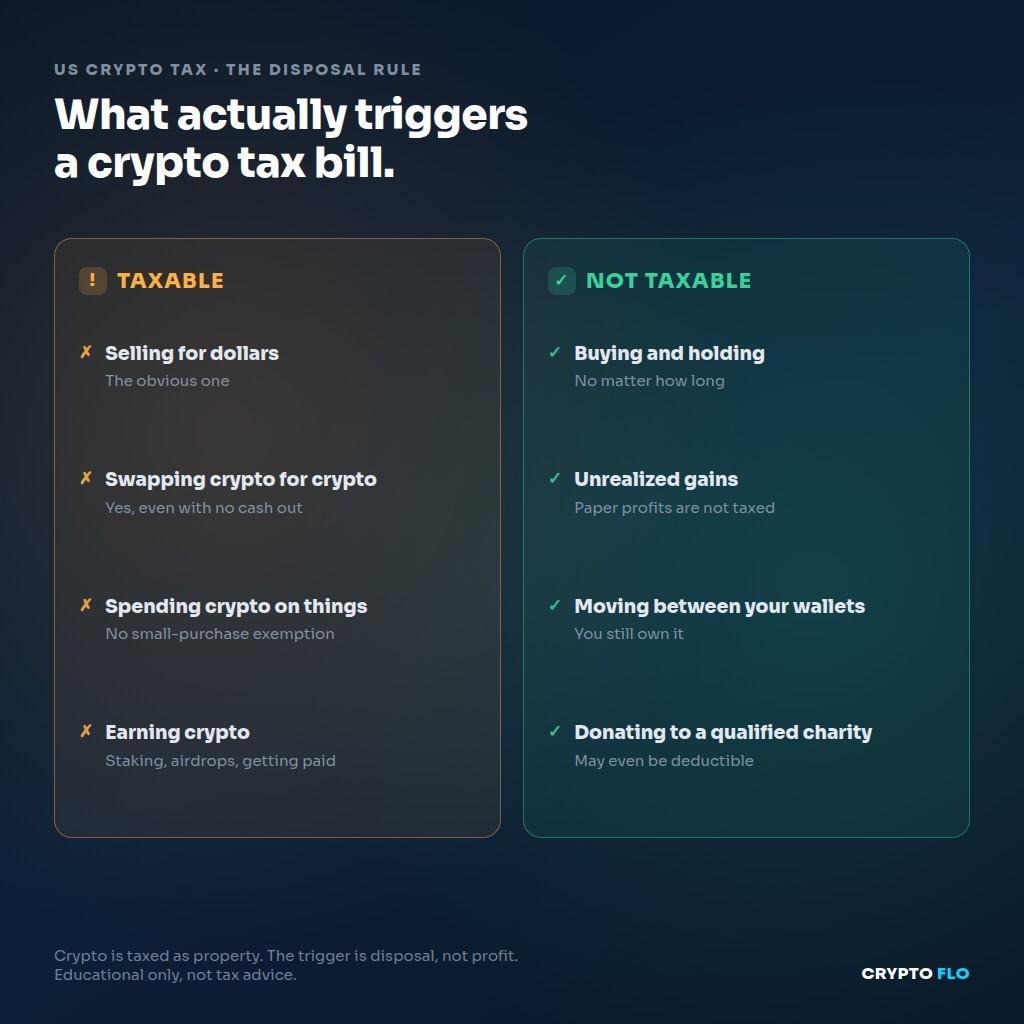
Four categories. The first is obvious. The next two surprise people constantly.
1. Selling crypto for dollars. The expected one. You bought at one price, sold at another, and the difference is a capital gain or loss.
2. Trading one crypto for another. This is the big one, and it is where the "I never cashed out" instinct goes wrong. Swapping Bitcoin for Solana is a disposal of the Bitcoin. The IRS treats it as if you sold the Bitcoin for its dollar value at that moment and immediately used those dollars to buy Solana. You owe tax on the Bitcoin's gain even though no dollars ever hit your bank account.
This catches people because it feels like moving money between pockets. It is not. It is two transactions wearing one coat.
3. Spending crypto on goods or services. Buying a laptop with Bitcoin is a disposal too. You owe capital gains on the appreciation of the Bitcoin you spent. If you bought that Bitcoin at $20,000 and it is worth $60,000 when you buy the laptop, you have realized a $40,000 gain, and the fact that you received a laptop rather than cash does not change it.
There is no general small-purchase exemption in current US law. A de minimis carve-out for tiny transactions has been proposed repeatedly in Congress and has not been enacted, so as things stand, the coffee counts the same way the laptop does.
4. Earning crypto. Staking rewards, mining income, airdrops, and getting paid in crypto are generally taxed as ordinary income at the value when you received them, not as capital gains. That amount then becomes your cost basis, so if you later sell it, you calculate the gain from there.
What is not taxable
This is the part the scary advertising never mentions, and it covers most of what most people actually do.
- Buying crypto with dollars and holding it. No tax event. None. You can buy every week for a decade and owe nothing on the purchases themselves.
- Unrealized gains. If your portfolio is up 300% and you have not sold, traded, or spent any of it, there is nothing to report from that appreciation. The US does not tax paper gains on property.
- Moving crypto between wallets you own. Exchange to hardware wallet, one wallet to another, self-custody shuffling. You still own it, so there is no disposal. Keep records showing these were your own wallets, because a transfer out of an exchange can look like a sale to automated reporting if you cannot show otherwise.
- Donating to a qualified charity. Generally not a taxable disposal, and it may be deductible.
Add that up and it means the classic long-term approach, buy and hold and do nothing, is also the simplest possible tax situation. That is genuinely calming and it is genuinely true.
The expensive mistake, with real numbers
Say you bought 1 ETH for $1,200 three years ago. Today it is worth $1,900 and you decide you would rather hold SOL. You swap directly, ETH for SOL, never touching dollars.
Most people file that under "rebalancing" and think nothing of it. In tax terms you disposed of the ETH at $1,900. You have a $700 long-term capital gain that you are required to report for that year, and depending on your income bracket you owe 0%, 15%, or 20% of it.
Now the part that actually stings. You have no dollars from the transaction, because you moved straight into SOL. If SOL then falls before you get around to thinking about taxes, you can end up owing real money on a gain you no longer have, with nothing liquid set aside to pay it. That is not an IRS trap. It is a timing mismatch that catches people who did not know the swap counted.
The fix is not to avoid swapping. It is to know it counts, so you can plan for it.
Lever one: how long you hold
This is the single largest legal difference in what you pay, and it is entirely within your control.
- Held one year or less: short-term gain, taxed at ordinary income rates, roughly 10% to 37% depending on your bracket.
- Held more than one year: long-term gain, taxed at 0%, 15%, or 20%.
On a $10,000 gain, that difference can be several thousand dollars for the same trade, decided only by the calendar. If you are near the one-year mark on a position you are thinking about selling, that date is worth checking before you click.
Note the 0% bracket really does exist. Lower-income filers can pay nothing on long-term gains, which surprises people who assume any gain means a bill.
Lever two: losses, and the rule crypto does not have
Capital losses offset capital gains. If one position is up and another is down, selling the loser reduces the taxable gain from the winner. Excess losses can offset a limited amount of ordinary income, and unused amounts carry forward to future years.
Here is the part specific to crypto. The wash sale rule, which stops stock investors from selling at a loss and immediately rebuying the same stock, has historically not applied to cryptocurrency, because crypto is classified as property rather than as a security. In practice that has meant crypto holders could realize a loss and re-establish the position without the waiting period that equities require.
Two important caveats. Legislation to extend the wash sale rule to digital assets has been proposed repeatedly, so this is a rule that could close, and anyone relying on it should confirm its current status for the tax year they are actually filing. And this is exactly the sort of strategy to run past a CPA before executing, not after. Loss harvesting done carelessly can create problems that cost more than the tax it saved.
What is changing: Form 1099-DA
For years, crypto tax reporting ran largely on the honor system, because exchanges were not required to report your transactions the way a stock brokerage does.
That is ending. Centralized exchanges are now required to issue Form 1099-DA, reporting proceeds to you and to the IRS, with cost basis reporting phasing in from 2026.
The practical implication is not that new taxes appeared. The rules did not change. What changed is that the IRS now receives an independent record, so the gap between what people reported and what actually happened is closing. If you have been casual about records, this is the year to stop being casual.
Keeping records without hating your life
You need four things for every transaction: what, when, how much you paid, and how much it was worth when you disposed of it.
- Export transaction history from every exchange you use, at least annually. Exchanges shut down, lose data, and restrict old accounts. Do not assume the history will be there when you need it.
- Track self-custody transfers separately so a wallet move is not mistaken for a sale.
- Record the dollar value at the time of each swap. This is the number people fail to capture, and it is the one that determines the gain.
- Crypto tax software connects to exchanges and wallets and calculates this automatically. For anyone with more than a handful of transactions, it costs less than the hours it saves.
Frequently Asked Questions
Q: Do I owe taxes on crypto if I never cash out to dollars?
A: Possibly, yes. Selling for dollars is only one kind of taxable disposal. Trading one crypto for another and spending crypto on goods or services are also taxable events in the US, even though no dollars reach your bank account.
Q: Is swapping Bitcoin for another coin taxable?
A: Yes. The IRS treats a crypto-to-crypto trade as disposing of the first asset at its fair market value. You realize a gain or loss on the coin you traded away, regardless of what you traded it for.
Q: Do I pay tax when I buy something with crypto?
A: Yes. Spending crypto is a disposal, so you owe capital gains on the difference between what you paid for that crypto and what it was worth when you spent it. There is currently no general small-purchase exemption in US law.
Q: Do I owe tax on crypto I am holding but have not sold?
A: No. Unrealized gains are not taxed. Buying and holding creates no taxable event no matter how much the position appreciates.
Q: Is moving crypto between my own wallets taxable?
A: No, because you have not disposed of anything. Keep records showing both wallets are yours, since a transfer off an exchange can otherwise look like a sale in automated reporting.
Q: How much tax do I pay on crypto gains?
A: It depends on holding period and income. Held a year or less, gains are taxed at ordinary income rates of roughly 10% to 37%. Held longer than a year, they are taxed at 0%, 15%, or 20%.
The Bottom Line
The scary framing gets the emotion right and the mechanics wrong. Nobody is coming for gains you have not realized, and the most common thing crypto holders do, buying and holding, generates no tax event at all.
What actually costs people money is not the IRS being aggressive. It is not knowing that a swap counts, or that buying something with Bitcoin counts, and finding out after the fact with no cash set aside. Learn the disposal rule, watch the one-year mark, keep your records, and most of this becomes routine.
And then get professional help. Not as a formality, genuinely: a CPA or enrolled agent who has actually handled crypto clients will know things that generalists miss, including how your state treats digital assets, whether your particular mix of staking and trading changes anything, and what documentation will hold up if you are ever asked for it. If you are making decisions large enough to affect your overall financial picture, a financial advisor belongs in that conversation too.
That is not a disclaimer we are adding to cover ourselves. It is the actual advice. This article is a blog post, and your tax return is not.
This content was created with AI assistance and may contain errors, always verify before acting. This is educational information only and is not tax, legal, accounting, or financial advice. Crypto tax rules vary by jurisdiction, differ at the state level, and change over time. Always consult a qualified CPA, enrolled agent, or tax professional, and where appropriate a licensed financial advisor, about your specific situation before making decisions.
Frequently Asked Questions
Do I owe taxes on crypto if I never cash out to dollars?
Possibly, yes. Selling for dollars is only one kind of taxable disposal. Trading one crypto for another and spending crypto on goods or services are also taxable events in the US, even though no dollars reach your bank account.
Is swapping Bitcoin for another coin taxable?
Yes. The IRS treats a crypto-to-crypto trade as disposing of the first asset at its fair market value. You realize a gain or loss on the coin you traded away, regardless of what you traded it for.
Do I pay tax when I buy something with crypto?
Yes. Spending crypto is a disposal, so you owe capital gains on the difference between what you paid for that crypto and what it was worth when you spent it. There is currently no general small-purchase exemption in US law.
Do I owe tax on crypto I am holding but have not sold?
No. Unrealized gains are not taxed. Buying and holding creates no taxable event no matter how much the position appreciates.
Is moving crypto between my own wallets taxable?
No, because you have not disposed of anything. Keep records showing both wallets are yours, since a transfer off an exchange can otherwise look like a sale in automated reporting.
How much tax do I pay on crypto gains?
It depends on holding period and income. Held a year or less, gains are taxed at ordinary income rates of roughly 10% to 37%. Held longer than a year, they are taxed at 0%, 15%, or 20%.
Let AI summarize these channels for you daily
Pick your favorite crypto YouTube channels and news sites. Get a 5-minute AI brief every morning.
Choose Your Sources