What Is a Layer 2? Blockchain Scaling Explained Without the Jargon
In This Article
Introduction
If you have ever paid an $80 transaction fee to move $200, or watched a network grind to a halt during an NFT mint, you have met the problem that layer 2s exist to solve. And if you have ever wondered why there are suddenly a dozen different Ethereums with names like Arbitrum, Base, and Optimism, this is the answer to that too.
Layer 2 is one of those terms that gets used constantly and explained badly. It sounds like jargon for insiders. It is actually a fairly intuitive idea, and understanding it explains a surprising amount about why the crypto landscape looks the way it does, why fees vary by a factor of a thousand between chains, and what you are actually holding when you hold an L2 token.
The problem: blockchains are deliberately inefficient
Start with why the bottleneck exists, because it is not an accident or bad engineering.
On a blockchain like Ethereum or Bitcoin, every full node processes and stores every transaction. That redundancy is the entire point. It is what means no single party can rewrite history, censor a payment, or invent money, because thousands of independent machines would each have to be persuaded to agree.
The cost of that guarantee is throughput. The network can only go as fast as ordinary participants can keep up with, because the moment running a node requires a data center, only data centers run nodes, and decentralization quietly dies. Ethereum settles on the order of a dozen or so transactions per second at its base layer. Visa handles thousands.
This is the blockchain trilemma: decentralization, security, and scalability, where pushing hard on any one tends to cost you one of the others. A chain can be fast if it accepts fewer, larger validators. It can be maximally decentralized if it accepts being slow. What it cannot easily do is all three at the base layer.
And when demand exceeds capacity, blockspace is auctioned. That is why fees spike during busy periods: you are not paying for computation, you are bidding against everyone else for a scarce slot.
The layer 2 idea
Layer 2s take a straightforward approach: do the work somewhere else, then post the result back.
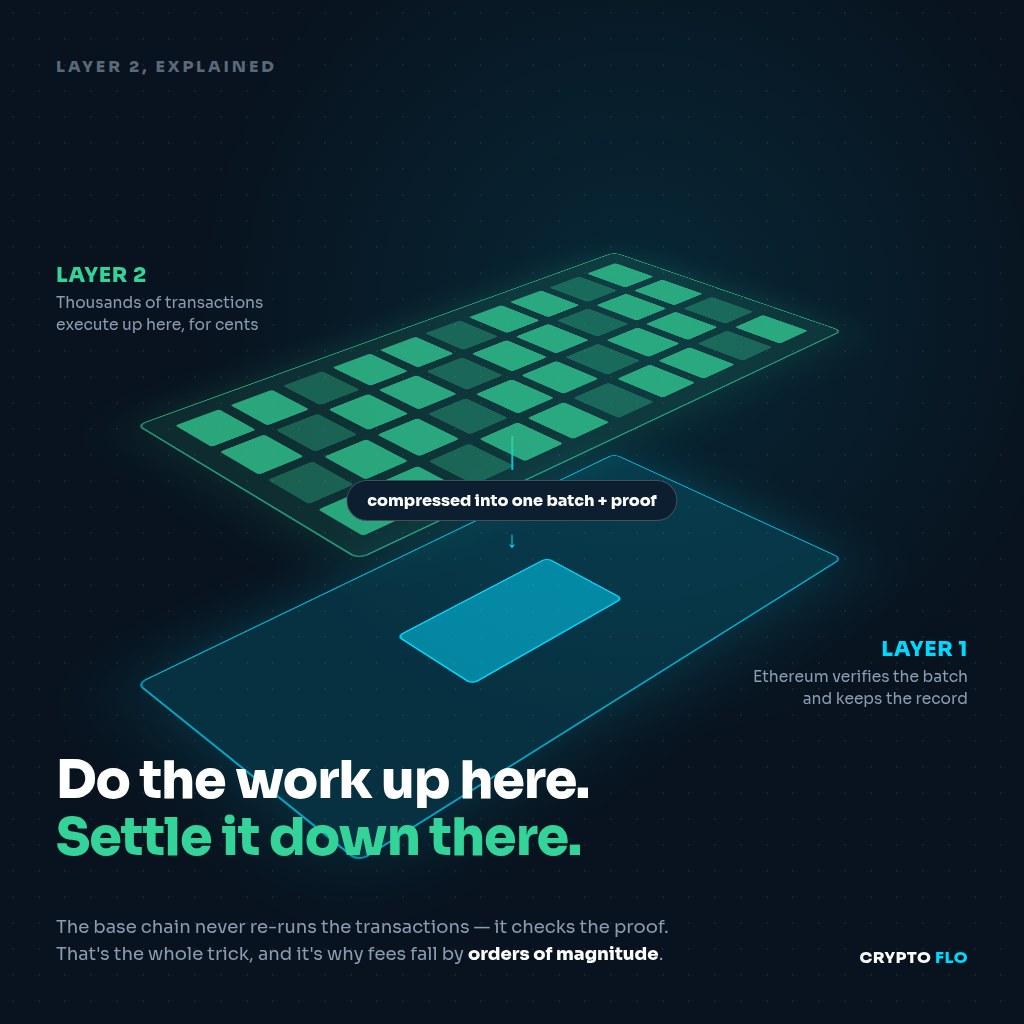
An L2 is a separate network that executes transactions off the main chain, bundles thousands of them together, and posts a compressed summary plus a proof back to the base layer. The base chain, layer 1, no longer processes each transaction individually. It verifies that the batch is valid.
The economics follow directly. If the cost of writing to Ethereum is split across four thousand transactions instead of one, each transaction carries a small fraction of it. This is why L2 fees are typically cents rather than dollars.
The important part, and the thing that separates a real L2 from merely another blockchain: the L2 inherits the base layer's security. Its final record lives on Ethereum. If the L2's operators vanish tomorrow, the data needed to reconstruct balances and withdraw funds is on the main chain. You are not trusting the L2 the way you would trust an exchange.
Rollups, and the two flavors
The dominant L2 design is the rollup, so named because it rolls many transactions up into one. Rollups come in two varieties, and the difference is entirely about how they prove the batch was honest.
Optimistic rollups
These assume the batch is valid, which is where the name comes from. The batch is posted, and a challenge window opens, typically about seven days. During that window anyone can submit a fraud proof demonstrating the batch contained something invalid. If nobody does, it stands.
- Advantage: relatively simple, and highly compatible with existing Ethereum tooling, so applications port over with little change.
- Cost: the challenge window means withdrawing back to Ethereum through the standard path takes about a week. Third-party bridges offer instant exits for a fee by fronting you the funds, which is a real convenience with its own counterparty risk.
- Examples: Arbitrum, Optimism, Base.
Zero-knowledge rollups
ZK rollups prove validity mathematically up front. Each batch carries a cryptographic validity proof that the transactions were executed correctly, verifiable by the base chain without re-running them.
- Advantage: no challenge window. Once the proof is verified, the batch is final, so withdrawals settle in minutes or hours rather than a week.
- Cost: generating proofs is computationally heavy, and the technology took longer to become compatible with general-purpose smart contracts.
- Examples: zkSync, Starknet, Linea, Scroll.
The industry's general expectation is that ZK rollups win on the merits eventually, because "prove it is correct" is a stronger position than "assume it is correct and hope someone is watching." Optimistic rollups got there first and hold most of the activity today.
What about the other chains?
A fair question: if Solana processes thousands of transactions per second on its base layer, why does Ethereum need this at all?
Because they made a different trilemma trade. High-throughput layer 1s achieve their speed partly through higher hardware requirements for validators, which means fewer independent participants. That is a legitimate design decision with real advantages, not a flaw. But it is a trade, and the marketing on all sides tends to present it as a free win.
Ethereum's bet is that the base layer should optimize for decentralization and security, and let scaling happen in a layer above it. Solana's bet is that the base layer should be fast enough not to need one. Both are coherent, and it is entirely reasonable to hold assets on both.
Bridges, and the part that deserves caution
To use an L2, assets have to get there. That happens through a bridge, which locks tokens on layer 1 and issues a representation on layer 2.
This is worth understanding clearly, because bridges have historically been the single most-exploited component in all of crypto, with individual incidents running into the hundreds of millions of dollars. The reason is structural: a bridge is a large pot of locked value guarded by code, which makes it the highest-value target on the board.
Practical guidance:
- Prefer the official or canonical bridge for a given L2 over a third-party one wherever possible.
- Understand that a bridged token is a claim. Bridged USDC on an L2 is a representation backed by real USDC locked on layer 1. Native issuance, where the issuer mints directly on the L2, avoids this and is increasingly common.
- Do not leave large balances sitting in bridge-related contracts longer than a transaction needs.
What L2 tokens actually are
This trips people up constantly, so it is worth being precise.
Most L2s do not require their own token to pay fees. Arbitrum, Optimism, and Base all charge fees in ETH. Their tokens, where they exist, are primarily governance tokens: they confer a vote over treasury and protocol decisions, not a claim on revenue in the way equity would.
That does not make them worthless, and it does not make them equity either. When evaluating one, the honest questions are: does this token capture any part of the value the network creates, or does it only vote on how a treasury gets spent? How much of the supply is still locked and scheduled to unlock? Is activity on this chain organic, or is it farming an anticipated airdrop?
That last one matters more than most people account for. A chain's transaction counts can look extraordinary while consisting largely of people making cheap transactions to qualify for a future token distribution. Activity that exists to farm a reward tends to leave once the reward arrives.
What this means in practice
For a normal person using crypto, the practical takeaways are short:
- Fees on an L2 are dramatically lower, usually cents. For most everyday activity, this is the difference between the network being usable and not.
- Check which network you are on before sending. Sending to an exchange deposit address on the wrong network is one of the most common ways people lose funds, and it is often unrecoverable. The address can look identical across networks.
- Withdrawals from optimistic rollups take about a week through the official route. Plan around it or accept a fee for a fast exit.
- An L2 is not a different coin. ETH on Arbitrum is ETH. You have not bought anything new by bridging.
Frequently Asked Questions
Q: What is a layer 2 in crypto?
A: A separate network that processes transactions off a main blockchain, then posts a compressed summary and proof back to it. This spreads the cost of writing to the base chain across thousands of transactions, cutting fees dramatically, while the base chain still provides the underlying security.
Q: What is the difference between layer 1 and layer 2?
A: Layer 1 is the base blockchain itself, such as Ethereum or Bitcoin, which handles final settlement and security. Layer 2 is built on top of it to handle execution at higher volume and lower cost, settling back down to layer 1.
Q: Are layer 2s safe?
A: A well-designed rollup inherits the base layer's security for its final record, which is a much stronger position than a separate chain or a custodial service. The realistic risks sit elsewhere: bridges have been the most exploited part of crypto, and many L2s still rely on a centralized sequencer that could in principle censor or reorder transactions.
Q: Why are Ethereum gas fees so high?
A: Because blockspace is limited by design and allocated by auction. Ethereum's base layer deliberately keeps throughput low enough that ordinary hardware can validate it, so when demand exceeds capacity, users bid against each other and fees rise.
Q: Is Solana a layer 2?
A: No. Solana is a layer 1 blockchain that achieves high throughput at the base layer, largely by requiring more capable validator hardware. It is a different answer to the same scaling problem, not a layer on top of another chain.
Q: Do I need to buy an L2 token to use a layer 2?
A: Usually not. Most major L2s charge transaction fees in ETH. Their native tokens, where they exist, are typically governance tokens rather than something required to transact.
The Bottom Line
Layer 2s exist because the properties that make a blockchain trustworthy are the same properties that make it slow, and that tension does not resolve at the base layer. Moving execution up a level and settling down to layer 1 keeps the security guarantee while removing the cost.
For users, this is mostly good news arriving quietly: the same activity that cost tens of dollars a few years ago now costs cents. The two things worth carrying with you are that bridges are the genuinely risky part of the stack, and that an L2 governance token is not the same kind of asset as the network's underlying value. Everything else is plumbing, and plumbing working well is what it looks like when infrastructure matures.
This content was created with AI assistance and may contain errors. Always verify before acting. Not financial advice. Always do your own research before making any investment decisions.
Frequently Asked Questions
What is a layer 2 in crypto?
A separate network that processes transactions off a main blockchain, then posts a compressed summary and proof back to it. This spreads the cost of writing to the base chain across thousands of transactions, cutting fees dramatically, while the base chain still provides the underlying security.
What is the difference between layer 1 and layer 2?
Layer 1 is the base blockchain itself, such as Ethereum or Bitcoin, which handles final settlement and security. Layer 2 is built on top of it to handle execution at higher volume and lower cost, settling back down to layer 1.
Are layer 2s safe?
A well-designed rollup inherits the base layer's security for its final record, which is a much stronger position than a separate chain or a custodial service. The realistic risks sit elsewhere: bridges have been the most exploited part of crypto, and many L2s still rely on a centralized sequencer that could in principle censor or reorder transactions.
Why are Ethereum gas fees so high?
Because blockspace is limited by design and allocated by auction. Ethereum's base layer deliberately keeps throughput low enough that ordinary hardware can validate it, so when demand exceeds capacity, users bid against each other and fees rise.
Is Solana a layer 2?
No. Solana is a layer 1 blockchain that achieves high throughput at the base layer, largely by requiring more capable validator hardware. It is a different answer to the same scaling problem, not a layer on top of another chain.
Do I need to buy an L2 token to use a layer 2?
Usually not. Most major L2s charge transaction fees in ETH. Their native tokens, where they exist, are typically governance tokens rather than something required to transact.
Get daily intelligence on the coins you track
Personalized AI briefings built from the sources you choose. Starting at $5.99/month.
Start with Crypto Flo