What Happens When the Last Bitcoin Is Mined?
In This Article
Introduction
There will only ever be 21 million Bitcoin. It is the most repeated fact about the asset and one of the least examined. Where does the number come from? What actually happens when the last one is mined? And if miners are paid in new Bitcoin, what pays them once there is no new Bitcoin left to pay with?
That last question is the interesting one. It is the subject of a genuine, unresolved debate among people who understand Bitcoin extremely well, and it does not have a settled answer. What follows is where the 21 million comes from, when the supply actually runs out, and what the serious version of the argument about the ending looks like.
Where 21 million comes from
The number was never chosen and typed into the code. It falls out of two other rules.
Bitcoin issues new coins as a reward to miners for each block, roughly every ten minutes. That reward started at 50 BTC per block in 2009. Every 210,000 blocks, which works out to roughly every four years, the reward is cut in half. This is the halving.
50, then 25, then 12.5, then 6.25, then 3.125, and onward. Halve a number enough times and the total of everything you have issued converges on a limit. Run the arithmetic on this particular schedule and the limit is just under 21 million, specifically about 20,999,999.98 BTC.
So 21 million is not a cap that gets enforced when the counter hits it. It is the sum of an infinite series that someone worked out and then designed the schedule around. The elegance is that no rule has to say "stop." The issuance simply shrinks toward nothing on its own.
Each Bitcoin divides into 100 million units called satoshis, which means the real supply cap, expressed in the smallest unit, is about 2.1 quadrillion satoshis. Divisibility is why a fixed supply does not become a practical problem as value per coin rises. You do not need whole units.
When does it actually end?
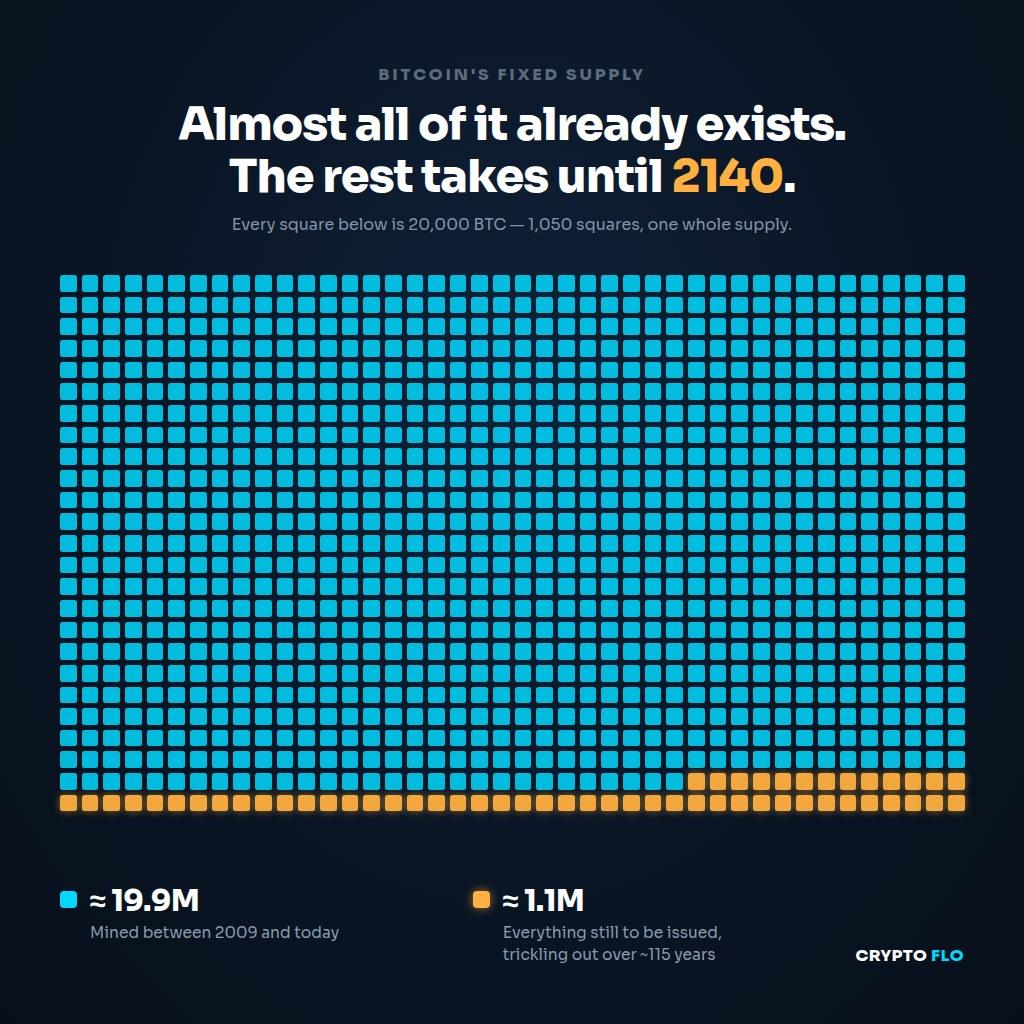
Around the year 2140.
That number surprises people, who often assume the supply runs out soon. It does not. But there is a much more important number hiding behind it, and it reframes the whole thing.
Roughly 95% of all Bitcoin that will ever exist has already been issued. The halving schedule is brutally front-loaded: the first four years alone issued half of everything. What remains between now and 2140 is a long tail of increasingly tiny amounts.
So the meaningful transition is not 2140. New issuance becomes economically negligible long before that, sometime in the 2030s. By then the block reward will be a fraction of a Bitcoin, and the economics of mining will already have to work without it. The last coin is a milestone. The problem it raises arrives decades earlier.
Lost coins make it smaller
The 21 million figure describes coins that will be issued, not coins that will be available.
A meaningful share is permanently inaccessible: keys lost to discarded hard drives and forgotten passwords, coins sent to addresses nobody controls, and holdings from the very early years that have never moved. Estimates commonly land somewhere between 3 and 4 million BTC, though this is genuinely an estimate. A coin cannot be proven lost, only observed not to have moved, and "has not moved in fifteen years" is not the same as "gone."
Notably this includes roughly 1.1 million BTC associated with Bitcoin's pseudonymous creator, Satoshi Nakamoto, untouched since the earliest days.
The practical effect: whatever the real number, the effective circulating supply is meaningfully below 21 million, and it only ever shrinks. There is no way to reissue a lost coin. Bitcoin is, in a quiet and permanent way, deflationary beyond its stated schedule.
The actual question: who pays the miners?
Here is the part worth thinking about carefully.
Mining is what secures Bitcoin. Miners spend real money on hardware and electricity, and in exchange they earn two things: the block subsidy, which is newly issued Bitcoin, and transaction fees paid by users. The cost of attacking the network scales with how much honest miners are collectively spending, which in turn is bounded by how much they earn.
Historically, the subsidy has been the overwhelming majority of that income. As it halves toward zero, fees have to take over completely. This is known as the security budget problem, and it is the one open question about Bitcoin's long-run design that thoughtful people genuinely disagree about.
The optimistic case. Fees are paid in Bitcoin, so if Bitcoin's value per coin grows over the decades, a smaller quantity of Bitcoin still represents substantial real-world purchasing power. Blockspace is permanently scarce, and if Bitcoin matters as a settlement layer, competition for that scarce space should support a real fee market. High-value settlement can bear meaningful fees; a bank wire costs money too. On this view, the transition is gradual, spread across a century, and the market adjusts as it goes.
The skeptical case. Fee revenue has been volatile and, outside of congestion spikes, has not consistently come close to replacing the subsidy. If transaction demand shifts to layer 2 systems and other off-chain arrangements, base layer fee revenue may not grow to fill the gap. And a security budget that falls in real terms means the cost of attacking the network falls with it. The counterargument to the optimistic case is that "the price will be high enough" is an assumption, not a mechanism.
Where this actually sits. Nobody knows, and anyone who tells you the question is settled is arguing a position rather than describing a fact. The honest framing is that Bitcoin is running a century-long experiment whose outcome is not yet observable, and that the transition is slow enough that the system has many halvings' worth of time to adapt. There are proposed responses, including changes to the block size and even to the issuance schedule itself, though changing the 21 million cap would be enormously contentious. The cap is close to a founding commitment, and the social consensus defending it is arguably as load-bearing as the code.
Why the fixed supply matters at all
Set the ending aside for a moment, because the fixed supply does something today regardless of how 2140 resolves.
Every other form of money in wide use can be created by decision. A central bank can expand the supply; a company can issue more shares. Whether that is good or bad depends entirely on circumstances and on who is deciding, and reasonable people disagree sharply about it.
Bitcoin's proposition is narrow: it removes the decision. The issuance schedule was fixed in 2009, is publicly verifiable, and cannot be changed without persuading a globally distributed set of participants who have strong incentives to refuse. That is the property people mean by "digital gold," and it is why the halving is treated as an event rather than a technical footnote.
Whether that scarcity translates into price is a separate question, and a much less certain one. Scarcity is not value. Something can be provably scarce and still worth nothing if nobody wants it. What the fixed supply provides is predictability about one variable, not a guarantee about the other.
Frequently Asked Questions
Q: Why is Bitcoin capped at 21 million?
A: The cap is not a rule that gets enforced directly. It is the mathematical result of the block reward starting at 50 BTC and halving every 210,000 blocks. That series converges on just under 21 million, so issuance winds down to nothing on its own without needing a stop condition.
Q: When will the last Bitcoin be mined?
A: Around the year 2140. But roughly 95% of all Bitcoin has already been issued, so the economically meaningful shift happens decades earlier, in the 2030s, when the block subsidy becomes too small to matter to miner income.
Q: What happens to miners when all Bitcoin is mined?
A: They earn only transaction fees. Whether fees alone can fund enough mining to keep the network secure is an open and genuinely debated question, known as the security budget problem. The transition happens gradually over more than a century, not all at once.
Q: How many Bitcoin are lost forever?
A: Estimates generally range from about 3 to 4 million BTC, lost to discarded drives, forgotten passwords, and unspendable addresses. It cannot be measured precisely, because a coin can only be observed not to have moved, never proven to be unrecoverable.
Q: Can the 21 million limit be changed?
A: Technically yes, since Bitcoin is software, but it would require overwhelming agreement among node operators, miners, exchanges, and holders, whose interests point strongly against it. The cap functions as a founding commitment, and the social consensus protecting it is arguably stronger than the code.
Q: Does a fixed supply guarantee the price goes up?
A: No. Scarcity constrains supply; it says nothing about demand. A fixed supply makes one variable predictable, which is genuinely unusual for a monetary asset, but price still depends on whether people want it.
The Bottom Line
The 21 million cap is not an arbitrary number. It is what you get when you halve a reward every four years and add it all up, and Bitcoin's supply curve has been running on that schedule, exactly as published, since 2009.
The interesting part is not the ending. It is that the ending forces a transition from subsidy-funded security to fee-funded security, and that transition is a real open question rather than a solved one. Anyone genuinely interested in Bitcoin as a long-term proposition should understand that debate rather than skip past it, and should be a little suspicious of confidence in either direction.
In the meantime, the practical fact holds: the supply schedule is fixed, verifiable by anyone, and outside anyone's control. That is the property, and it is doing its work now, whatever happens in 2140.
This content was created with AI assistance and may contain errors. Always verify before acting. Not financial advice. Always do your own research before making any investment decisions.
Frequently Asked Questions
Why is Bitcoin capped at 21 million?
The cap is not a rule that gets enforced directly. It is the mathematical result of the block reward starting at 50 BTC and halving every 210,000 blocks. That series converges on just under 21 million, so issuance winds down to nothing on its own without needing a stop condition.
When will the last Bitcoin be mined?
Around the year 2140. But roughly 95% of all Bitcoin has already been issued, so the economically meaningful shift happens decades earlier, in the 2030s, when the block subsidy becomes too small to matter to miner income.
What happens to miners when all Bitcoin is mined?
They earn only transaction fees. Whether fees alone can fund enough mining to keep the network secure is an open and genuinely debated question, known as the security budget problem. The transition happens gradually over more than a century, not all at once.
How many Bitcoin are lost forever?
Estimates generally range from about 3 to 4 million BTC, lost to discarded drives, forgotten passwords, and unspendable addresses. It cannot be measured precisely, because a coin can only be observed not to have moved, never proven to be unrecoverable.
Can the 21 million limit be changed?
Technically yes, since Bitcoin is software, but it would require overwhelming agreement among node operators, miners, exchanges, and holders, whose interests point strongly against it. The cap functions as a founding commitment, and the social consensus protecting it is arguably stronger than the code.
Does a fixed supply guarantee the price goes up?
No. Scarcity constrains supply; it says nothing about demand. A fixed supply makes one variable predictable, which is genuinely unusual for a monetary asset, but price still depends on whether people want it.
Get daily intelligence on the coins you track
Personalized AI briefings built from the sources you choose. Starting at $5.99/month.
Start with Crypto Flo