The CLARITY Act Gets Its Biggest Meeting Yet: What to Watch This Week
In This Article
Introduction
Ten days ago the CLARITY Act looked close to dead. The Senate left for recess without a floor vote, and prediction market traders cut its odds of becoming law in 2026 to around 13%. This Wednesday, August 19, the people who could actually unstick it are sitting in the same room at the White House: the President, two of the regulators who would enforce the bill, two cabinet secretaries, and the CEOs of the companies that have been arguing about its details for months.
The odds have already started moving on the news alone. That's worth paying attention to, and so is what it would take for the meeting to mean anything.
Who Is Actually In The Room
This isn't a listening session with a trade association. The reported guest list is unusually senior on both sides.
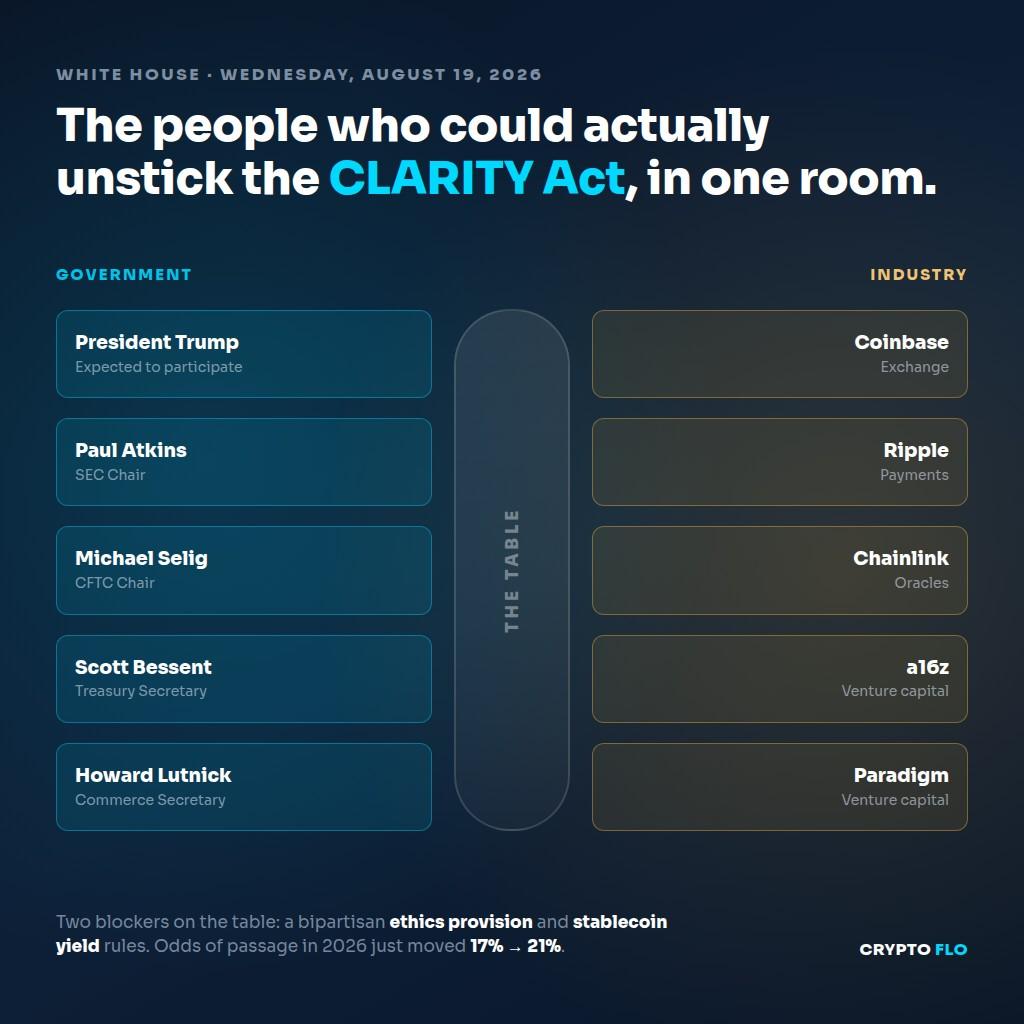
From the industry: Ripple, Coinbase, Chainlink, plus the venture firms Andreessen Horowitz (a16z) and Paradigm. Prediction market executives are also expected, which is its own signal given how much regulatory ambiguity that sector still operates under.
From the government: SEC Chair Paul Atkins and CFTC Chair Michael Selig, the heads of the two agencies the CLARITY Act would divide authority between. Treasury Secretary Scott Bessent and Commerce Secretary Howard Lutnick are also expected, and President Trump is expected to participate directly.
The detail that matters most: Atkins and Selig in the same room. CLARITY's entire purpose is deciding which of their two agencies regulates what. Having both chairs present alongside the companies that would live under those rules is the setup for an actual negotiation, not a photo opportunity.
The Two Things Actually Blocking The Bill
We covered the delay when it happened, and the story since then has narrowed to two specific sticking points. Neither is about whether crypto should be regulated. Both are about details that are blocking the votes.
The ethics provision. The Senate is waiting on a bipartisan ethics package from Senators Thom Tillis and Ruben Gallego. This has been the quiet obstacle for weeks, and it's the kind of provision that can stall a bill even when the broader framework has support on both sides of the aisle.
Stablecoin yields. Banking groups have real objections to provisions around paying yield on stablecoin holdings, and resolving those concerns is widely seen as necessary to build the bipartisan support the bill needs. This is the same fight that led Coinbase to publicly object to earlier Senate changes, and it hasn't gone away.
Notice what both have in common: they're negotiable. That's precisely why a meeting with this guest list is more meaningful than the usual round of public statements.
What The Prediction Markets Are Saying
If you want one number that tracks the mood on this bill, Polymarket's odds on CLARITY becoming law in 2026 have been a remarkably good barometer. The full arc this year:
- Over 70% earlier in 2026
- Roughly 47% about a month before the August recess
- Around 24% in mid-July
- Roughly 13-15% in the days right after the Senate punted
- 17% in mid-August
- 21% now, up four points in a single day on reports of the White House meeting
That's a bill traders had nearly written off, ticking back up on the news that the right people are talking. It's still a minority position, and 21% means the market thinks failure this year remains roughly four times more likely than success. But the direction reversed, and it reversed on a scheduling announcement rather than on any actual legislative movement. That tells you how much weight the market is putting on this particular meeting.
The Rest Of A Genuinely Busy Week
The White House meeting isn't the only thing on the calendar, and one of the others has nothing to do with crypto policy at all.
- August 17-20: Wyoming Blockchain Symposium, in Jackson Hole. Wyoming has been the most aggressive US state on digital asset legislation for years, and the timing next to a White House policy meeting is not a coincidence.
- August 19: FOMC minutes. Same day as the White House meeting, and a reminder that crypto still trades on macro. Rate expectations have been moving markets more than regulatory headlines for most of this year.
- August 20-21: Coinfest Asia, in Bali.
- Throughout the week: a heavy token unlock schedule, including Aptos, LayerZero, Starknet, Arbitrum, and Pyth. Unlocks add sell-side supply, which matters more than usual in a market this soft.
The Market Backdrop: This Is Not A Strong Tape
Context matters for reading any of this. Bitcoin opened Monday around $62,800, down more than 3% on the week and a long way from the highs above $126,000 it saw last October. Ethereum is near $1,874 and has struggled to reclaim $1,900. XRP is defending the $1 level.
Analysts are openly debating whether a bear market bottom is in or still ahead. That backdrop cuts both ways for this week's news: a genuine regulatory breakthrough would land in a market that badly wants a reason to rally, but a market this weak also means headlines alone are unlikely to hold a bid for long without follow-through.
What To Actually Watch For
The meeting will generate headlines regardless of what happens inside it. Two things would signal it mattered:
- Specific movement on the ethics provision. Not "productive discussions," but an actual indication that the Tillis-Gallego package has a path. That's the concrete blocker.
- Any softening between banking groups and the industry on stablecoin yield. This is the fight that has to end for the votes to materialize.
And one number to track afterward: whether Polymarket's odds hold above 21% by the end of the week, or drift back down. A pop on the announcement that fades by Friday would tell you the meeting was theater. Odds that keep climbing would suggest something real came out of it.
The Senate returns September 14 with three weeks to work before the calendar gets crowded again. That's the actual deadline this meeting is working against.
Frequently Asked Questions
Q: What is the White House crypto meeting on August 19?
A: A meeting bringing together President Trump, SEC Chair Paul Atkins, CFTC Chair Michael Selig, Treasury Secretary Scott Bessent, Commerce Secretary Howard Lutnick, and executives from companies including Ripple, Coinbase, Chainlink, a16z, and Paradigm, alongside prediction market executives.
Q: Will the CLARITY Act pass because of this meeting?
A: Nothing gets passed at a meeting. Congress votes on legislation. What this meeting could do is resolve the disputes, chiefly an ethics provision and stablecoin yield rules, that are currently preventing the Senate from having the votes to move it.
Q: What are the odds of the CLARITY Act passing in 2026?
A: Polymarket traders currently put it around 21%, up from roughly 13-15% shortly after the Senate missed its pre-recess window, but still well down from over 70% earlier in the year.
Q: When does the Senate actually vote?
A: No vote is scheduled. The Senate returns to Washington on September 14 and has roughly three weeks of working calendar before the fall agenda gets crowded.
The Bottom Line
A bill that traders had mostly given up on is getting the most senior meeting it has ever had, and the market has already repriced it upward on that fact alone. The honest read is that this is a real opportunity rather than a resolution: the blockers are specific and negotiable, the right people will be in the room, and there's still no floor vote on any calendar. Watch what happens to the ethics provision, and watch whether the odds hold once the headlines fade.
This content was created with AI assistance and may contain errors, always verify before acting. Not financial advice. Always do your own research before making any investment decisions.
Frequently Asked Questions
What is the White House crypto meeting on August 19?
A meeting bringing together President Trump, SEC Chair Paul Atkins, CFTC Chair Michael Selig, Treasury Secretary Scott Bessent, Commerce Secretary Howard Lutnick, and executives from companies including Ripple, Coinbase, Chainlink, a16z, and Paradigm, alongside prediction market executives.
Will the CLARITY Act pass because of this meeting?
Nothing gets passed at a meeting. Congress votes on legislation. What this meeting could do is resolve the disputes, chiefly an ethics provision and stablecoin yield rules, that are currently preventing the Senate from having the votes to move it.
What are the odds of the CLARITY Act passing in 2026?
Polymarket traders currently put it around 21%, up from roughly 13-15% shortly after the Senate missed its pre-recess window, but still well down from over 70% earlier in the year.
When does the Senate actually vote?
No vote is scheduled. The Senate returns to Washington on September 14 and has roughly three weeks of working calendar before the fall agenda gets crowded.
Let AI summarize these channels for you daily
Pick your favorite crypto YouTube channels and news sites. Get a 5-minute AI brief every morning.
Choose Your Sources