The CLARITY Act Just Defined "Decentralized" — and a Lot of DeFi Won't Qualify
In This Article
Introduction
The CLARITY Act is back, it is 630 pages long, and the Senate votes on Monday.
That vote matters, and we will get to the arithmetic of it. But buried in the revised text is something more interesting than the procedural drama: for the first time, the bill tries to write down a test for whether a protocol is actually decentralized. Not a definition in the abstract. A set of questions with a yes or no answer, and real consequences attached to getting a yes.
Anyone who has spent time in crypto knows the problem it is aiming at. "Decentralized" is the most load-bearing word in the industry and one of the least policed. Plenty of projects use it to describe something with a multisig held by four people at the same company. Lawmakers have finally noticed, and the shorthand now circulating in Washington is blunt: decentralized in name only.
What actually happens on September 15
First, the unglamorous part, because a lot of coverage will overstate it.
The Senate vote scheduled for Monday, September 15, is a motion to proceed. It is a vote about whether to start debating the bill. It is not passage, it does not make anything law, and clearing it would still leave amendments, a final Senate vote, reconciliation with the House version, and a signature between here and an actual statute.
What it is, though, is the first real test of whether this bill has a path at all. And it carries the same 60-vote threshold as the finish line.
The arithmetic: 60 votes are required. Republicans hold roughly 53 seats. So at least seven Democrats have to vote yes just to begin debate. As of the revised text's release, there is still no bipartisan agreement. That is the whole story of this bill in one sentence.
Senator Cynthia Lummis, who led the revision, says the new text incorporates more than 114 amendments requested by Senate Democrats. Treasury Secretary Scott Bessent has publicly urged the Senate to pass it. Neither of those is the same as seven committed votes.
The genuinely new part: a control test
Here is what is worth your attention regardless of how Monday goes.
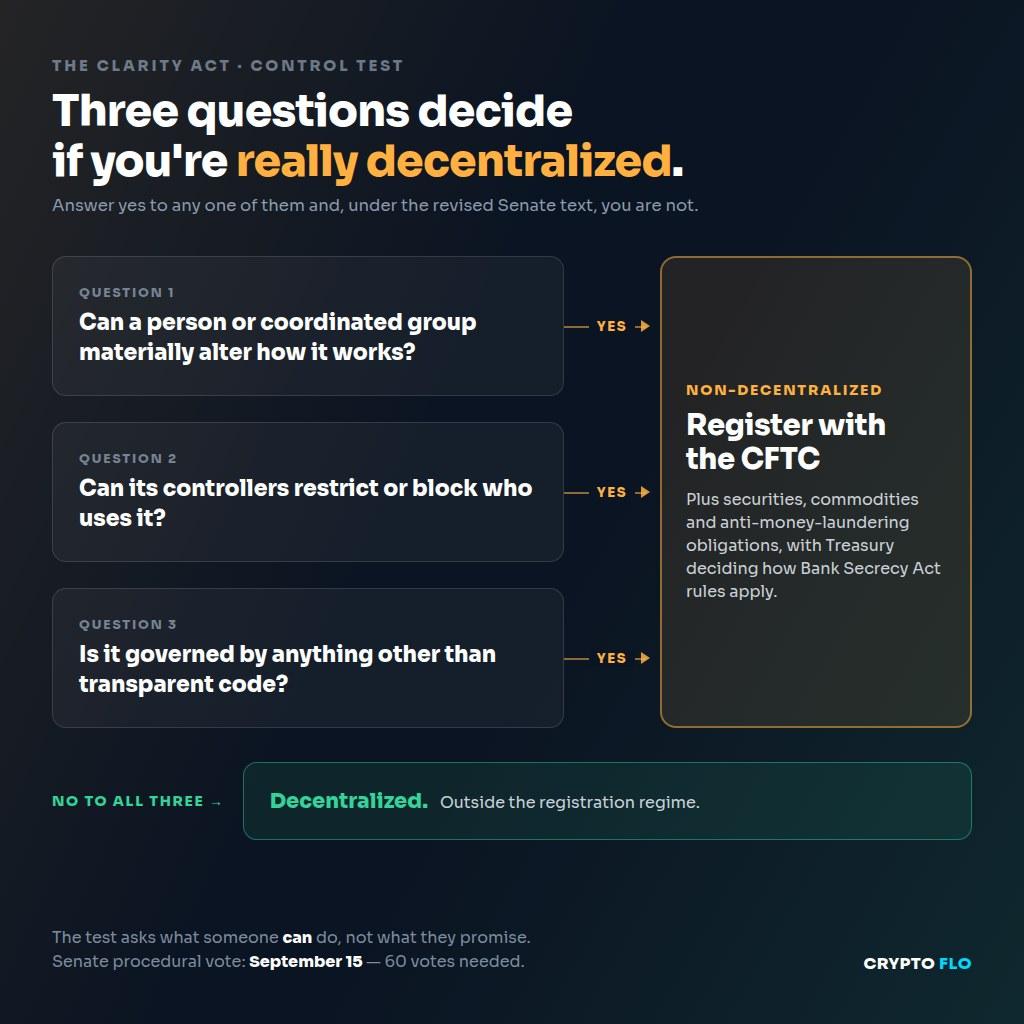
Earlier drafts leaned on "decentralized" as something close to a self-declared status. The revised text instead describes non-decentralized finance trading protocols and gives regulators criteria for identifying them. A protocol falls on the regulated side of the line if any of the following is true:
- Its functionality can be materially altered by a person or a coordinated group.
- Its controllers can restrict who uses it — block, gate, or exclude users.
- Its transactions are not governed solely by transparent code.
Answer yes to any one of those and, under this text, you are not decentralized for regulatory purposes. The controllers would be expected to register with the Commodity Futures Trading Commission and comply with securities, commodities, and anti-money-laundering obligations.
Why this is smarter than it sounds
The elegant thing about the test is that it ignores what a project calls itself and asks only what someone can do to it. It is a question about capability, not intent. Not "did you promise not to interfere" but "are you able to."
That is the same instinct behind a lot of good security thinking, and it is very hard to argue with in principle. If a group of people can change the rules, users are trusting those people, whatever the marketing says. The presence of a trusted party is exactly what regulation has always attached to.
And where it gets uncomfortable
Applied literally, that test catches a great deal of what the industry currently calls DeFi.
Upgradeable contracts are the norm, not the exception. Admin keys and pause functions exist all over the space, usually for defensible reasons — the ability to halt a contract mid-exploit has saved real money. Front-end operators geoblock sanctioned jurisdictions, which is itself a compliance measure. Governance tokens are often concentrated enough that a handful of holders can pass anything.
Each of those is a plausible "yes" to one of the three questions. So the practical effect of the test depends enormously on how regulators interpret words like materially and coordinated group, and the bill leaves that interpretation to the SEC, the CFTC, and Treasury rather than settling it in the text. Whether that is sensible delegation or a blank cheque is precisely what people are arguing about.
What compliance would actually involve
The bill does not write the rules itself. It instructs agencies to write them:
- The SEC and CFTC would develop activity-based rules covering registration, conduct standards, disclosure, recordkeeping, and supervision.
- Treasury would determine how existing Bank Secrecy Act obligations apply to the controllers of affected protocols.
That last one is the sharpest edge. BSA obligations are the machinery of financial surveillance — know-your-customer, suspicious activity reporting, recordkeeping. Extending them to whoever "controls" a protocol raises a question the text does not fully answer: if control is distributed across an anonymous token-holder base, who exactly files the report?
Law enforcement groups, meanwhile, have pushed back from the opposite direction, arguing the DeFi carve-out is too generous rather than too strict. That both sides are unhappy is either a sign of a reasonable compromise or of a provision nobody is satisfied with. Probably some of each.
What is still unresolved
Three things are keeping this from being bipartisan, and only one of them is technical.
Ethics. This is the big one. The ethics section came through the revision largely unchanged, despite being among the most contested parts of the bill. One Democratic aide described it as the "biggest stumbling block by far." The underlying concern is conflicts of interest among public officials holding or promoting digital assets. If 114 amendments were accepted elsewhere and this section moved barely at all, that tells you where the real fight is — and it is not really about market structure.
Anti-money-laundering scope. Ongoing disagreement about how far the obligations reach and who they land on.
Stablecoin rewards. Whether issuers may pay yield to holders, which banks have lobbied against hard, since a yield-bearing dollar token competes directly with deposits.
What to watch on Monday
- Clears 60 votes: the bill is genuinely alive. Expect a stronger tone across crypto markets, though the remaining path is still long.
- Falls short: not necessarily fatal. Failed procedural votes are a standard negotiating instrument, and a second attempt after further concessions is entirely normal. It would, though, push any realistic timeline toward the end of the year and into an election calendar that gets less hospitable by the month.
- The number that matters most: not whether it passes, but how many Democrats cross over. Three or four signals a deal is close. Zero signals the ethics fight is unresolved and nothing else in the bill can compensate.
Frequently Asked Questions
Q: What is the CLARITY Act?
A: Proposed US legislation to set market structure rules for digital assets, principally by dividing regulatory authority between the SEC and the CFTC and defining when a token is treated as a security versus a commodity. It has been through multiple drafts; the current Senate text runs 630 pages.
Q: What happens at the September 15 vote?
A: It is a procedural motion to proceed, meaning a vote on whether to begin debate, not on passage. It requires 60 of 100 votes. Clearing it would still leave amendments, a final vote, and reconciliation with the House version before anything becomes law.
Q: What does "decentralized in name only" mean?
A: The shorthand for protocols that market themselves as decentralized while remaining under the effective control of a person or small group. The revised bill treats a protocol as non-decentralized if its functionality can be materially altered by a coordinated group, if controllers can restrict users, or if transactions are not governed solely by transparent code.
Q: Would this force DeFi protocols to register with the CFTC?
A: It would for protocols that fail the control test. Truly autonomous protocols would not be captured. How wide that net is depends on how regulators interpret terms like "materially alter," which the bill delegates to the SEC, CFTC, and Treasury rather than defining precisely.
Q: Does the CLARITY Act affect me if I just hold crypto?
A: Not directly and not immediately. This is market structure regulation aimed at issuers, exchanges, and protocol operators. Over time it would shape which products are available to you and under what conditions, but nothing changes for a holder the day it passes.
Q: Why do Democrats object if 114 of their amendments were accepted?
A: Because the section they care most about moved the least. Ethics provisions covering conflicts of interest among public officials came through the revision largely unchanged, and disagreements also remain over anti-money-laundering scope and whether stablecoin issuers may pay yield.
The Bottom Line
Monday is a real checkpoint, but treat it as a temperature reading rather than a verdict. Procedural votes fail and get retried all the time, and the count of Democratic crossovers will tell you more than the pass-or-fail result.
The part worth carrying forward is the control test. Whether or not this particular bill survives, the idea is now written down in legislative language: decentralization is a claim that can be checked, and the check is about what a small group is capable of doing, not what they promise. That framing is unlikely to disappear even if the bill does.
It is also, quietly, a useful question for your own research. When a project tells you it is decentralized, the three questions in that test are a good thing to ask before taking its word for it.
This content was created with AI assistance and may contain errors. Legislation changes rapidly, and details described here reflect a draft that may be amended further. Always verify current status before acting. Not financial or legal advice. Always do your own research before making any investment decisions.
Frequently Asked Questions
What is the CLARITY Act?
Proposed US legislation to set market structure rules for digital assets, principally by dividing regulatory authority between the SEC and the CFTC and defining when a token is treated as a security versus a commodity. It has been through multiple drafts; the current Senate text runs 630 pages.
What happens at the September 15 vote?
It is a procedural motion to proceed, meaning a vote on whether to begin debate, not on passage. It requires 60 of 100 votes. Clearing it would still leave amendments, a final vote, and reconciliation with the House version before anything becomes law.
What does decentralized in name only mean?
The shorthand for protocols that market themselves as decentralized while remaining under the effective control of a person or small group. The revised bill treats a protocol as non-decentralized if its functionality can be materially altered by a coordinated group, if controllers can restrict users, or if transactions are not governed solely by transparent code.
Would this force DeFi protocols to register with the CFTC?
It would for protocols that fail the control test. Truly autonomous protocols would not be captured. How wide that net is depends on how regulators interpret terms like materially alter, which the bill delegates to the SEC, CFTC and Treasury rather than defining precisely.
Does the CLARITY Act affect me if I just hold crypto?
Not directly and not immediately. This is market structure regulation aimed at issuers, exchanges and protocol operators. Over time it would shape which products are available to you and under what conditions, but nothing changes for a holder the day it passes.
Why do Democrats object if 114 of their amendments were accepted?
Because the section they care most about moved the least. Ethics provisions covering conflicts of interest among public officials came through the revision largely unchanged, and disagreements also remain over anti-money-laundering scope and whether stablecoin issuers may pay yield.
Let AI summarize these channels for you daily
Pick your favorite crypto YouTube channels and news sites. Get a 5-minute AI brief every morning.
Choose Your Sources