The CLARITY Act Votes Tomorrow — and Republicans Need Nine Democrats
In This Article
Introduction
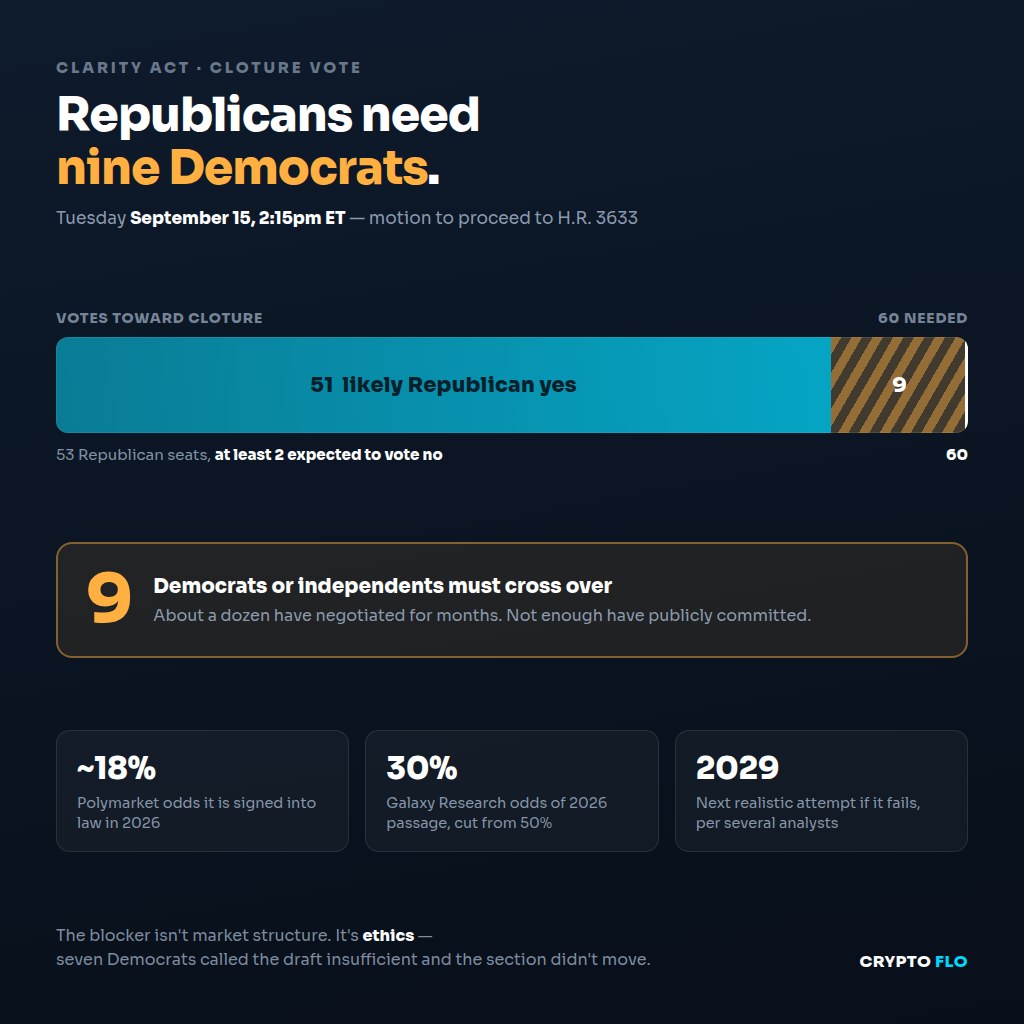
The CLARITY Act gets its vote tomorrow: Tuesday, September 15, at 2:15pm ET, a cloture vote on the motion to proceed to H.R. 3633, scheduled by Majority Leader John Thune.
We wrote last week about the control test buried in the revised text — the three questions that decide whether a protocol counts as decentralized. That is the substance. This is the arithmetic, and the arithmetic is not friendly.
Here is the number that matters: nine. That is how many Democrats or independents have to vote yes. Not seven, which is the figure most coverage used a week ago. Nine.
Where the nine comes from
The cloture threshold is 60 votes. Republicans hold 53 seats. That alone would put the gap at seven.
But at least two Republicans are expected to vote no. That moves the likely Republican yes column to 51, and the gap from seven to nine.
It is worth being precise about what this vote is, because a lot of coverage will blur it. This is not final passage. It is a vote on whether the Senate will begin debating the bill at all. Clearing it would still leave amendments, a final vote, reconciliation with the House, and a signature.
But it is the checkpoint that matters most, because of what failure costs.
Why failure would not be a small setback
Ordinarily a failed procedural vote is routine — a negotiating instrument, retried a few weeks later after concessions. That is not really the situation here.
The calendar is the problem. Failing tomorrow would push any realistic path deep into a midterm election year, and market structure legislation historically does not move in those. Several analysts have put the practical consequence bluntly: a loss here likely ends the bill for 2026, and possibly until 2029.
That is why this vote is being treated as the whole ballgame despite being procedural.
What the people betting on it think
The prediction markets and research desks are not optimistic, and they have moved in the wrong direction recently:
- Polymarket prices the CLARITY Act being signed into law in 2026 at roughly 18%.
- Galaxy Research cut its odds of 2026 passage to 30%, down from 50%.
Against that, Coinbase CEO Brian Armstrong has said publicly that it will pass. Read that as a stakeholder expressing confidence rather than as a forecast — he is not a neutral observer, and neither are most of the loudest voices this week in either direction.
The honest summary is that informed money currently expects this to fail, while the industry's most invested participants expect it to pass.
The actual blocker is ethics, not market structure
This is the part worth understanding, because it explains why "the bill got better" has not translated into votes.
Seven Democratic senators issued a joint statement saying the current draft is insufficient on three grounds: ethics, consumer protection, and illicit finance. Their support was made conditional on text changes — and those changes did not materialize during the August recess.
Recall that the revised text incorporated more than 114 Democrat-requested amendments. That sounds like enormous accommodation, and in most respects it was. But the ethics section came through largely unchanged, and the ethics section is the one they care about.
The underlying dispute is about conflicts of interest among public officials holding or promoting digital assets, with particular attention to the Trump family's holdings in World Liberty Financial. That is a political fight wearing a financial-regulation costume, and no amount of refinement to the token taxonomy resolves it.
Which is why the count is genuinely uncertain. Roughly a dozen Democrats have been negotiating on this bill for months and are not hostile to it. But not enough have publicly committed, and the thing standing between them and a yes is not something the drafters can fix with better definitions.
What to watch tomorrow
- The headline result, obviously. 60 or more and the bill lives.
- The Democratic crossover count, even in defeat. Seven or eight means a deal is genuinely close and a second attempt is plausible. Two or three means the ethics impasse is real and the bill is done for this Congress.
- Whether the two expected Republican defections actually materialize. If they hold their noses and vote yes, the required Democratic number drops back to seven, which is a materially easier target.
- Any last-minute substitute text. A manager's amendment addressing ethics appearing before the vote would change everything. Its absence by Monday evening is itself a signal.
What this means if you just hold crypto
Very little immediately, and it is worth saying that plainly because the coverage this week will be loud.
Nothing about your holdings changes tomorrow either way. The CLARITY Act is market structure regulation: it governs how tokens are classified, which agency supervises whom, and what registration obligations fall on issuers, exchanges, and protocol operators. It does not change what you own or how you are taxed. Our post on what actually triggers a crypto tax bill covers the part that does affect you directly, and that is unaffected by this vote.
What a passage would change, over years rather than days, is the range of products US firms are willing to offer, the willingness of institutions to custody and list assets, and the volume of enforcement-by-litigation that has substituted for rules until now.
What a failure would change is that the current ambiguity persists into 2027 and beyond. Which is not a catastrophe. It is simply more of what the industry has already been operating under.
Frequently Asked Questions
Q: When exactly is the CLARITY Act vote?
A: Tuesday, September 15, 2026 at 2:15pm ET. It is a cloture vote on the motion to proceed to H.R. 3633, scheduled by Senate Majority Leader John Thune.
Q: How many votes does the CLARITY Act need?
A: 60. Republicans hold 53 seats and at least two are expected to vote no, so roughly nine Democrats or independents would need to vote yes for the motion to advance.
Q: Is this the final vote on the CLARITY Act?
A: No. It is a procedural vote on whether to begin debate. Passage would still require amendments, a final Senate vote, reconciliation with the House version, and a presidential signature.
Q: What happens if the CLARITY Act fails this vote?
A: It would likely end the bill's chances for 2026. Because market structure legislation rarely advances during midterm election years, several analysts suggest a failure could push the next realistic attempt to 2029.
Q: Why are Democrats blocking the CLARITY Act?
A: Seven Democratic senators issued a joint statement calling the draft insufficient on ethics, consumer protection, and illicit finance. The central objection concerns conflicts of interest among public officials holding digital assets, and the ethics section was left largely unchanged in the revision.
Q: Will the CLARITY Act pass?
A: Nobody knows, and the signals conflict. Polymarket prices 2026 enactment near 18% and Galaxy Research cut its odds to 30% from 50%, while Coinbase CEO Brian Armstrong has said publicly that it will pass. Treat confident predictions in either direction with suspicion.
The Bottom Line
The bill is better than it was. It absorbed 114 amendments, it added a real test for decentralization, and it has a Majority Leader willing to spend floor time on it. None of that is the binding constraint.
The binding constraint is nine votes, and the thing holding those nine back is an ethics dispute that the drafters have not addressed and may not be able to. Watch the crossover count rather than the headline, because that number tells you whether this is a bill that failed once or a bill that is finished.
This content was created with AI assistance and may contain errors. Legislative situations change rapidly and vote counts described here reflect expectations before the vote, not outcomes. Always verify current status before acting. Not financial or legal advice. Always do your own research before making any investment decisions.
Frequently Asked Questions
When exactly is the CLARITY Act vote?
Tuesday, September 15, 2026 at 2:15pm ET. It is a cloture vote on the motion to proceed to H.R. 3633, scheduled by Senate Majority Leader John Thune.
How many votes does the CLARITY Act need?
60. Republicans hold 53 seats and at least two are expected to vote no, so roughly nine Democrats or independents would need to vote yes for the motion to advance.
Is this the final vote on the CLARITY Act?
No. It is a procedural vote on whether to begin debate. Passage would still require amendments, a final Senate vote, reconciliation with the House version, and a presidential signature.
What happens if the CLARITY Act fails this vote?
It would likely end the bill's chances for 2026. Because market structure legislation rarely advances during midterm election years, several analysts suggest a failure could push the next realistic attempt to 2029.
Why are Democrats blocking the CLARITY Act?
Seven Democratic senators issued a joint statement calling the draft insufficient on ethics, consumer protection and illicit finance. The central objection concerns conflicts of interest among public officials holding digital assets, and the ethics section was left largely unchanged in the revision.
Will the CLARITY Act pass?
Nobody knows, and the signals conflict. Polymarket prices 2026 enactment near 18% and Galaxy Research cut its odds to 30% from 50%, while Coinbase CEO Brian Armstrong has said publicly that it will pass. Treat confident predictions in either direction with suspicion.
Let AI summarize these channels for you daily
Pick your favorite crypto YouTube channels and news sites. Get a 5-minute AI brief every morning.
Choose Your Sources