Why Crypto Drops 11% Overnight With No News: Liquidation Cascades Explained
In This Article
- Introduction
- What a liquidation actually is
- Why one liquidation becomes ten thousand
- The engine underneath: perpetual futures
- Why crypto and not stocks
- Why it always seems to happen at 3am
- Long squeeze and short squeeze
- What to actually watch
- If you do not use leverage
- Frequently Asked Questions
- The Bottom Line
Introduction
You check your phone. Bitcoin is down 11% since you went to bed. You search for news and there is nothing — no hack, no regulation, no announcement. By lunchtime it has recovered half of it.
That is not a bug in the market, and it is not manipulation in the way people usually mean. It is a liquidation cascade, and it is the single most common explanation for violent crypto moves that have no story attached.
Understanding it does two things. It stops you reacting to a mechanical event as though it were news about what your assets are worth. And it explains why these moves cluster at the least convenient hours.
What a liquidation actually is
Start with the borrowed money, because none of this happens without it.
Traders can open positions much larger than their account by borrowing from the exchange. Put down $1,000, control $10,000 of Bitcoin — that is 10x leverage. Your gains are ten times larger. So are your losses.
Because the exchange is lending, it will not let you lose more than you put up. Every leveraged position therefore has a liquidation price: the level at which your collateral is nearly exhausted. Reach it and the exchange does not call you or ask permission. It force-closes the position and sells your collateral into the market immediately, at whatever price it can get.
At 10x leverage, roughly a 10% move against you wipes out the position. At 50x, about 2%. At 100x, a 1% wobble — which Bitcoin does several times on a quiet day — ends you.
The crucial detail: a liquidation is a forced market sell that has to happen right now, regardless of price, sentiment, or whether anyone wants to buy.
Why one liquidation becomes ten thousand
Here is the loop that produces the overnight crash.
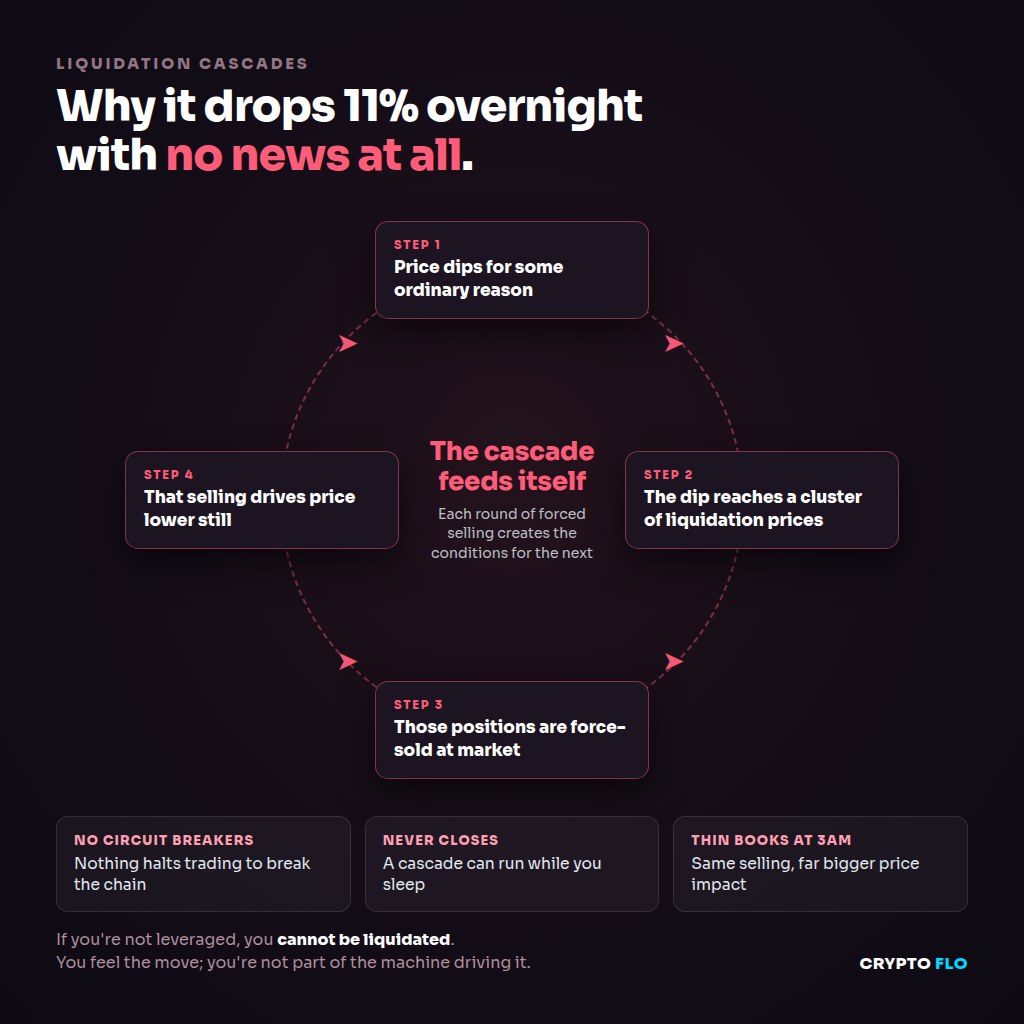
1. Price dips for some ordinary reason — a large seller, a macro headline, nothing at all.
2. The dip reaches a cluster of liquidation prices. Leverage is not spread evenly; it piles up at round numbers and below recent lows, because that is where people place bets and set stops.
3. Those positions are force-sold at market. This is not a choice to sell. It is an automatic order that must fill.
4. That selling pushes the price lower, which reaches the next cluster of liquidation prices.
And then it runs again. Each round of forced selling manufactures the conditions for the next round. This is a genuine feedback loop, and while it is running, price has temporarily stopped being about what Bitcoin is worth and become about how much leverage has to be unwound.
It ends when the selling exhausts the leverage sitting below, which is why these moves often reverse sharply. The spike was mechanical, so once the mechanism finishes, price frequently snaps back toward where it started. The people who panic-sold into the bottom sold to a machine that had no opinion.
The engine underneath: perpetual futures
Crypto has a specific instrument that makes all of this far more common than in other markets.
Perpetual futures — "perps" — are derivatives that track an asset's price with no expiry date. You can hold one indefinitely, with leverage, without ever touching the underlying asset. They dominate crypto trading volume, frequently exceeding spot trading by a wide margin.
They are kept tethered to the real price by a funding rate: a small payment exchanged periodically between longs and shorts. When more traders are long, longs pay shorts, and vice versa. It is an elegant mechanism, and it doubles as a sentiment gauge — persistently high positive funding means the market is crowded with leveraged longs, which is precisely the condition a cascade needs.
The practical consequence is that a large share of crypto "buying" is not someone acquiring Bitcoin. It is someone taking a leveraged bet that can be liquidated. That leverage is the fuel.
Why crypto and not stocks
Equities have violent days too, but rarely in this shape, for four structural reasons.
No circuit breakers. US stock markets halt trading when an index falls far enough in a session, deliberately interrupting exactly this feedback loop. Crypto has no equivalent. There is no pause, no cooling-off, nothing to break the chain.
It never closes. Equities stop overnight and at weekends, which forces a gap between the panic and the next opportunity to act. Crypto runs every hour of every day, so a cascade can develop with nobody watching.
Retail leverage is extreme. A US stock brokerage typically offers about 2x on margin. Crypto exchanges have offered 50x and 100x to ordinary users. A market where a 1% move can wipe out positions is structurally fragile.
Order books thin out. The buy orders waiting to absorb selling are far smaller at 4am than at midday, and smaller on a Sunday than a Wednesday. The same forced sell moves price much further when there is less on the other side.
Why it always seems to happen at 3am
Because that is when the fourth point bites hardest.
Liquidity follows working hours. When the US and Europe are asleep, order books are at their thinnest, which means each dollar of forced selling moves price further, which triggers the next tier of liquidations faster. A cascade that would be absorbed at 2pm runs unchecked at 3am.
It is not that something sinister is scheduled for the middle of the night. It is that the same event does more damage when fewer people are around to take the other side. This is also why weekend moves are disproportionately sharp.
Long squeeze and short squeeze
The mechanism is symmetrical, and the upside version is worth knowing.
A long squeeze is what has been described so far: leveraged buyers are liquidated, forced selling drives price down.
A short squeeze is the mirror image. Traders betting on a decline get liquidated as price rises, and closing a short means buying. Forced buying pushes price up, which liquidates more shorts. Violent green candles with no news are usually this.
Same machinery, opposite direction. A market heavily crowded on either side is primed for a move against the crowd — which is the grain of truth in the folk wisdom that the market moves to hurt the most people.
What to actually watch
You do not need to be a derivatives trader for these to be useful context:
- Open interest — the total value of outstanding derivative positions. Rising open interest alongside rising price means the move is leverage-driven, which makes it more fragile than a move on spot buying.
- Funding rates — persistently high positive funding means longs are crowded and paying to stay. This is the loaded-spring condition.
- Liquidation data — several analytics sites publish liquidations in real time. After a violent move, this tells you within minutes whether it was mechanical.
None of these predict direction. What they tell you is how much dry tinder is lying around, which is a different and more honest kind of information.
If you do not use leverage
Most people reading this do not trade perps, so here is the part that matters for you.
You cannot be liquidated. If you bought with your own money and hold your own coins, no mechanism exists that forcibly sells your position. You feel the price move; you are not part of the cascade. That is genuinely the most important sentence in this article.
What follows from that:
- A cascade is not new information about your thesis. Nothing changed about the asset. Leverage got flushed. If you were holding for reasons unrelated to yesterday's price, those reasons are intact.
- Be careful with stop-loss orders. A cascade produces long wicks — brief spikes far below where price settles. A stop sitting in that zone executes at the worst possible moment and you are out of a position that recovered by breakfast.
- Do not add leverage to "recover" from one. The instrument that caused the move is not the tool for responding to it.
- Waking up to red is not a reason to act at 3am. Almost nothing good is decided then.
Frequently Asked Questions
Q: What is a liquidation in crypto?
A: When a leveraged position loses enough that the trader's collateral is nearly exhausted, the exchange automatically closes it and sells the collateral at market price. It is forced and immediate, and the trader has no say in the timing or price.
Q: Why did crypto crash with no news?
A: Most likely a liquidation cascade. A price dip triggers leveraged positions to be force-sold, that selling pushes price lower, which triggers more liquidations. The move is mechanical rather than informational, which is why it often partly reverses.
Q: Why does crypto crash at night and on weekends?
A: Because order books are thinnest when the US and Europe are asleep or off. The same amount of forced selling moves price much further when fewer buyers are waiting, so cascades run faster and further at those hours.
Q: Can I be liquidated if I just buy and hold?
A: No. Liquidation only applies to leveraged or borrowed positions. If you bought with your own money and hold the asset yourself, there is no mechanism that can force you to sell, whatever the price does.
Q: What is a short squeeze?
A: The reverse of a long squeeze. Traders betting on a price fall are liquidated as price rises, and closing a short position requires buying, so the forced buying pushes price up further and liquidates more shorts.
Q: What are perpetual futures?
A: Derivatives that track an asset's price with no expiry date, letting traders hold leveraged positions indefinitely. They are kept in line with spot price by a funding rate paid between longs and shorts, and they account for a large share of crypto trading volume.
Q: Why does crypto not have circuit breakers?
A: Stock exchanges are centralized and regulated venues that can halt trading together. Crypto trades across many independent global venues with no shared authority and no legal mandate to pause, so there is no mechanism to interrupt a cascade.
The Bottom Line
The violence people associate with crypto is not mostly about crypto being a risky asset. It is about market structure: heavy retail leverage, a dominant derivatives market, no circuit breakers, continuous trading, and order books that thin out when half the world is asleep. Put those together and a small push produces a large, fast, self-reinforcing move.
The practical value of knowing this is mostly emotional. When you see a double-digit drop with no explanation, the useful first question is not "what happened?" but "was this leverage unwinding?" — and the liquidation data usually answers it within minutes.
If you are not leveraged, a cascade is weather rather than an earthquake. Unpleasant to watch, over fairly quickly, and not a verdict on anything you own.
This content was created with AI assistance and may contain errors. Always verify before acting. Leveraged trading carries a high risk of total loss and is not suitable for most people. Not financial advice. Always do your own research before making any investment decisions.
Frequently Asked Questions
What is a liquidation in crypto?
When a leveraged position loses enough that the trader's collateral is nearly exhausted, the exchange automatically closes it and sells the collateral at market price. It is forced and immediate, and the trader has no say in the timing or price.
Why did crypto crash with no news?
Most likely a liquidation cascade. A price dip triggers leveraged positions to be force-sold, that selling pushes price lower, which triggers more liquidations. The move is mechanical rather than informational, which is why it often partly reverses.
Why does crypto crash at night and on weekends?
Because order books are thinnest when the US and Europe are asleep or off. The same amount of forced selling moves price much further when fewer buyers are waiting, so cascades run faster and further at those hours.
Can I be liquidated if I just buy and hold?
No. Liquidation only applies to leveraged or borrowed positions. If you bought with your own money and hold the asset yourself, there is no mechanism that can force you to sell, whatever the price does.
What is a short squeeze?
The reverse of a long squeeze. Traders betting on a price fall are liquidated as price rises, and closing a short position requires buying, so the forced buying pushes price up further and liquidates more shorts.
What are perpetual futures?
Derivatives that track an asset's price with no expiry date, letting traders hold leveraged positions indefinitely. They are kept in line with spot price by a funding rate paid between longs and shorts, and they account for a large share of crypto trading volume.
Why does crypto not have circuit breakers?
Stock exchanges are centralized and regulated venues that can halt trading together. Crypto trades across many independent global venues with no shared authority and no legal mandate to pause, so there is no mechanism to interrupt a cascade.
Get daily intelligence on the coins you track
Personalized AI briefings built from the sources you choose. Starting at $5.99/month.
Start with Crypto Flo