What It Would Actually Take for the CLARITY Act to Pass
In This Article
Introduction
This is being written while the Senate votes. The result is not in, and by the time you read this it may be — so treat everything here as the state of play going into the vote rather than a prediction of how it went.
The more useful question, and the one that survives today's outcome either way, is this: what would actually have to change for the CLARITY Act to become law?
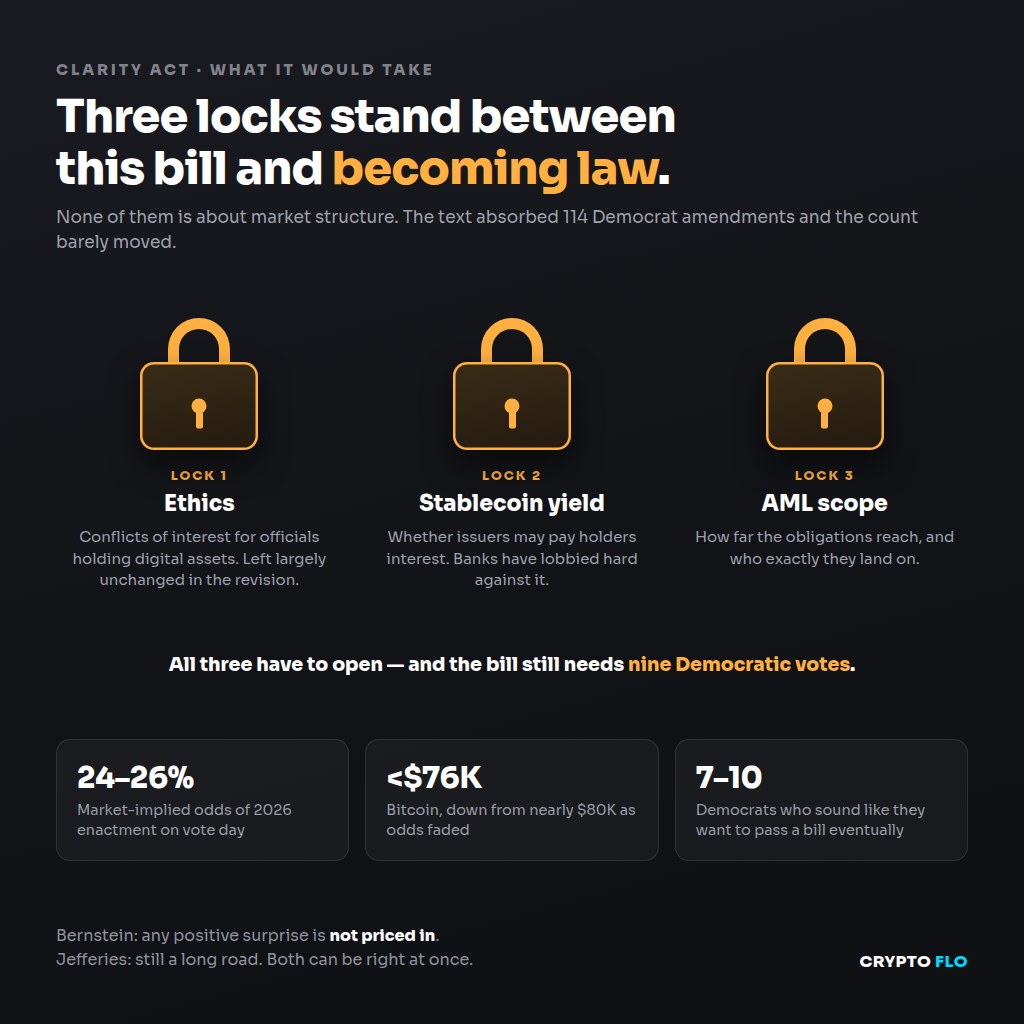
Not "will it pass." That is a coin flip dressed up as analysis. The answer is three specific disputes, and none of them is about market structure.
The three locks
The revised text absorbed more than 114 amendments requested by Senate Democrats. That is a lot of accommodation, and it has not moved the vote count much, which tells you the remaining disagreements are not technical.
1. Ethics. The central one. The provisions concern conflicts of interest among public officials who hold or promote digital assets, with particular attention to the Trump family's stake in World Liberty Financial. Seven Democratic senators issued a joint statement calling the draft insufficient here, and the ethics section came through the revision largely unchanged. There were reports over the weekend that the White House had agreed to new ethics language, which if it holds is the single most consequential development in weeks — but agreeing to language and getting it into a text senators have read are different things.
2. Stablecoin rewards. Whether issuers may pay yield to holders. Banks have lobbied hard against this, for an obvious reason: a dollar token that pays interest competes directly with a deposit account that mostly does not. Some analysts rate this the biggest hurdle of the three, ahead of ethics.
3. Anti-money-laundering scope. How far the obligations reach and which parties they land on. Law enforcement groups have pushed from the opposite direction to the industry, arguing the DeFi provisions are too generous rather than too strict.
All three have to resolve. Any one of them left open is enough to keep a bloc of Democrats from voting yes, and the arithmetic leaves no room — Republicans hold 53 seats, at least two are expected to vote no, so roughly nine Democrats or independents are needed.
What the experts actually disagree about
The interesting thing about the commentary this week is that the split is not optimists versus pessimists. It is people measuring different things.
Bernstein argues there has been more progress than markets expected, and made the sharper point that "any positive surprise is definitely not priced in." That is a statement about positioning, not about the bill: if the market has fully absorbed failure, then success is asymmetric.
Jefferies has taken the opposite emphasis, warning the bill still faces a long road despite genuine Senate progress, and flagging crypto market volatility around the process.
Both can be right. Bernstein is describing what happens to prices if it passes; Jefferies is describing the probability that it does. Those are different claims and they are not in conflict.
The count itself is genuinely uncertain in a specific way: roughly seven to ten Democrats sound like they want to pass a bill eventually. That is the whole story. There is a bloc that is not opposed in principle, sitting on its hands over provisions that are political rather than economic. It is the difference between "no" and "not this text," and that distinction determines whether a failed vote today is an ending or an intermission.
The market has already voted
Prices moved ahead of the Senate, which is its own kind of forecast.
Bitcoin slid from nearly $80,000 toward below $76,000 as passage odds faded through the session. Prediction markets and research desks converged in the same direction: odds of 2026 enactment quoted around 24% to 26% on the day, after Galaxy Research had already cut its estimate to 30% from 50%.
Against that, Coinbase CEO Brian Armstrong has said publicly that it will pass. He is not a neutral party, and neither are most of the confident voices this week in either direction.
What the price action tells you is that failure is substantially expected. Which is exactly the condition Bernstein was pointing at — the downside is largely in the price, and the upside is not.
The thing that actually decides this: the calendar
Strip away the provisions and the deepest constraint is time.
Market structure legislation does not move well in election years. Every month from here compresses the window, and a failure today pushes the realistic next attempt toward a period when neither party wants to hand the other a win. Several analysts have suggested that if this dies now, the next genuine opportunity may not come until 2029.
That cuts both ways, and it is why the outcome is not obvious. Some Senate Democrats are wary of being cast as anti-crypto going into the midterms, and the crypto lobby has funded candidates in both parties. There is real political cost to blocking, not only to supporting. Whether that cost outweighs the ethics objection is, in the end, the entire question.
What happens next, either way
If cloture clears: the bill is alive but far from done. Amendments, a final Senate vote, reconciliation with the House version, and a signature all remain. Expect a strong market reaction that is, on the merits, somewhat ahead of the actual progress.
If it fails: watch the crossover count rather than the headline. A failed procedural vote with seven or eight Democrats crossing means a deal is close and a second attempt is normal legislative practice. A failure with two or three means the ethics impasse is structural, and the 2029 framing stops being hyperbole.
Either way, for holders: nothing changes about what you own tomorrow. This is regulation of issuers, exchanges and protocol operators. It shapes which products American firms are willing to offer over years, not what is in your wallet tonight.
Frequently Asked Questions
Q: What would it take for the CLARITY Act to pass?
A: Resolution of three disputes, none of them about market structure: ethics provisions covering conflicts of interest among public officials, whether stablecoin issuers may pay yield to holders, and the scope of anti-money-laundering obligations. Plus roughly nine Democratic or independent votes.
Q: Why is the ethics provision such a sticking point?
A: It concerns conflicts of interest among public officials who hold or promote digital assets, with particular attention to the Trump family's holdings in World Liberty Financial. Seven Democratic senators called the draft insufficient, and the section was left largely unchanged while 114 other amendments were accepted.
Q: What are analysts saying about the CLARITY Act?
A: The views split by what is being measured. Bernstein sees more progress than markets expected and notes any positive surprise is not priced in. Jefferies warns the bill still faces a long road and flags volatility. Both can hold at once, since one describes the payoff and the other the probability.
Q: What are the odds the CLARITY Act passes in 2026?
A: Market-implied odds were quoted around 24% to 26% on the day of the cloture vote, after Galaxy Research cut its estimate to 30% from 50%. These move quickly and should be read as sentiment rather than fact.
Q: What happens to the CLARITY Act if the vote fails?
A: Not necessarily the end, but close to it for this Congress. Failed procedural votes are often retried after concessions, though the election calendar compresses the window sharply, and several analysts suggest the next realistic attempt could be 2029.
Q: Does the CLARITY Act change anything for me as a holder?
A: Not directly or immediately. It governs how tokens are classified and who supervises issuers, exchanges and protocol operators. Over time it would shape which products are available to you; nothing about your holdings changes on the day it passes or fails.
The Bottom Line
The CLARITY Act does not need better drafting. It needs three political disputes to close, and the most important of them has nothing to do with crypto market structure at all.
That is why forecasting it from the text is useless and why the expert commentary looks contradictory without being so. The bill's quality was never the constraint. Nine votes are, and those votes are being withheld over ethics language, stablecoin yield, and AML scope — in roughly that order of stubbornness.
Whatever the Senate did this afternoon, that is still the list. If it failed, the list is what a second attempt has to clear. If it passed, the list is what the amendment fight will be about.
This content was created with AI assistance and may contain errors. It was written before the outcome of the September 15 cloture vote was known and describes the state of play going into it, not the result. Legislative situations change rapidly — always verify current status before acting. Not financial or legal advice. Always do your own research before making any investment decisions.
Frequently Asked Questions
What would it take for the CLARITY Act to pass?
Resolution of three disputes, none of them about market structure: ethics provisions covering conflicts of interest among public officials, whether stablecoin issuers may pay yield to holders, and the scope of anti-money-laundering obligations. Plus roughly nine Democratic or independent votes.
Why is the ethics provision such a sticking point?
It concerns conflicts of interest among public officials who hold or promote digital assets, with particular attention to the Trump family's holdings in World Liberty Financial. Seven Democratic senators called the draft insufficient, and the section was left largely unchanged while 114 other amendments were accepted.
What are analysts saying about the CLARITY Act?
The views split by what is being measured. Bernstein sees more progress than markets expected and notes any positive surprise is not priced in. Jefferies warns the bill still faces a long road and flags volatility. Both can hold at once, since one describes the payoff and the other the probability.
What are the odds the CLARITY Act passes in 2026?
Market-implied odds were quoted around 24% to 26% on the day of the cloture vote, after Galaxy Research cut its estimate to 30% from 50%. These move quickly and should be read as sentiment rather than fact.
What happens to the CLARITY Act if the vote fails?
Not necessarily the end, but close to it for this Congress. Failed procedural votes are often retried after concessions, though the election calendar compresses the window sharply, and several analysts suggest the next realistic attempt could be 2029.
Does the CLARITY Act change anything for me as a holder?
Not directly or immediately. It governs how tokens are classified and who supervises issuers, exchanges and protocol operators. Over time it would shape which products are available to you; nothing about your holdings changes on the day it passes or fails.
Let AI summarize these channels for you daily
Pick your favorite crypto YouTube channels and news sites. Get a 5-minute AI brief every morning.
Choose Your Sources