The CLARITY Act Failed. Now the SEC and CFTC Write the Rules Instead.
In This Article
Introduction
The CLARITY Act failed its cloture vote on Tuesday. More than 40 senators voted against, it never came close to 60, and market structure legislation is effectively finished for this Congress.
The obvious conclusion is that crypto regulation is now stalled. That conclusion is wrong.
Rules are still coming. They are simply going to be written by the SEC and the CFTC rather than by Congress — and both agencies were already well into the job before Tuesday. What changed this week is not whether America regulates crypto. It is who writes the rules, how fast they arrive, and how long they last.
That last part is the one worth understanding, because it is the real cost of what happened.
What the agencies are already doing
This is the part most coverage skipped in the rush to call the vote a disaster. Neither agency was waiting for Congress.
The SEC has a proposal on the table right now
Two steps, both already taken:
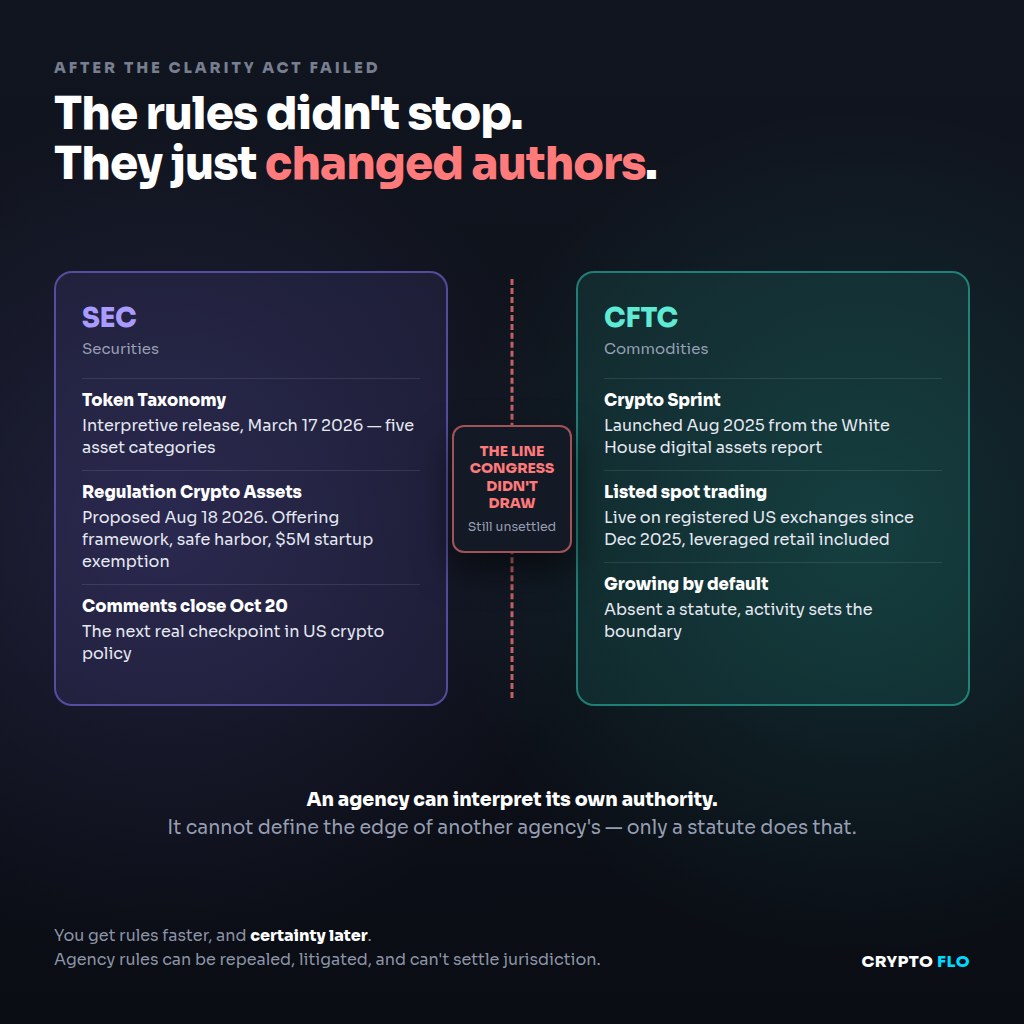
The Token Taxonomy. In an interpretive release dated March 17, 2026, the SEC set out how it views digital assets, sorting them into categories: digital commodities, digital collectibles, digital tools, payment stablecoins, and digital securities. That is the classification question — the thing everyone said only Congress could answer — being answered administratively.
Regulation Crypto Assets. On August 18, 2026, the SEC formally proposed a tailored offering framework for crypto assets. It includes new exempt offering routes, disclosure and reporting requirements, and a conditional safe harbor. Among its provisions is a startup exemption permitting offerings of up to $5 million over four years without full Securities Act registration, subject to public filings and principles-based disclosure, plus a safe harbor once an issuer has completed or permanently abandoned the managerial efforts it promised.
Critically, none of this required congressional action. It is happening under existing authority.
The date that matters now: the comment period on Regulation Crypto Assets closes October 20, 2026. That is the next real checkpoint in US crypto regulation, and it is weeks away rather than years.
The CFTC has been moving for over a year
The CFTC's work has been quieter and, in practical terms, further along.
Its Crypto Sprint initiative, launched in August 2025 to implement recommendations from the White House Digital Assets Report, set out to bring spot digital asset trading onto CFTC-registered exchanges. In September 2025 the CFTC and SEC issued a joint statement clarifying that registered exchanges were not prohibited from facilitating certain spot crypto commodity products. By December 2025, Acting Chairman Caroline Pham announced the first-ever listed spot crypto trading on US federally regulated exchanges, followed by the first leveraged spot crypto product on a CFTC-regulated venue.
The effect is that spot trading in assets the CFTC treats as commodities — Bitcoin and Ether among them — now happens inside the same regulated exchange structure that has governed commodities markets for decades, with leveraged retail trading folded into it.
So: one agency has proposed a full offering framework, and the other has already put products on regulated exchanges. "Nothing is happening" is not an accurate description of the last twelve months.
The question neither agency can answer
Here is what Congress was for, and what the agencies genuinely cannot replace.
The core problem in US crypto regulation has never been the absence of rules. It is the absence of a boundary. Which assets are securities, supervised by the SEC, and which are commodities, supervised by the CFTC? Two agencies, two statutes, two enforcement philosophies, and one unresolved line between them.
An agency can interpret its own authority. It cannot define the edge of another agency's. The SEC's Token Taxonomy is the SEC's view of what the SEC covers. It binds the SEC. It does not bind the CFTC, a court, or a future SEC.
The CLARITY Act's central purpose was to draw that line in statute, permanently, in a way nobody could relitigate. That is the thing that died on Tuesday, and no amount of rulemaking substitutes for it.
Why agency rules are weaker than a law
Three differences, and they compound.
They can be undone by whoever comes next. A rule adopted by this SEC can be amended or repealed by a future SEC through the same notice-and-comment process. A statute requires Congress to repeal it. Every crypto business planning around Regulation Crypto Assets is planning around something with a shelf life tied to an election cycle.
They can be challenged in court. Rules get litigated on whether the agency exceeded its statutory authority — an argument with real force when an agency is applying decades-old securities law to an asset class that did not exist when it was written. Courts have grown notably less deferential to agency interpretation in recent years. A statute passed by Congress is not vulnerable in the same way.
They cannot settle jurisdiction. Two agencies writing rules in parallel can produce overlap, gaps, or outright conflict, and the only forum that resolves a genuine conflict is a court, case by case, over years. This is precisely the enforcement-by-litigation regime the industry has spent years complaining about.
The blunt version: agency rulemaking gives you rules faster and certainty later. Legislation gives you certainty slower. The industry wanted both, and got the first.
What actually changes for the next two years
Some of this is better than the headlines suggest, and some is worse.
Product timelines probably pull forward, not back. With no statute imminent, firms stop waiting. Work on tokenization and new products that had been paused pending CLARITY moves into 2027 and 2028 under the existing SEC and CFTC approach, because the alternative is waiting until 2029.
The SEC's proposal becomes the main event. Regulation Crypto Assets was one track of two. It is now the track. Whatever emerges from the October 20 comment period and the final rule that follows will shape US token issuance more than any other document in play.
The CFTC's remit likely grows in practice. Spot trading of digital commodities on registered exchanges is operational and expanding. Absent a statute redrawing the line, the boundary gets set by where activity actually goes — which tends to favor the venue that already works.
Ambiguity persists at the edges. For assets that sit awkwardly between commodity and security, nothing was resolved this week. That uncertainty continues, and it continues to be settled by enforcement and litigation rather than by rule.
What to watch
- October 20, 2026 — comments close on Regulation Crypto Assets. Read the industry submissions; they signal where the final rule bends.
- The final rule's timing and content. Proposals change substantially between proposal and adoption. This one will.
- Whether the SEC and CFTC keep coordinating. The September 2025 joint statement was unusual and constructive. More of that is the best available substitute for legislation.
- Litigation. The first serious challenge to a crypto rule on statutory-authority grounds will tell you how durable any of this is.
- Leadership. Agency direction follows its chair. Nomination fights and turnover at either agency matter more now than they did when a statute looked plausible.
Frequently Asked Questions
Q: What happens to crypto regulation now that the CLARITY Act failed?
A: Regulation continues through agency rulemaking rather than legislation. The SEC has proposed Regulation Crypto Assets, a tailored offering framework requiring no congressional action, and the CFTC has already enabled listed spot crypto trading on registered exchanges through its Crypto Sprint initiative.
Q: What is Regulation Crypto Assets?
A: An SEC rule proposal from August 18, 2026 creating a securities offering framework specific to crypto assets, including exempt offering routes, disclosure requirements, a conditional safe harbor, and a startup exemption allowing up to $5 million raised over four years without full registration. Its comment period closes October 20, 2026.
Q: Can the SEC and CFTC regulate crypto without Congress?
A: Within their existing authority, yes, and both are doing so. What they cannot do is define the boundary between them. Only a statute can settle which assets fall under which agency in a way that binds both and survives a change of leadership.
Q: Are agency rules as good as a law?
A: No, and the difference matters. Rules can be repealed by a future administration through the same process that created them, can be challenged in court on whether the agency exceeded its authority, and cannot resolve jurisdictional conflicts between agencies. A statute is durable in all three respects.
Q: What is the CFTC's Crypto Sprint?
A: An initiative launched in August 2025 to implement recommendations from the White House Digital Assets Report, aimed at bringing spot digital asset trading onto CFTC-registered exchanges. It led to the first listed spot crypto trading on US regulated exchanges in December 2025.
Q: When will there be clear crypto rules in the US?
A: Partial clarity is arriving now through agency rulemaking, with the SEC's comment period closing October 20, 2026. Full clarity on the securities-versus-commodity boundary requires legislation, and with the CLARITY Act stalled, several analysts suggest the next realistic window may not open until 2029.
The Bottom Line
Tuesday was a real defeat, but not the one the headlines described. The US is not going without crypto rules for the next three years. It is getting them from two agencies working in parallel under authority they already had, on a timeline measured in months rather than years.
What it lost is permanence. Agency rules are quicker to write and quicker to unwrite, they are vulnerable to legal challenge in a way statutes are not, and they cannot draw the one line the whole fight was about. The industry will get regulation. It will not get settlement.
Practically, the next date on the calendar is October 20, when comments close on the SEC's proposal. That is now the most consequential deadline in US crypto policy, and almost nobody is talking about it.
This content was created with AI assistance and may contain errors. Regulatory situations change rapidly and proposed rules often change substantially before adoption. Always verify current status before acting. Not financial or legal advice. Always do your own research before making any investment decisions.
Frequently Asked Questions
What happens to crypto regulation now that the CLARITY Act failed?
Regulation continues through agency rulemaking rather than legislation. The SEC has proposed Regulation Crypto Assets, a tailored offering framework requiring no congressional action, and the CFTC has already enabled listed spot crypto trading on registered exchanges through its Crypto Sprint initiative.
What is Regulation Crypto Assets?
An SEC rule proposal from August 18, 2026 creating a securities offering framework specific to crypto assets, including exempt offering routes, disclosure requirements, a conditional safe harbor, and a startup exemption allowing up to $5 million raised over four years without full registration. Its comment period closes October 20, 2026.
Can the SEC and CFTC regulate crypto without Congress?
Within their existing authority, yes, and both are doing so. What they cannot do is define the boundary between them. Only a statute can settle which assets fall under which agency in a way that binds both and survives a change of leadership.
Are agency rules as good as a law?
No, and the difference matters. Rules can be repealed by a future administration through the same process that created them, can be challenged in court on whether the agency exceeded its authority, and cannot resolve jurisdictional conflicts between agencies. A statute is durable in all three respects.
What is the CFTC's Crypto Sprint?
An initiative launched in August 2025 to implement recommendations from the White House Digital Assets Report, aimed at bringing spot digital asset trading onto CFTC-registered exchanges. It led to the first listed spot crypto trading on US regulated exchanges in December 2025.
When will there be clear crypto rules in the US?
Partial clarity is arriving now through agency rulemaking, with the SEC's comment period closing October 20, 2026. Full clarity on the securities-versus-commodity boundary requires legislation, and with the CLARITY Act stalled, several analysts suggest the next realistic window may not open until 2029.
Let AI summarize these channels for you daily
Pick your favorite crypto YouTube channels and news sites. Get a 5-minute AI brief every morning.
Choose Your Sources