Why XRP's Market Cap Isn't the Ceiling People Think It Is
In This Article
Introduction
The most common objection to XRP has nothing to do with the technology. It goes like this: "the market cap is already too big — it can't realistically go much higher."
Sometimes it is dressed up with comparisons. XRP at $10 would be worth more than some of the largest companies on earth. XRP at $50 would exceed the entire crypto market. Therefore, the argument concludes, it cannot happen.
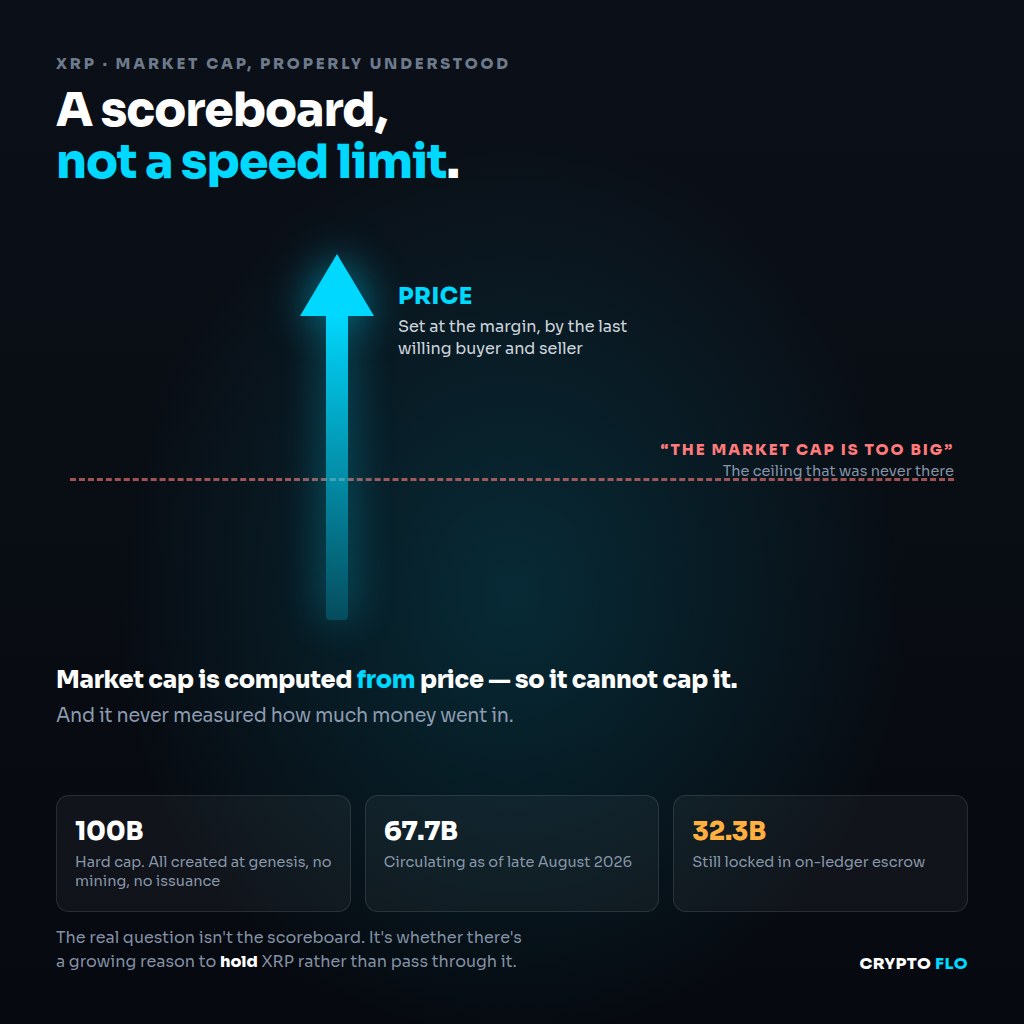
That argument sounds like arithmetic. It is not. It rests on a misunderstanding of what market capitalisation actually measures, and once you see the mistake, the objection stops being a ceiling and becomes what it always was — a scoreboard reading.
Market cap is an output of price. It is not a constraint on it. Figures below use a live price of $1.29 on 16 September 2026; the reasoning matters more than the snapshot.
What market cap actually is
One multiplication:
price × supply
That is the whole thing. It is not money invested. It is not money raised. It is not money you could withdraw. It is the last traded price applied to every unit in existence — including all the units nobody is selling, and the ones nobody can.
The crucial consequence: market cap does not measure inflows. When an asset's market cap rises by a billion dollars, a billion dollars did not arrive. The last trade might have been a few thousand dollars, and that new price gets multiplied across tens of billions of units.
This is why "it would take trillions of dollars to move XRP to $X" is not a real objection. The relationship between capital entering an asset and its resulting market cap is not one-to-one, and in thin, supply-constrained markets it is nowhere close. Market cap is downstream of price. Price is set at the margin, by the last willing buyer and seller.
Why the comparisons don't work
"XRP at $10 would be worth more than [large company]" is the most repeated version, and it is a category error.
A company's market cap is a claim on future earnings. It is anchored to cash flows, and you can argue about whether the multiple is sensible. A monetary or settlement asset has no earnings to anchor to. Its value comes from demand to hold it — for liquidity, for settlement, for savings, for speculation.
Comparing the two is like comparing the value of all the gold in the world to a technology company's share price and concluding one of them must be wrong. They are priced by different mechanisms entirely. Gold's valuation is not restrained by the fact that it exceeds any single company, because nothing about that comparison is binding.
The same applies to the "bigger than all of crypto" framing. Crypto's total market cap is itself just the sum of a lot of price × supply calculations. It is not a fixed pool of money that assets compete over. It is a scoreboard that grows when prices grow.
XRP's actual supply picture
Worth having the real numbers rather than vibes.
XRP's maximum supply is hard-capped at 100 billion, all created at genesis. There is no mining and no ongoing issuance — unusual among major assets, and it means supply can only ever shrink slightly, since small amounts are burned as transaction fees.
Of that:
- Roughly 67.7 billion is in circulation as of late August 2026
- Roughly 32.3 billion remains locked in on-ledger escrow
At $1.29 that is about $87.6 billion on circulating supply, or about $129.4 billion on total supply. A $42 billion difference between two equally defensible descriptions of the same asset on the same day — which is a decent illustration of how soft this number is. Two reputable sites can quote you meaningfully different XRP market caps and both be telling the truth.
The escrow matters for a reason people usually miss. Ripple originally locked 55 billion XRP into time-released contracts, with 1 billion unlocking monthly and most of it historically returned to new escrow. The net addition to circulating supply has tended to run around 200 to 300 million tokens a month.
That is a supply overhang, and it is fair to treat it as one. But it also means the genuinely tradeable float is constrained and known. A demand shock does not meet 100 billion tokens. It meets whatever is actually liquid and for sale at the time, which is a far smaller number than any market cap figure implies.
Throughput is not capped by market cap either
The second place the objection fails is on usage.
If XRP functions as a bridge asset — currency A into XRP, move, XRP into currency B — the same tokens are reused continuously. One token can settle many transactions a day. Annual settlement volume can therefore be an enormous multiple of the value of the tokens doing the work.
This is velocity, and it is why "XRP would need a $5 trillion market cap to settle $5 trillion in payments" is simply wrong. It would not. Every currency works this way: the dollars in circulation are a small fraction of annual dollar-denominated transaction volume.
So market cap does not limit how much value XRP can move, and it does not limit what price it can reach. Two separate objections, both dissolved by understanding one metric properly.
What would actually have to happen
Removing a false ceiling is not the same as demonstrating an outcome, and it is worth being straight about that.
Price rises when demand to hold rises against available float. For XRP, the candidates are real and identifiable:
- Liquidity provider inventory. Institutions running settlement corridors need working balances. Corridors that scale require deeper inventory, and that inventory has to be held rather than passed through.
- Institutional and ETF custody. Products that hold the asset on behalf of investors remove float from the tradeable pool entirely, which is the mechanism that has repriced other major assets.
- Regulatory position. For XRP more than most assets, this has historically driven more price action than any usage metric.
- Constrained float meeting new demand. With a fixed cap, no issuance, and a third of supply escrowed, incremental demand meets a smaller effective supply than headline numbers suggest.
That is the honest shape of the argument: not "market cap doesn't matter so the price can be anything," but "market cap is not the binding constraint, and here is what the actual constraint is." The actual constraint is holding demand against float — a question with real, watchable answers rather than an arithmetic dead end.
What to watch instead of market cap
- Order book depth — how much can be bought or sold before price moves materially. The real liquidity picture.
- Float versus locked supply — the monthly escrow release and how much is re-escrowed.
- Custody and product flows — assets moving into vehicles that hold rather than trade.
- Corridor volume that requires inventory — settlement usage where participants must keep balances, not just pass through.
Our guide to XRP versus XLM covers what each network is actually built to do, which sits underneath all of this.
Frequently Asked Questions
Q: Does market cap limit how high XRP's price can go?
A: No. Market cap is calculated from price, not the other way around, so it cannot act as a ceiling. It rises when price rises. The real constraint on price is demand to hold the asset relative to the supply actually available to buy.
Q: Would XRP at a high price be worth more than major companies, and does that matter?
A: The comparison is a category error. A company's market cap is a claim on future earnings; a monetary or settlement asset's is simply price times units, driven by demand to hold it. The two are priced by different mechanisms, so one exceeding the other proves nothing.
Q: Does it take billions of dollars of inflows to raise XRP's market cap by billions?
A: No. Market cap does not measure money invested. Price is set at the margin by the most recent trade, and that price is then applied across the entire supply, so market cap can move by far more than the capital that moved it.
Q: How much XRP is in escrow, and why does it matter?
A: Roughly 32.3 billion XRP remained in on-ledger escrow as of late August 2026, from the 55 billion originally locked. One billion releases monthly with most historically re-escrowed, netting roughly 200 to 300 million added per month. It means the genuinely tradeable float is much smaller than total supply.
Q: Why do different websites show different XRP market caps?
A: Because they treat escrowed tokens differently. Using circulating supply of about 67.7 billion gives roughly $87.6 billion at $1.29; using the full 100 billion gives about $129.4 billion. Both are quoted, and the gap is about $42 billion.
Q: Does high transaction volume automatically raise XRP's price?
A: Not by itself. Volume reflects demand to move through an asset; price reflects demand to hold it. Usage supports price when it creates a reason to keep balances — such as liquidity providers holding inventory for settlement corridors.
The Bottom Line
Market cap is a scoreboard, not a speed limit. It is computed from price, it does not measure money invested, and comparing it across asset classes that are priced by entirely different mechanisms proves nothing at all.
So the objection that XRP "can't go up because its market cap is already too big" does not survive contact with what the number actually is. Neither does the related claim that settlement volume is capped by it — velocity means a modest float can move many multiples of its own value.
What remains is a much better question, and the one worth your attention: is there a growing reason to hold XRP rather than pass through it? With a hard-capped supply, no issuance, a third of it escrowed, and a float far smaller than headline numbers suggest, demand meeting that float is where price actually comes from.
That is a real debate with real evidence on both sides. Market cap was never part of it.
This content was created with AI assistance and may contain errors. Prices and supply figures move constantly — those quoted here are a snapshot from 16 September 2026 and should be verified before use. Nothing here is a price prediction. Not financial advice. Always do your own research before making any investment decisions.
Frequently Asked Questions
Does market cap limit how high XRP's price can go?
No. Market cap is calculated from price, not the other way around, so it cannot act as a ceiling. It rises when price rises. The real constraint on price is demand to hold the asset relative to the supply actually available to buy.
Would XRP at a high price be worth more than major companies, and does that matter?
The comparison is a category error. A company's market cap is a claim on future earnings; a monetary or settlement asset's is simply price times units, driven by demand to hold it. The two are priced by different mechanisms, so one exceeding the other proves nothing.
Does it take billions of dollars of inflows to raise XRP's market cap by billions?
No. Market cap does not measure money invested. Price is set at the margin by the most recent trade, and that price is then applied across the entire supply, so market cap can move by far more than the capital that moved it.
How much XRP is in escrow, and why does it matter?
Roughly 32.3 billion XRP remained in on-ledger escrow as of late August 2026, from the 55 billion originally locked. One billion releases monthly with most historically re-escrowed, netting roughly 200 to 300 million added per month. It means the genuinely tradeable float is much smaller than total supply.
Why do different websites show different XRP market caps?
Because they treat escrowed tokens differently. Using circulating supply of about 67.7 billion gives roughly $87.6 billion at $1.29; using the full 100 billion gives about $129.4 billion. Both are quoted, and the gap is about $42 billion.
Does high transaction volume automatically raise XRP's price?
Not by itself. Volume reflects demand to move through an asset; price reflects demand to hold it. Usage supports price when it creates a reason to keep balances, such as liquidity providers holding inventory for settlement corridors.
Get daily intelligence on the coins you track
Personalized AI briefings built from the sources you choose. Starting at $5.99/month.
Start with Crypto Flo