Crypto Off-Ramps: How to Actually Cash Out Without Surprises
In This Article
Introduction
Getting into crypto is a solved problem. Half the apps on your phone will sell you Bitcoin in about ninety seconds.
Getting out is where people discover the friction. The route back to ordinary money — the off-ramp — is slower, more expensive, and more likely to go wrong than the way in, and almost nobody researches it until the moment they need it. That is exactly the wrong time to learn how it works.
This is a practical guide to converting crypto into spendable currency: the routes available, what each one actually costs, why banks sometimes block the transfer, and the mistakes that turn a simple withdrawal into a genuine problem.
What an off-ramp actually is
An off-ramp is any service that converts cryptocurrency into fiat currency — dollars, euros, pounds — and delivers it somewhere you can spend it.
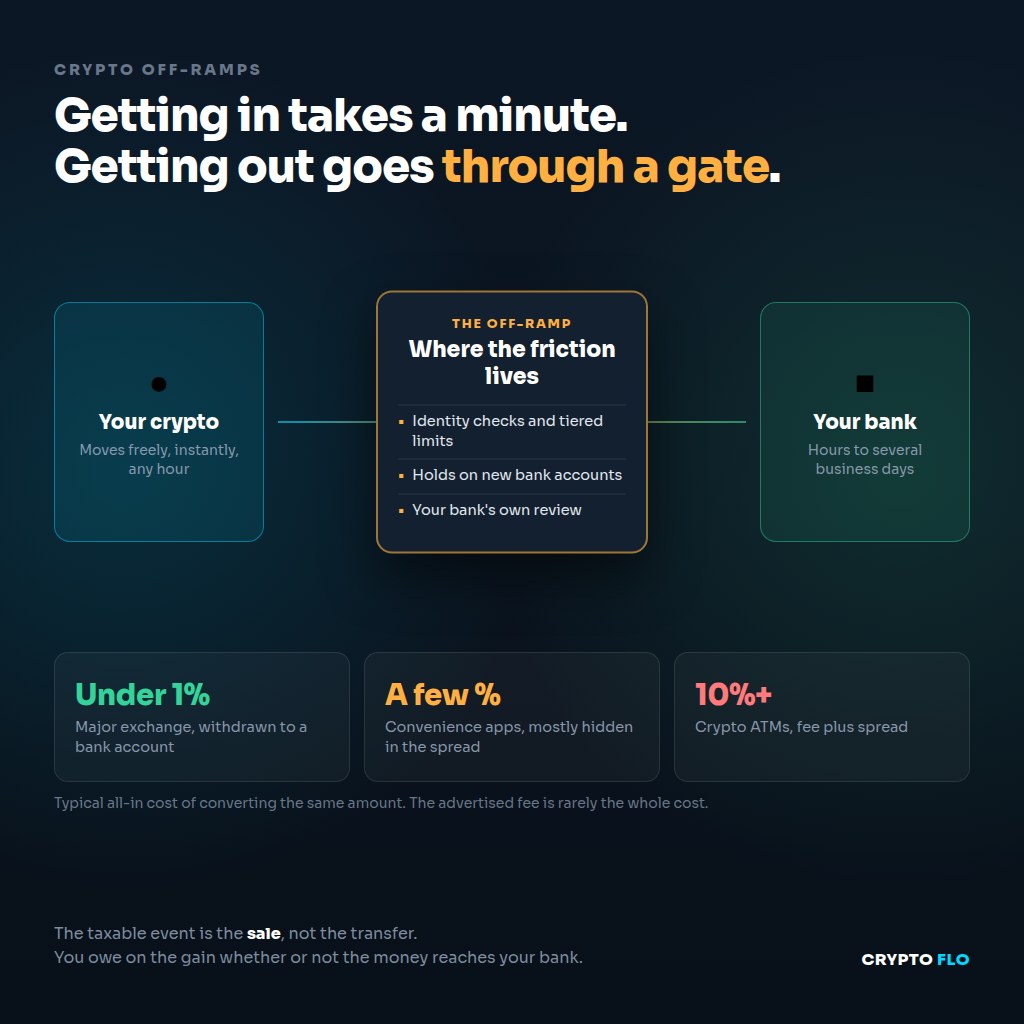
The word matters because it names a specific bottleneck. Crypto moves between wallets freely and instantly. The moment you want that value inside the traditional banking system, you pass through a regulated gateway that must know who you are, report certain transactions, and satisfy its own banking partners. That gateway is the off-ramp, and nearly every difficulty people hit is a property of the gateway rather than of crypto.
The main routes out
1. A centralized exchange. Sell on the exchange, withdraw dollars to your linked bank account. This is the default and usually the cheapest for meaningful amounts. Expect identity verification, a withdrawal method (ACH, wire, or SEPA), and a settlement delay of anywhere from a few hours to several business days.
2. A brokerage or payment app. PayPal, Cash App, Revolut and similar let you sell crypto directly into a balance you already spend from. Enormously convenient, and typically the most expensive per dollar, because the cost is buried in the price rather than shown as a fee.
3. A crypto debit card. Spends your balance at the point of sale, converting at transaction time. Good for incidental spending, poor for converting a large position. Note that every swipe is a disposal for tax purposes, which makes bookkeeping tedious in proportion to how much you use it.
4. Peer-to-peer. You sell directly to another person, usually through a platform holding the crypto in escrow until they confirm payment. Useful where banking access is limited, and it carries by far the highest fraud risk of anything on this list. Never release funds outside an escrow, and treat a buyer who wants to move the conversation off-platform as a scammer, because they almost always are.
5. A crypto ATM. Fast, physical, and expensive. Fees in the high single digits to mid teens as a percentage are common, plus a spread. Reasonable for small amounts in a hurry; a poor way to move real money.
What it actually costs
The advertised fee is rarely the whole cost, and the gap between "the price I saw" and "what landed in my bank" surprises people constantly. Four things come out:
- The spread. The difference between the real market price and the price you are quoted. This is the largest hidden cost on consumer apps and is frequently invisible, because it is baked into the number you are shown rather than itemized.
- The trading fee. Usually a stated percentage. On major exchanges this is often the smallest component.
- The withdrawal fee. A flat charge for moving fiat out. Wires cost more than ACH and arrive sooner.
- The network fee. Paid if you first move crypto from your own wallet to the exchange.
A rough sense of scale: a major exchange might cost you well under 1% all-in on a large sale, while a convenience app can cost several percent once the spread is counted. On small amounts that difference is trivial. On a five-figure sale it is the price of a holiday.
How to see the real number: check the live market price on an independent source, then look at the total fiat the platform says you will receive. The difference is your true cost. Do that before you confirm, not after.
Why your bank might block it
This is the failure mode people are least prepared for, and it has nothing to do with whether crypto is legal.
Banks apply their own risk policies to incoming funds. A transfer from a crypto exchange can be flagged, delayed, held for manual review, or occasionally rejected — especially if it is large relative to your normal activity, if it is your first such transfer, or if the receiving institution has a conservative policy toward digital assets.
Practical steps that genuinely reduce friction:
- Tell your bank before a large transfer. A thirty-second call naming the amount and the source pre-empts most holds. This sounds excessive and it is remarkably effective.
- Do a small test transfer first. Move a token amount, confirm it lands, then send the rest. The delay is worth it.
- Keep the paper trail. Exchange statements showing purchase and sale history answer the question a compliance officer will eventually ask.
- Use a bank that is comfortable with this. If yours has frozen a transfer before, it will again. Some institutions are simply easier to work with here.
Limits, timing, and the thing about new accounts
Two mechanical details worth knowing in advance:
Withdrawal limits are per-account and often tiered by verification level. A newly verified account may have a daily fiat limit well below what you intend to move. Raising a tier can take days.
New payment methods have holds. Many platforms impose a waiting period on a newly added bank account before you can withdraw to it, as fraud protection. If you plan to cash out on a particular date, add and verify the destination account well ahead, not on the day.
Neither is a problem if you know about them a week early. Both are a serious problem if you find out the morning you need the money.
The tax part, briefly
Selling crypto for fiat is a disposal, which means it is a taxable event and you will owe on any gain. That is true whether the proceeds sit on the exchange or reach your bank — the tax is triggered by the sale, not by the withdrawal.
Two things follow from that. First, set aside a portion of the proceeds rather than spending all of it, because the bill arrives later. Second, keep the records now, while they are easy to export.
Our guide to what actually triggers a crypto tax bill covers the full picture, including the events people wrongly assume are safe. And as always on this subject: a CPA or tax professional who has handled crypto clients is worth their fee, particularly on a large cash-out.
A sane sequence for a large cash-out
If you are moving a meaningful sum, doing it in this order removes most of the ways it goes wrong:
1. Confirm the destination account is added, verified, and past any holding period. Do this first, days ahead.
2. Check your withdrawal tier covers the amount, and raise it early if not.
3. Compare the real all-in cost on two platforms, spread included, not just headline fees.
4. Send a small test transaction end to end and confirm it arrives.
5. Notify your bank if the amount is unusual for your account.
6. Sell, withdraw, and export your transaction history the same day, while it is in front of you.
7. Set aside the estimated tax before you treat the rest as spendable.
A note on where we fit
Crypto Flo does not custody funds, execute trades, or move money. It delivers a daily briefing on the coins you follow, built from sources you select from our vetted library — so nothing here is a product pitch. It is simply the sort of thing worth understanding before you need it, which is the same reason we write about scams and taxes.
Frequently Asked Questions
Q: What is a crypto off-ramp?
A: Any service that converts cryptocurrency into fiat currency and delivers it somewhere you can spend it, such as a bank account or a card balance. Centralized exchanges, payment apps, crypto debit cards, peer-to-peer platforms and crypto ATMs are all off-ramps.
Q: What is the cheapest way to cash out crypto?
A: For meaningful amounts, a major centralized exchange with a bank withdrawal is usually cheapest, often well under 1% all-in. Convenience apps and crypto ATMs cost considerably more, mostly through spread rather than stated fees.
Q: How long does it take to get money from crypto into my bank?
A: Typically a few hours to several business days, depending on the platform and the withdrawal method. Wires are faster and cost more than ACH. New accounts and newly added bank details often face additional holding periods.
Q: Why did my bank block my crypto withdrawal?
A: Banks apply their own risk policies to incoming transfers from exchanges, and may flag or hold one that is large relative to your usual activity or is your first. Calling ahead, sending a small test transfer first, and keeping exchange statements all reduce the chance of a hold.
Q: Do I pay tax when I cash out crypto?
A: Yes, on any gain. The taxable event is the sale itself, not the bank transfer, so the liability exists whether or not you withdraw the proceeds. Set money aside for it and consult a qualified tax professional about your situation.
Q: Are crypto ATMs a good way to cash out?
A: Only for small amounts where speed matters more than cost. Fees are commonly in the high single digits to mid teens as a percentage, plus a spread, which makes them one of the most expensive routes available.
Q: Is peer-to-peer selling safe?
A: It carries the highest fraud risk of the common routes. If you use it, stay inside the platform's escrow, never release funds before payment has genuinely cleared, and treat any attempt to move the conversation off-platform as a scam.
The Bottom Line
The way out of crypto is slower and more expensive than the way in, and that asymmetry is a feature of the banking gateway rather than a temporary inconvenience. It is entirely manageable, but only if you find out about limits, holds and bank policies before the day you need the money rather than during it.
Two habits cover most of it. Compare the total fiat you will actually receive rather than the advertised fee, because the spread is where the real cost hides. And run the whole path once with a small amount before you run it with a large one.
This content was created with AI assistance and may contain errors. Fees, limits and availability vary by platform and jurisdiction and change often, so always verify current terms directly with the provider before acting. This is educational information only and is not financial, tax or legal advice. Consult a qualified professional about your specific situation.
Frequently Asked Questions
What is a crypto off-ramp?
Any service that converts cryptocurrency into fiat currency and delivers it somewhere you can spend it, such as a bank account or a card balance. Centralized exchanges, payment apps, crypto debit cards, peer-to-peer platforms and crypto ATMs are all off-ramps.
What is the cheapest way to cash out crypto?
For meaningful amounts, a major centralized exchange with a bank withdrawal is usually cheapest, often well under 1% all-in. Convenience apps and crypto ATMs cost considerably more, mostly through spread rather than stated fees.
How long does it take to get money from crypto into my bank?
Typically a few hours to several business days, depending on the platform and the withdrawal method. Wires are faster and cost more than ACH. New accounts and newly added bank details often face additional holding periods.
Why did my bank block my crypto withdrawal?
Banks apply their own risk policies to incoming transfers from exchanges, and may flag or hold one that is large relative to your usual activity or is your first. Calling ahead, sending a small test transfer first, and keeping exchange statements all reduce the chance of a hold.
Do I pay tax when I cash out crypto?
Yes, on any gain. The taxable event is the sale itself, not the bank transfer, so the liability exists whether or not you withdraw the proceeds. Set money aside for it and consult a qualified tax professional about your situation.
Are crypto ATMs a good way to cash out?
Only for small amounts where speed matters more than cost. Fees are commonly in the high single digits to mid teens as a percentage, plus a spread, which makes them one of the most expensive routes available.
Is peer-to-peer selling safe?
It carries the highest fraud risk of the common routes. If you use it, stay inside the platform's escrow, never release funds before payment has genuinely cleared, and treat any attempt to move the conversation off-platform as a scam.
Get daily intelligence on the coins you track
Personalized AI briefings built from the sources you choose. Starting at $5.99/month.
Start with Crypto Flo