The Rally Got the Headlines. The Plumbing Got Rebuilt.
In This Article
Introduction
Bitcoin opened Tuesday at $86,597.82, about 6.7% above Monday's open, easing back toward $86,000 through the morning. Ether opened at $2,775.96, up roughly 5%, its highest level since January.
That is the story everyone covered.
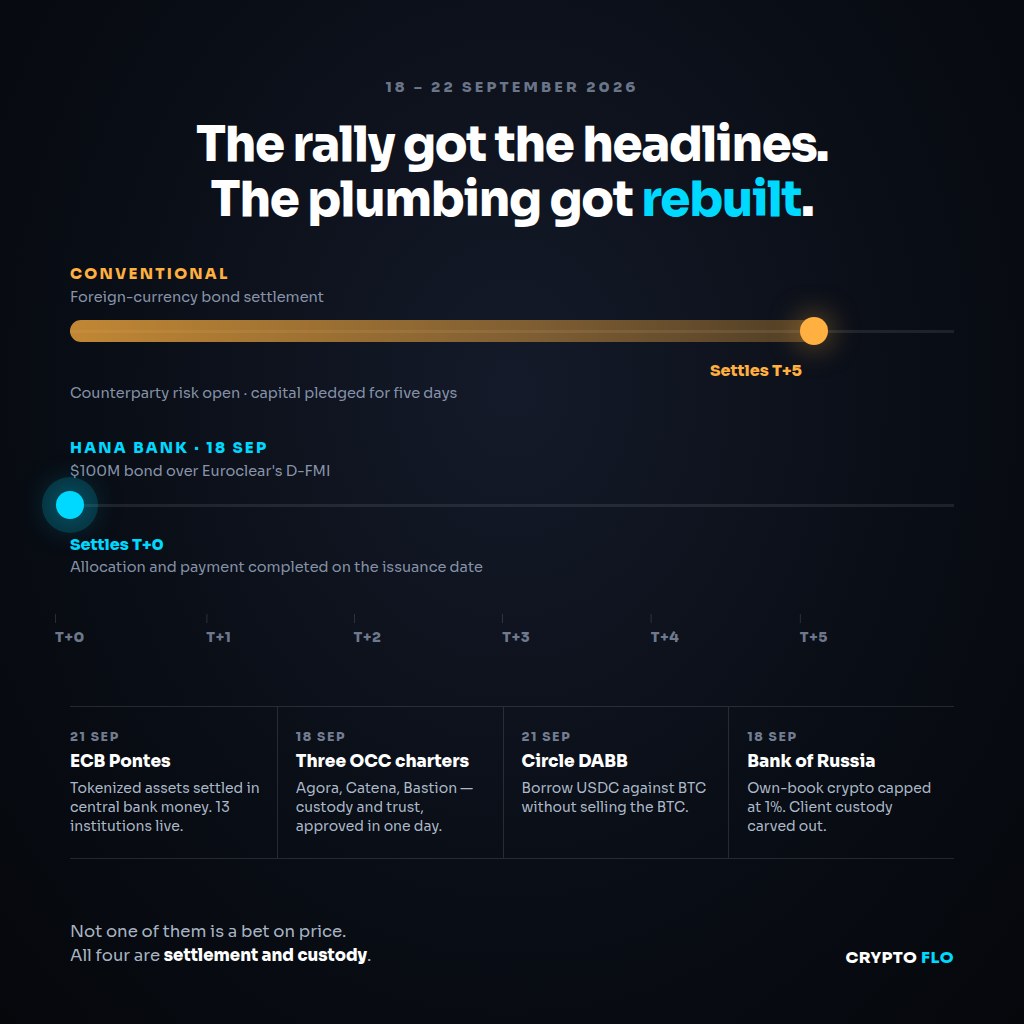
In the same five days, four separate institutions did something considerably less exciting and considerably more consequential: the European Central Bank switched on a settlement platform, a Korean bank settled a $100 million bond in a single day, the US comptroller of the currency approved three federally chartered trust banks at once, and Circle started lending against Bitcoin without selling it.
None of those is a bet on price. All of them are plumbing. And when you line them up next to a draft rule published in Moscow the same week, they turn out to be telling one coherent story — one that is genuinely more useful than the candles.
What actually happened
Monday, 21 September — the ECB turned on Pontes. The platform links distributed-ledger systems to the Eurosystem's TARGET Services, letting banks settle tokenized-asset transactions in central bank money. Thirteen institutions were onboarded at launch, Deutsche Bank and Santander among them. The ECB also said it has begun preparatory work to invest a small portion of its own funds in tokenized securities settled through Pontes, starting with euro-denominated paper from euro-area governments, agencies and European supranationals.
Friday, 18 September — Hana Bank issued a $100 million digital bond. The five-year foreign-currency bond went out over Euroclear's Digital Financial Market Infrastructure, with Standard Chartered as sole lead manager. Allocations and payments completed on the issuance date. Conventional foreign-currency bond transactions typically take three to five business days. It was the first time a Korean financial institution used an international central securities depository's blockchain infrastructure directly.
Friday, 18 September — the OCC approved three trust banks in one day. Agora received preliminary conditional approval for a federally chartered national trust bank covering stablecoin issuance, custody and transaction services. Catena Trust Bank received its own approval, and Bastion Platforms Trust Company was cleared to convert into a national bank.
Monday, 21 September — Circle launched Digital Asset-Backed Borrowing. Institutional Circle Mint clients can deposit BTC, mint cirBTC, post it as collateral in a supported lending market, and receive USDC straight into their Circle Mint balance — without selling the Bitcoin. It went live on Arc and Ethereum with Morpho as the first integrated protocol.
The thing they have in common
Not one of these is a directional bet.
The ECB is not buying Bitcoin. Hana Bank did not add crypto to its balance sheet — it issued an ordinary dollar bond that happened to settle on a distributed ledger. The OCC did not approve banks that speculate; it approved trust banks, which custody assets for other people. And Circle built a facility whose entire selling point is that the borrower keeps their Bitcoin.
Every one of them is about settlement and custody. The boring layer.
This matters because it is not the adoption story the market keeps waiting for. The anticipated version is "institutions buy the asset," measured in ETF inflows. We [pointed out yesterday](https://cryptoflo.news/blog/why-crypto-market-up-september-2026) that this rally ran without that bid — spot Bitcoin ETFs took in about $6.21 million for the week ending 19 September, effectively nothing.
The resolution may simply be that institutions were busy with something else. Not buying the asset. Rebuilding the pipes it moves through.
Why T+0 is the actual product
The Hana bond is the clearest window into why a bank would bother, so it is worth sitting with.
In a T+5 world, a bond trades on Monday and settles on Friday. For those five days, both sides carry counterparty risk — the possibility the other side fails before delivery — and capital has to be held against the unsettled trade. Multiply that across every unsettled position on a bank's book and the number stops being trivial.
Compress settlement to T+0 and both problems disappear at once. The risk window closes. The capital held against it is freed.
That is a balance-sheet improvement, available immediately, with no view on any token's price. It is the sort of thing a treasurer can put in a memo and defend.
The design detail that makes it plausible at scale is easy to miss: Euroclear's D-FMI is wired into its conventional settlement network. Institutional investors bought and can trade the bond through their existing Euroclear accounts. Nobody had to install anything, open a crypto account, or learn a new system.
Adoption that requires no adoption is the kind that actually happens.
Two regulators, opposite sides, same line
Here is the part that turns four news items into an argument.
On 18 September, the Bank of Russia published a draft rule capping commercial banks' crypto exposure at 1% of their own capital, through two new ratios — N31 for individual banks, N32 for consolidated groups. It covers direct investments, crypto-linked derivatives and loans secured by crypto. Holdings on a bank's own account, and client positions where the bank bears the liability, get a 1250% risk weight.
That number sounds arbitrary and is not. Under standard bank capital rules, a 1250% risk weight paired with an 8% minimum capital ratio means the bank must hold capital roughly equal to the entire exposure. A dollar of crypto costs a dollar of capital. It is a permission written to be almost never used.
But read the carve-out. Client positions where the bank does not bear that liability are excluded from the caps entirely and carry a 50% risk weight.
So Russia's rule says: hold crypto risk on your own book, and it will cost you everything. Custody it for clients, and it is ordinary business.
Now look back at Washington. The OCC did not charter banks to trade digital assets. It chartered trust banks — institutions whose function is custody and fiduciary service, holding assets that belong to somebody else.
Two regulators, on opposite sides of about as wide a geopolitical gap as exists, arrived in the same week at the same line: institutions may operate the rails. They may not take the risk.
That is a far more informative signal about where this is heading than any price level, and almost nobody wrote it up, because it only appears when you put the week's boring stories next to each other.
What this does not mean
Worth being straight about the limits, because the enthusiastic version of this article would overstate all of it.
- Pontes launched deliberately small. A limited set of services, thirteen institutions, restricted operating hours. Full implementation is expected by 2028. This is the beginning of a build-out, not a finished system.
- The OCC approvals are conditional and reversible. Agora's final authorization requires at least $10 million in Tier 1 capital and an OCC examination before it can open. If the capital is not raised within 12 months, or it does not open within 18, the approval expires. A preliminary conditional approval is a permission to try, not a bank.
- One bond is one bond. Hana's $100 million issuance proves T+0 works over Euroclear's rails. It does not prove the market migrates. Ask again after a dozen issuers.
- Circle's facility carries real risk. The loans are overcollateralized, and rates, collateral requirements and liquidation thresholds are set by the lending market — Morpho, initially — not by Circle. Borrowing against a volatile asset means a price drop can trigger liquidation of the collateral you borrowed specifically in order to keep.
- The direction is not uniformly positive. Russia's rule is a restriction. It happens to be a coherent restriction that points the same way, but nobody in Moscow was trying to be encouraging.
How to follow the story that isn't the price
Infrastructure news is systematically under-covered, for an obvious reason: it produces no chart. A settlement platform going live generates one paragraph; a 6% candle generates a hundred articles.
If you want to track it, these are the signals that actually carry information:
- Settlement times. T+2, T+1, T+0. When an asset class compresses, capital is freed and someone has a reason to act.
- Charters and licences, not partnerships. A press release about a "strategic partnership" costs nothing. A federal charter requires capital, an examination and ongoing supervision.
- Who bears the liability. The single most revealing question in any institutional crypto announcement. Custody for clients and proprietary risk are completely different activities that press releases work hard to blur.
- Central bank money versus commercial bank money. Whether a settlement system touches central bank money is the difference between a pilot and market infrastructure.
- Whether existing accounts work unchanged. The Euroclear detail. Infrastructure that requires no migration gets adopted; infrastructure that requires migration gets a pilot and a white paper.
None of those requires a subscription to anything. They require noticing the paragraph that ran below the price story — which is precisely the thing a headline-ranked feed is worst at surfacing, and the reason we think choosing your own sources beats being fed the loudest ones.
Frequently Asked Questions
Q: What is the ECB's Pontes platform?
A: It connects distributed-ledger platforms to the Eurosystem's TARGET Services so banks can settle tokenized-asset transactions in central bank money. It went live on 21 September 2026 with thirteen institutions including Deutsche Bank and Santander, with a limited service set and full implementation expected by 2028.
Q: What does T+0 settlement mean and why does it matter?
A: It means a trade settles the same day it is executed, rather than the conventional three to five business days for foreign-currency bonds. During the gap both sides carry counterparty risk and must hold capital against the unsettled trade, so compressing it to zero closes the risk window and frees that capital — a balance-sheet benefit independent of any token's price.
Q: What is a national trust bank, and why did three get approved at once?
A: A trust bank holds and administers assets on behalf of clients rather than taking positions for itself, under direct federal supervision. The OCC granted approvals to Agora, Catena and Bastion on 18 September 2026, which signals that US regulators are comfortable with custody and infrastructure roles specifically.
Q: Does Russia's 1% cap ban banks from crypto?
A: Not quite, but close in effect for proprietary exposure. Own-account holdings carry a 1250% risk weight, which under standard capital rules means holding capital roughly equal to the whole exposure. Client positions where the bank does not bear the liability are excluded from the caps and carry a 50% weight, so custody remains ordinary business.
Q: What is Circle's Digital Asset-Backed Borrowing?
A: Institutional Circle Mint clients deposit BTC, mint cirBTC, post it as collateral in a supported lending market and borrow USDC into their Circle Mint balance without selling the Bitcoin. It launched 21 September 2026 on Arc and Ethereum with Morpho first; loans are overcollateralized and terms are set by the lending market rather than by Circle.
Q: Does institutional infrastructure news move the price?
A: Rarely and not immediately. These are multi-year build-outs — Pontes alone runs to 2028 — and they change what institutions are able to do rather than what they currently hold. They are better understood as evidence about direction than as a catalyst.
Q: Why does so little of this show up in crypto news feeds?
A: Because it produces no chart and no conflict. A settlement platform going live is one paragraph; a 6% move is a hundred articles. Feeds ranked by engagement systematically under-surface the slow structural story in favour of the fast price story.
The Bottom Line
The rally is real and the numbers are the numbers: Bitcoin near $86,600, Ether above $2,775, both at levels last seen in January.
But the more durable news of the week was the ECB settling tokenized assets in central bank money, a $100 million bond clearing in a day instead of five, three federal trust charters approved in a single session, and an institutional facility for borrowing against Bitcoin without selling it.
Lay those beside Russia's draft rule and a line appears that both Washington and Moscow drew in the same week: institutions can run the infrastructure, but not carry the risk.
That is not a price prediction and it will not resolve this quarter. It is a better description of where this is actually going than anything on a chart — and you would not have found it by reading the biggest headline of the day.
This content was created with AI assistance and may contain errors. Prices and market data move constantly — figures here are a snapshot from 22 September 2026 and should be verified before use. Regulatory details are summarised from published reporting and should be checked against the primary filings before being relied on. Nothing here is a prediction or a recommendation. Not financial advice. Always do your own research before making any investment decisions.
Frequently Asked Questions
What is the ECB's Pontes platform?
It connects distributed-ledger platforms to the Eurosystem's TARGET Services so banks can settle tokenized-asset transactions in central bank money. It went live on 21 September 2026 with thirteen institutions including Deutsche Bank and Santander, with a limited service set and full implementation expected by 2028.
What does T+0 settlement mean and why does it matter?
It means a trade settles the same day it is executed, rather than the conventional three to five business days for foreign-currency bonds. During the gap both sides carry counterparty risk and must hold capital against the unsettled trade, so compressing it to zero closes the risk window and frees that capital — a balance-sheet benefit independent of any token's price.
What is a national trust bank, and why did three get approved at once?
A trust bank holds and administers assets on behalf of clients rather than taking positions for itself, under direct federal supervision. The OCC granted approvals to Agora, Catena and Bastion on 18 September 2026, which signals that US regulators are comfortable with custody and infrastructure roles specifically.
Does Russia's 1% cap ban banks from crypto?
Not quite, but close in effect for proprietary exposure. Own-account holdings carry a 1250% risk weight, which under standard capital rules means holding capital roughly equal to the whole exposure. Client positions where the bank does not bear the liability are excluded from the caps and carry a 50% weight, so custody remains ordinary business.
What is Circle's Digital Asset-Backed Borrowing?
Institutional Circle Mint clients deposit BTC, mint cirBTC, post it as collateral in a supported lending market and borrow USDC into their Circle Mint balance without selling the Bitcoin. It launched 21 September 2026 on Arc and Ethereum with Morpho first; loans are overcollateralized and terms are set by the lending market rather than by Circle.
Does institutional infrastructure news move the price?
Rarely and not immediately. These are multi-year build-outs — Pontes alone runs to 2028 — and they change what institutions are able to do rather than what they currently hold. They are better understood as evidence about direction than as a catalyst.
Why does so little of this show up in crypto news feeds?
Because it produces no chart and no conflict. A settlement platform going live is one paragraph; a 6% move is a hundred articles. Feeds ranked by engagement systematically under-surface the slow structural story in favour of the fast price story.
Let AI summarize these channels for you daily
Pick your favorite crypto YouTube channels and news sites. Get a 5-minute AI brief every morning.
Choose Your Sources