XRP's Trend, the $1.50 Ceiling, and What Big Names Actually Said
In This Article
Introduction
XRP is trading around $1.4957, up about 6.1% on the day after opening at $1.4100 and touching $1.5099 — its highest print in almost four weeks.
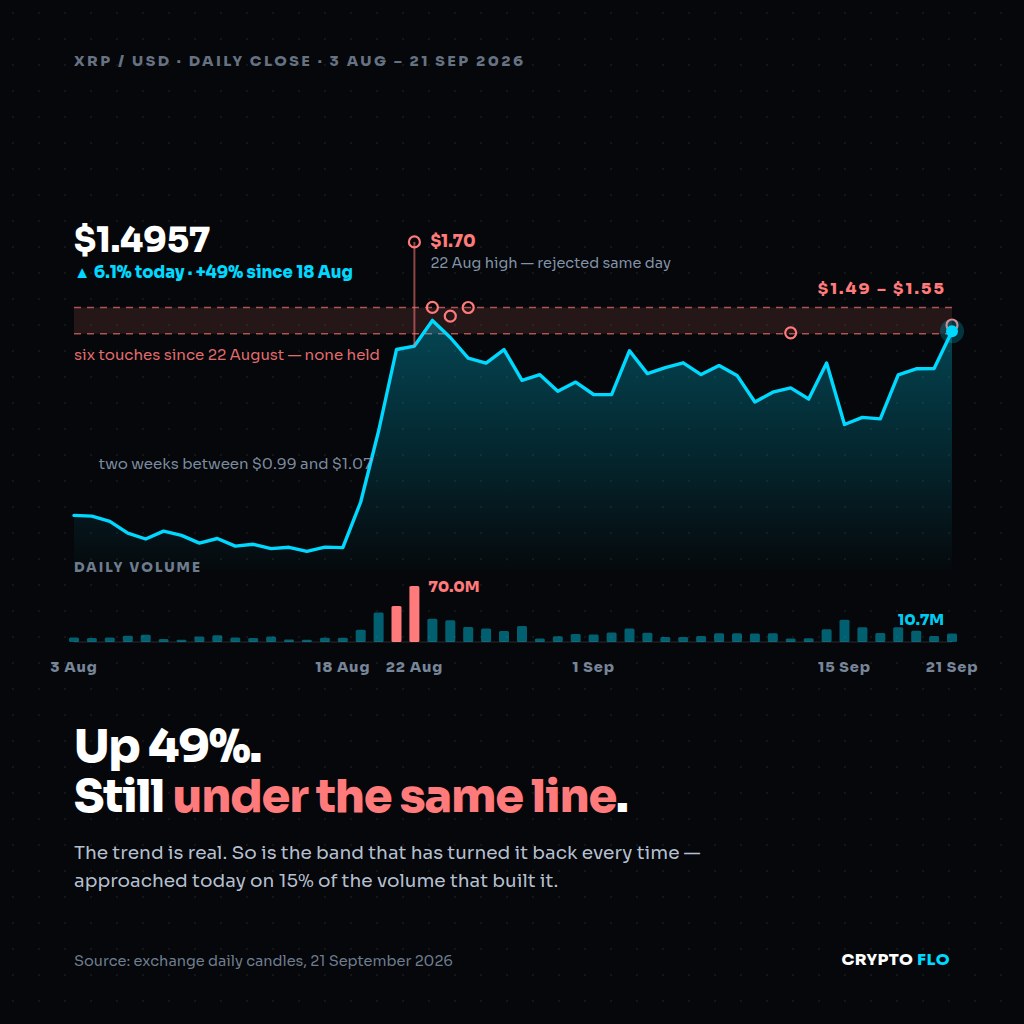
Zoom out and the move is bigger than one day. XRP is up roughly 15.5% in four sessions and about 49% since mid-August, when it spent two solid weeks doing essentially nothing between $0.99 and $1.08.
That is a real trend, and it is worth understanding properly — including the level it keeps failing at, the flow data underneath it, and what prominent names have actually said about XRP, as opposed to what has been published under their names.
All price figures here are taken live from exchange data on 21 September 2026.
The trend, in four phases
XRP's last seven weeks break cleanly into four distinct stretches. This is the part most commentary skips, and it is the part that tells you what kind of move this is.
Phase 1 — Dead flat (3–18 August). XRP closed every single day between $0.9927 and $1.0749. Daily volume ran 2.7 to 9.1 million XRP, which is low. A fortnight of nothing.
Phase 2 — The breakout (19–22 August). From a $1.0016 open on the 19th, XRP ran to a high of $1.7000 on the 22nd. That is roughly +70% in four days, on volume that peaked at 70 million XRP — by far the heaviest session in the window.
It did not hold. The 22nd closed at $1.4617, leaving a long wick: a $0.24 rejection from the high in the same session the high was set.
Phase 3 — A month of chop (23 August – 17 September). Range-bound between roughly $1.25 and $1.55. Grinding, directionless, with the low end tested repeatedly. By 17 September XRP closed at $1.2954, near the bottom of the range.
Phase 4 — This week (18–21 September). Four green sessions: $1.2954 → $1.3961 → $1.4100 → $1.4106 → $1.4957. The 18th alone was +7.8%.
So the honest framing of today: XRP is recovering the top of a range it has been stuck in for a month, not breaking new ground. It remains about 12% below the 22 August high.
The level that keeps stopping it
Look at the highs since that August spike:
| Date | Session high |
|---|---|
| 22 August | $1.7000 |
| 23 August | $1.5502 |
| 24 August | $1.5300 |
| 25 August | $1.5500 |
| 14 September | $1.4922 |
| 21 September | $1.5099 |
The $1.49–$1.55 band has capped every attempt for a month. Today's $1.5099 poked into it and the price came back under.
This is not a Crypto Flo opinion — it is what the price data says, and it happens to be where a number of independent technical analysts have landed too, generally framing a sustained break above $1.50–$1.55 as opening a path toward $1.60–$1.70, with $1.35–$1.31 as the support that matters on the downside.
When several people looking at the same chart converge on the same number, that is not confirmation the number is right. It is confirmation that a lot of orders are probably sitting there — which is its own kind of self-fulfilling significance, and the reason these levels tend to matter regardless of what you think of technical analysis.
The volume tell
Here is the detail that gets left out of the bullish write-ups.
Today's move happened on roughly 10.7 million XRP of volume. The 22 August breakout happened on 70 million.
Today is running at about 15% of the participation of the move it is trying to reclaim.
That does not make the move fake. Thin markets move further per dollar than thick ones, and a lot of genuine trends start quietly. But it does mean the level being approached was built on far heavier trade than the approach itself — which is exactly the setup where a resistance band tends to hold.
What the flows actually show
XRP has one genuinely structural story running underneath the chart, and it is the ETF complex.
US spot XRP ETFs have now recorded ten consecutive weeks of net inflows. Seven funds are trading, holding roughly 1.1 billion XRP with combined assets around $2 billion. Cumulative net inflows since the November launch sit near $1.71 billion.
Ten straight weeks is the headline. The size is the story.
The final week of August pulled in around $110 million — the largest weekly figure of 2026. Last week pulled in around $9.56 million. The streak is intact; the magnitude fell by more than 90%.
And on 15 September — the day the Senate rejected the CLARITY Act 49 to 50 — XRP ETFs recorded no inflows at all.
That combination is worth sitting with. A ten-week streak sounds like accelerating institutional conviction. A streak that shrinks from $110 million to $9.6 million a week looks more like a small, steady, automatic bid that has not yet scaled — roughly 1.6% of circulating supply locked in ETF form after ten months of trading.
This is the same pattern we flagged in [today's piece on the broader rally](https://cryptoflo.news/blog/why-crypto-market-up-september-2026): prices moving without the institutional flows that usually accompany durable repricings. It shows up in XRP too.
What the big names actually said
This is where it gets interesting, because the gap between what prominent figures have said and what is published under their names is unusually wide for XRP.
Kevin O'Leary
O'Leary's name is attached to more XRP headlines than almost anyone's. Articles and videos circulate with titles like "Kevin O'Leary Just Proved Why XRP Is About to Absolutely Destroy Bitcoin."
We went looking for the underlying statement. We could not verify a single specific XRP call from O'Leary in 2026.
What he has actually and verifiably said runs in a rather different direction:
- In January he sold 27 crypto positions, reportedly arguing that sovereign wealth funds and index buyers care about Bitcoin and Ethereum, which capture the overwhelming majority of the market's returns — and that this makes the rest largely irrelevant to large allocators. He moved capital toward land, power and copper, saying "power is now more valuable than bitcoin."
- He told Fox Business that only Bitcoin and Ethereum are worth owning in crypto.
- In June he said "Bitcoin's going nowhere until the CLARITY Act becomes law."
- He has since started buying crypto again, and at the Avalanche Summit in New York framed Bitcoin as a plausible 1–3% of institutional alternative-asset allocations, comparable to gold's share.
- On legislation, he predicted in January that market structure law would pass by 15 May. It did not. He now expects Congress to return to it in Q1 or Q2 after the midterms.
Read that list honestly. His stated framework — that only the top two assets capture allocator interest — is an argument against XRP, not for it. The headlines using his name to make a bullish XRP case are constructing something he did not say.
Two caveats, in fairness. He has reversed his crypto positioning before and may again. And absence of a reported quote is not proof of silence — if he said something on air that has not been picked up in coverage, we would not find it. We would rather tell you we could not verify it than invent the quote.
Brad Garlinghouse
Ripple's CEO opened 2026 at Davos telling CNBC he was "very bullish" and expected crypto to reach new all-time highs during the year — without naming a specific asset or giving a price target. He has consistently framed XRP as neutral financial infrastructure rather than a speculative instrument, pointing to stablecoin transaction volume rising from roughly $19 trillion in 2024 to $33 trillion in 2025.
He is also the most interested party in the conversation, and his regulatory forecasting record this year is poor: he gave the CLARITY Act an 80–90% chance of passing by April, then revised to late May. It failed in September.
That is not a character criticism. It is the single most useful thing to know about executive commentary in general — CEOs are paid to be confident about their own product, and confident predictions from interested parties are the weakest form of evidence available.
The $1,000 XRP claim
A revived round of $1,000 XRP posts circulated this week, drawing visible pushback from reporters who cover the space.
We have argued at length that [market cap is not a ceiling on price](https://cryptoflo.news/blog/xrp-market-cap-not-a-ceiling) — and we stand by every word of it. Market cap is computed from price and cannot cap it.
But "not a ceiling" is not the same as "no scale check." At $1,000, XRP's circulating supply alone would be worth roughly $67.7 trillion — around forty times Bitcoin's entire market value today, and a majority of global annual GDP.
The problem with $1,000 is not the arithmetic of market cap. It is that no one advancing the number pairs it with a demand story that could plausibly produce it. That is the actual test, and it is the test these posts never attempt.
How to read big-name commentary
A short filter, useful well beyond XRP:
1. Find the primary source. A headline saying someone "just revealed" something should lead to a dated interview, a transcript, or a post. If it leads only to other articles making the same claim, the claim may have no origin at all.
2. Check whether they named the asset. An enormous amount of XRP commentary is general crypto commentary with XRP attached afterwards by whoever wrote the headline.
3. Ask what they own. An exchange CEO, a fund manager and a token's issuer are all talking their book. That does not make them wrong, it makes them evidence of a particular weight.
4. Score their last prediction. Two of the most quoted people in this article made specific, dated, falsifiable calls on CLARITY Act timing this year. Both were wrong. That is the most useful thing on the page.
5. Prefer flows to opinions. ETF inflow data, order-book depth and escrow releases are all publicly checkable and none of them have an agenda.
That filter is essentially the thinking behind how Crypto Flo works. You choose which vetted sources brief you, and you get their actual output summarised — rather than an algorithmic feed that surfaces whichever headline attached the most famous name to the biggest number.
What to watch next
- A daily close above $1.55, not just an intraday tap. Six approaches since 22 August, none of which converted into a close above it. The next one is either different or it is not.
- Weekly ETF flows. A return toward $100 million-plus weeks would say something. Continued $10 million weeks say the streak is a formality.
- Volume on any breakout. Reclaiming $1.55 on 10 million XRP is a very different event from reclaiming it on 50 million.
- $1.35–$1.31 on the downside. The support that has held through the whole month of chop.
- SEC rulemaking. With the CLARITY Act dead, [the agencies are writing the rules instead](https://cryptoflo.news/blog/sec-cftc-crypto-rules-after-clarity-act-failed), and the comment period on the SEC's proposed crypto framework closes 20 October.
Frequently Asked Questions
Q: Why is XRP up right now?
A: It has risen about 15.5% over four sessions, from a $1.2954 close on 17 September to around $1.4957. The move is broadly in line with a wider market rally rather than XRP-specific news, and it brings XRP back to the top of the range it has traded in since late August rather than into new territory.
Q: What is XRP's key resistance level?
A: The $1.49–$1.55 band. Session highs of $1.5502, $1.5300, $1.5500, $1.4922 and $1.5099 have all been rejected there since 23 August. A sustained daily close above it is what would confirm a break; analysts generally point to $1.60–$1.70 above and $1.35–$1.31 as support below.
Q: Did Kevin O'Leary say XRP is going up?
A: We could not verify any specific XRP call from him in 2026, despite many headlines using his name to suggest one. What is documented is that he sold 27 crypto positions in January, has said only Bitcoin and Ethereum are worth owning, and moved capital toward power and commodities. His stated framework argues against holding assets outside the top two.
Q: Are institutions buying XRP?
A: Slowly. US spot XRP ETFs have logged ten consecutive weeks of net inflows and hold roughly 1.1 billion XRP, around $2 billion in assets. But weekly inflows fell from about $110 million at the end of August to roughly $9.56 million last week, so the streak is continuing at a much smaller scale.
Q: Is $1,000 XRP realistic?
A: There is no plausible demand story attached to that number. At $1,000, circulating supply alone would be worth about $67.7 trillion, roughly forty times Bitcoin's entire market value. Market cap does not cap price, but a target still needs a mechanism, and that one has never been supplied with a credible one.
Q: Why do so many XRP headlines quote famous investors who never mentioned XRP?
A: Because attention is the product. General crypto commentary gets a famous name and a specific coin attached in the headline, which performs far better than the original statement would. Checking whether the person named the asset at all filters out most of it.
Q: Did the CLARITY Act failing hurt XRP?
A: It removed a catalyst rather than creating a shock. XRP ETFs recorded zero inflows on 15 September, the day the Senate rejected the bill 49 to 50, and XRP traded near the bottom of its range that week. Rulemaking has shifted to the SEC and CFTC, which is slower and less durable than legislation.
The Bottom Line
XRP's trend is genuine and measurable: up roughly 15.5% in four sessions and 49% since mid-August, recovering toward the top of a month-long range. It is also still 12% below its August high, approaching a band that has rejected it six times, on about 15% of the volume that built that band.
Underneath, the ETF bid is real but modest — ten weeks of inflows that shrank by more than 90% in magnitude.
As for the big names, the most valuable finding is a negative one. The most-quoted investor in XRP headlines has not, as far as we can verify, said anything specific about XRP at all this year, and his actual stated position argues the other way. The most bullish voice on the asset runs the company that issues it.
The chart, the volume and the flow data are all publicly checkable and none of them are trying to sell you anything. Start there.
This content was created with AI assistance and may contain errors. Prices and market data move constantly — figures here are a snapshot from 21 September 2026 and should be verified before use. Quotes attributed to named individuals are drawn from published reporting and should be checked against the original source. Nothing here is a price prediction or a recommendation. Not financial advice. Always do your own research before making any investment decisions.
Frequently Asked Questions
Why is XRP up right now?
It has risen about 15.5% over four sessions, from a $1.2954 close on 17 September to around $1.4957. The move is broadly in line with a wider market rally rather than XRP-specific news, and it brings XRP back to the top of the range it has traded in since late August rather than into new territory.
What is XRP's key resistance level?
The $1.49-$1.55 band. Session highs of $1.5502, $1.5300, $1.5500, $1.4922 and $1.5099 have all been rejected there since 23 August. A sustained daily close above it is what would confirm a break; analysts generally point to $1.60-$1.70 above and $1.35-$1.31 as support below.
Did Kevin O'Leary say XRP is going up?
We could not verify any specific XRP call from him in 2026, despite many headlines using his name to suggest one. What is documented is that he sold 27 crypto positions in January, has said only Bitcoin and Ethereum are worth owning, and moved capital toward power and commodities. His stated framework argues against holding assets outside the top two.
Are institutions buying XRP?
Slowly. US spot XRP ETFs have logged ten consecutive weeks of net inflows and hold roughly 1.1 billion XRP, around $2 billion in assets. But weekly inflows fell from about $110 million at the end of August to roughly $9.56 million last week, so the streak is continuing at a much smaller scale.
Is $1,000 XRP realistic?
There is no plausible demand story attached to that number. At $1,000, circulating supply alone would be worth about $67.7 trillion, roughly forty times Bitcoin's entire market value. Market cap does not cap price, but a target still needs a mechanism, and that one has never been supplied with a credible one.
Why do so many XRP headlines quote famous investors who never mentioned XRP?
Because attention is the product. General crypto commentary gets a famous name and a specific coin attached in the headline, which performs far better than the original statement would. Checking whether the person named the asset at all filters out most of it.
Did the CLARITY Act failing hurt XRP?
It removed a catalyst rather than creating a shock. XRP ETFs recorded zero inflows on 15 September, the day the Senate rejected the bill 49 to 50, and XRP traded near the bottom of its range that week. Rulemaking has shifted to the SEC and CFTC, which is slower and less durable than legislation.
Let AI summarize these channels for you daily
Pick your favorite crypto YouTube channels and news sites. Get a 5-minute AI brief every morning.
Choose Your Sources