Why HBAR Jumped 29%, and What Hedera Actually Does Well
In This Article
Introduction
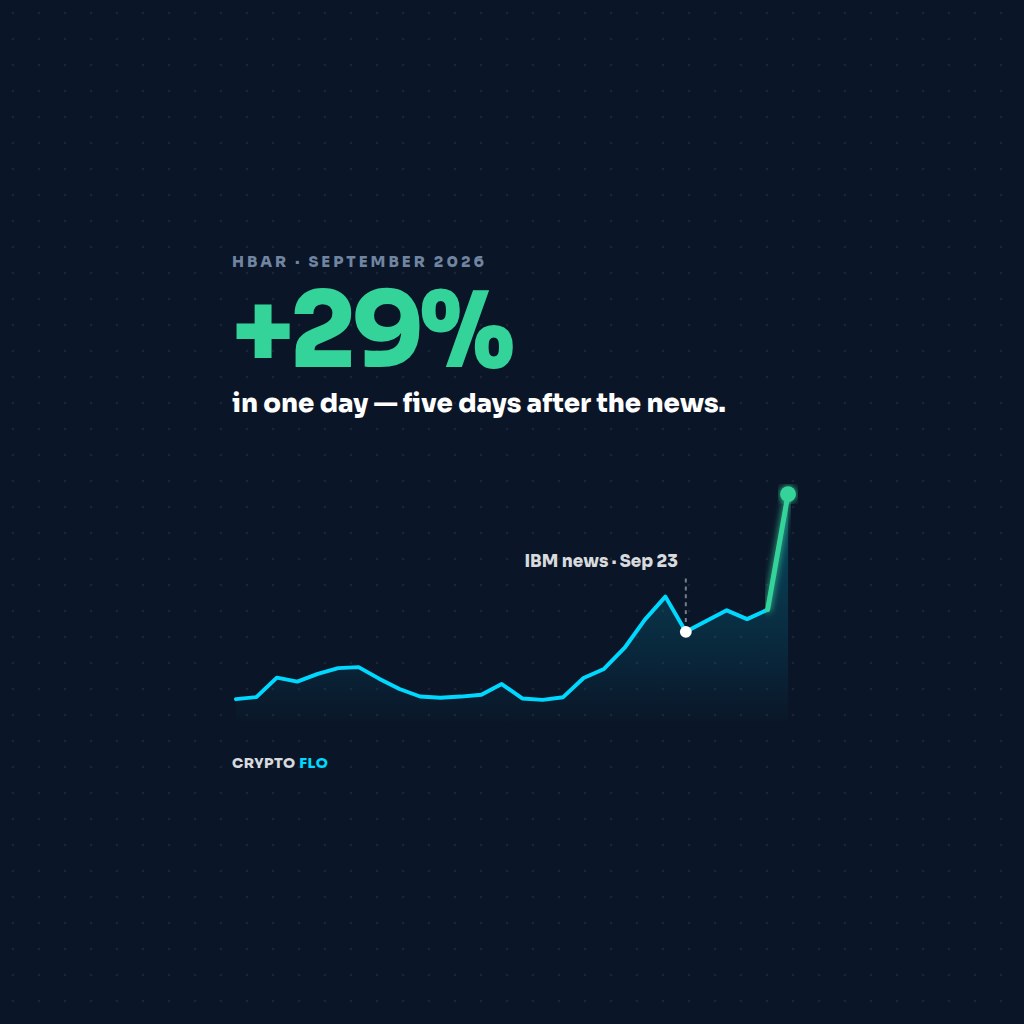
HBAR, the token behind the Hedera network, rose about 29% on September 28, 2026, trading near $0.12 late that day. That caps a run of roughly 54% since September 18, when it closed at $0.079. As of 22:25 UTC on September 28, HBAR ranked 23rd on our top 100 crypto list, with a market cap of $5.36 billion and $1.46 billion traded in 24 hours.
The easy explanation, repeated across most of the coverage, is "IBM partnership." That news is real and it matters. But the price chart tells a more interesting story, and knowing what actually moved the price is more useful than the headline, whether you hold HBAR or are thinking about it.
What Actually Happened, Day by Day
September 18–22: the run started before any of the headlines. HBAR climbed from $0.079 to $0.099 over four days. There was no single announcement behind it. It lined up with a broad rotation into altcoins as Bitcoin pushed toward $84,000.
September 23: the IBM news landed, and HBAR fell. The Hashgraph Group (THG) announced that its IDTrust identity platform, which runs on Hedera, had passed IBM's validation and been listed on the IBM Cloud Catalog. THG also reached IBM Silver Partner status and signed an Embedded Solution Agreement. Around the same time, Hedera was reported as joining the UK's Wholesale Digital Markets Champion Taskforce, an HM Treasury-backed group of 83 institutions that includes BlackRock, JPMorgan, Goldman Sachs, Ripple and Chainlink. HBAR opened that day at $0.099 and closed at $0.090, down about 9%.
September 24–27: flat. HBAR drifted between $0.093 and $0.096. The market had the news and did nothing with it.
September 28: the breakout. HBAR opened at $0.096 and traded as high as $0.131, on volume roughly nine times the previous day's on Crypto.com. It broke above its February high near $0.107, a level traders had been watching. Open interest in HBAR futures reportedly rose more than 80% in a day. On the same day, Hedera posted that five of its Council members, plus EQTY Lab, appear on the roster for NVIDIA's Open Agent Safety Platform. EQTY Lab already records AI audit trails on Hedera.
So Why Is HBAR Up?
The most accurate answer is a combination, and the order of events matters.
1. Real news gave the rally a reason. IDTrust on IBM's Cloud Catalog means an IBM enterprise customer can now buy a Hedera-based identity product through contracts they already have. That's a genuine distribution channel, not a press-release partnership. IBM has also sat on Hedera's governing council since 2019.
2. The price broke a level traders were watching. Clearing February's high turned a slow grind into a breakout, which pulls in momentum traders and new futures positions. That explains the size of the September 28 move far better than news that was five days old.
3. An AI narrative arrived the same day. The NVIDIA-related post tied Hedera to verifiable AI and agent safety, one of the hottest themes in the market right now. Note what it actually says: Council members appear on NVIDIA's roster. It isn't an NVIDIA partnership with Hedera.
One thing it was not: a big short squeeze. Reported liquidations of short positions were about $310,000, which is small next to more than $1 billion of daily volume. This was mostly buying, not forced covering. If you want the mechanics of when liquidations do drive a move, see liquidation cascades explained.
A claim to be careful with: some posts this week say BlackRock's ICS US Treasury fund is being tokenized on Hedera. What exists is a product from Archax, which tokenized pool shares of that BlackRock fund on Hedera. BlackRock has said before that it has no commercial relationship with Hedera and did not choose it. It's the same pattern we covered with BlackRock's name on Ondo's tokens: a BlackRock asset on a network is not BlackRock backing that network.
What Is Actually Great About Hedera
Set the price aside and Hedera has some design choices that are genuinely different from most blockchains. For the longer background, see our Hedera Hashgraph explainer.
- Fees are fixed in dollars. A basic transfer costs about $0.0001, set in US dollars and paid in HBAR. On most networks fees rise when the network is busy. On Hedera a business can budget a million transactions in advance and know the bill. That predictability is the single biggest reason enterprises look at it.
- Transactions are final in seconds. Hedera uses hashgraph consensus rather than a traditional blockchain. Transactions reach finality in about three to five seconds and can't be reversed afterwards. There's no waiting for extra confirmations.
- It's governed by a council of large, named organizations. Around 30 organizations sit on the Hedera Council, including Google, IBM, Dell, Boeing, Deutsche Telekom and Standard Bank. Each has one equal vote and a term-limited seat, so no single company controls the network.
- It has real, non-speculative uses. IDTrust for identity, and EQTY Lab's AI audit trails, are working products businesses pay for. They aren't pilots that exist only in a press release.
- Most of the supply is already out. About 43.8 billion of the 50 billion maximum HBAR is in circulation, roughly 88%. Many tokens still have large unlocks ahead that dilute holders. HBAR has comparatively little left to come. (See circulating supply.)
The Honest Caveats
- Usage doesn't automatically mean token demand. The same fixed fees that make Hedera attractive to businesses mean each transaction buys a tiny amount of HBAR. IBM listed THG's product, not HBAR. A company can use Hedera heavily and hold very little of the token. It's the same gap we saw with Quant's Clearing House contract: the company won the deal, and the token's link to that deal is less direct.
- Council governance is a trade-off. A council of known companies is what reassures enterprises, and it's also more centralized than Bitcoin or Ethereum. Whether that's a strength or a weakness depends on what you want from a network.
- It's still far below its high. HBAR's all-time high was $0.569 in September 2021. At $0.12 it's about 78% below that.
- The chart is stretched. HBAR's RSI went above 80 on September 28, a level usually read as overbought. Vertical single-day moves often give back part of the gain before the trend is clear. Treat the next few days as the real test of whether the breakout holds above $0.107.
Frequently Asked Questions
Q: Why is HBAR up?
A: HBAR rose about 29% on September 28, 2026. It broke above its February high near $0.107 on heavy volume, five days after The Hashgraph Group's Hedera-based IDTrust platform was listed on the IBM Cloud Catalog. A same-day Hedera post linking its Council members to NVIDIA's Open Agent Safety Platform added momentum.
Q: Did IBM partner with Hedera?
A: IBM listed IDTrust, a product built on Hedera by The Hashgraph Group, on its Cloud Catalog and made THG a Silver Partner. IBM has also been a member of the Hedera Council since 2019. The partnership is with THG, and it doesn't involve IBM buying or holding HBAR.
Q: Is BlackRock using Hedera?
A: Not directly. Archax tokenized pool shares of a BlackRock Treasury money market fund on Hedera, but BlackRock has said it has no commercial relationship with Hedera and didn't choose the network.
Q: What makes Hedera different from other blockchains?
A: Fees fixed in US dollars (about $0.0001 for a transfer), finality in roughly three to five seconds, and governance by a council of around 30 large organizations, including Google, IBM and Boeing.
Q: Why hasn't enterprise adoption pushed HBAR much higher?
A: Because Hedera's fees are tiny and fixed in dollars, even heavy business use buys relatively little HBAR. Adoption strengthens the network, but it doesn't translate one-for-one into demand for the token.
Q: How far is HBAR from its all-time high?
A: HBAR's all-time high was about $0.569 in September 2021. At around $0.12 on September 28, 2026, it is roughly 78% below that peak.
Q: Is HBAR overbought after this move?
A: By one common measure, yes. Its RSI went above 80 on September 28, which is usually read as overbought. That doesn't predict a drop, but sharp single-day rallies often retrace part of the move before a new trend is confirmed.
The Bottom Line
HBAR's jump is real and the news behind it is real. An IBM distribution channel for a Hedera product and a seat at the UK's tokenization table are meaningful for a network built around enterprise use. But the market sat on that news for five days, and the 29% day came from a chart breakout, fresh futures positions and an AI-themed post. What makes Hedera worth understanding is the design: fees fixed in dollars, fast finality, and council governance. What should keep you measured is the gap between businesses using the network and demand for the token itself. Watch whether HBAR holds above $0.107; that will say more than any headline.
This content was created with AI assistance and may contain errors, always verify before acting. Not financial advice. Always do your own research before making any investment decisions.
Frequently Asked Questions
Why is HBAR up?
HBAR rose about 29% on September 28, 2026. It broke above its February high near $0.107 on heavy volume, five days after The Hashgraph Group's Hedera-based IDTrust platform was listed on the IBM Cloud Catalog. A same-day Hedera post linking its Council members to NVIDIA's Open Agent Safety Platform added momentum.
Did IBM partner with Hedera?
IBM listed IDTrust, a product built on Hedera by The Hashgraph Group, on its Cloud Catalog and made THG a Silver Partner. IBM has also been a member of the Hedera Council since 2019. The partnership is with THG, and it doesn't involve IBM buying or holding HBAR.
Is BlackRock using Hedera?
Not directly. Archax tokenized pool shares of a BlackRock Treasury money market fund on Hedera, but BlackRock has said it has no commercial relationship with Hedera and didn't choose the network.
What makes Hedera different from other blockchains?
Fees fixed in US dollars (about $0.0001 for a transfer), finality in roughly three to five seconds, and governance by a council of around 30 large organizations, including Google, IBM and Boeing.
Why hasn't enterprise adoption pushed HBAR much higher?
Because Hedera's fees are tiny and fixed in dollars, even heavy business use buys relatively little HBAR. Adoption strengthens the network, but it doesn't translate one-for-one into demand for the token.
How far is HBAR from its all-time high?
HBAR's all-time high was about $0.569 in September 2021. At around $0.12 on September 28, 2026, it is roughly 78% below that peak.
Is HBAR overbought after this move?
By one common measure, yes. Its RSI went above 80 on September 28, which is usually read as overbought. That doesn't predict a drop, but sharp single-day rallies often retrace part of the move before a new trend is confirmed.
Let AI summarize these channels for you daily
Pick your favorite crypto YouTube channels and news sites. Get a 5-minute AI brief every morning.
Choose Your Sources