BlackRock's Name Is on Ondo's New Tokens. BlackRock Isn't Running Them.
In This Article
Introduction
Ondo Finance launched three tokenized investment portfolios this week built on model strategies supplied by BlackRock. ONDO rose more than 16% in a day and roughly 37% on the week.
It did that while the rest of the market went the other way. Bitcoin opened Friday at $84,378, down from Wednesday's eight-month high, after a Thursday pullback driven by rising odds the Fed hikes again — possibly twice more this year. Ether opened at $2,687.
So the headline writes itself: BlackRock partners with Ondo, token soars.
The headline is also doing a lot of quiet work. There is one sentence in the announcement that changes what this actually is, and most coverage has skipped past it. It is worth slowing down on, because the distinction it draws is the single most useful thing to understand about how large institutions are entering crypto right now.
All figures are as of 25 September 2026.
What actually launched
Three tokens, under a new Ondo product category called Intelligent Portfolios:
- BLKHIon — Ondo High Income
- BLKDIGon — Ondo Diversified Growth
- BLKGRWon — Ondo High Growth
Each wraps a multi-asset strategy that can hold equities, fixed income and Bitcoin ETFs, depending on the mandate. Holders can mint, redeem and transfer them across wallets, exchanges and DeFi protocols, and the holdings, allocations and rebalancing activity are visible on-chain.
That last part is a genuine improvement on the traditional version. A conventional model portfolio is a quarterly statement. This one you can inspect whenever you like.
The sentence that changes the story
Here it is, and it appears in the reporting rather than the headlines:
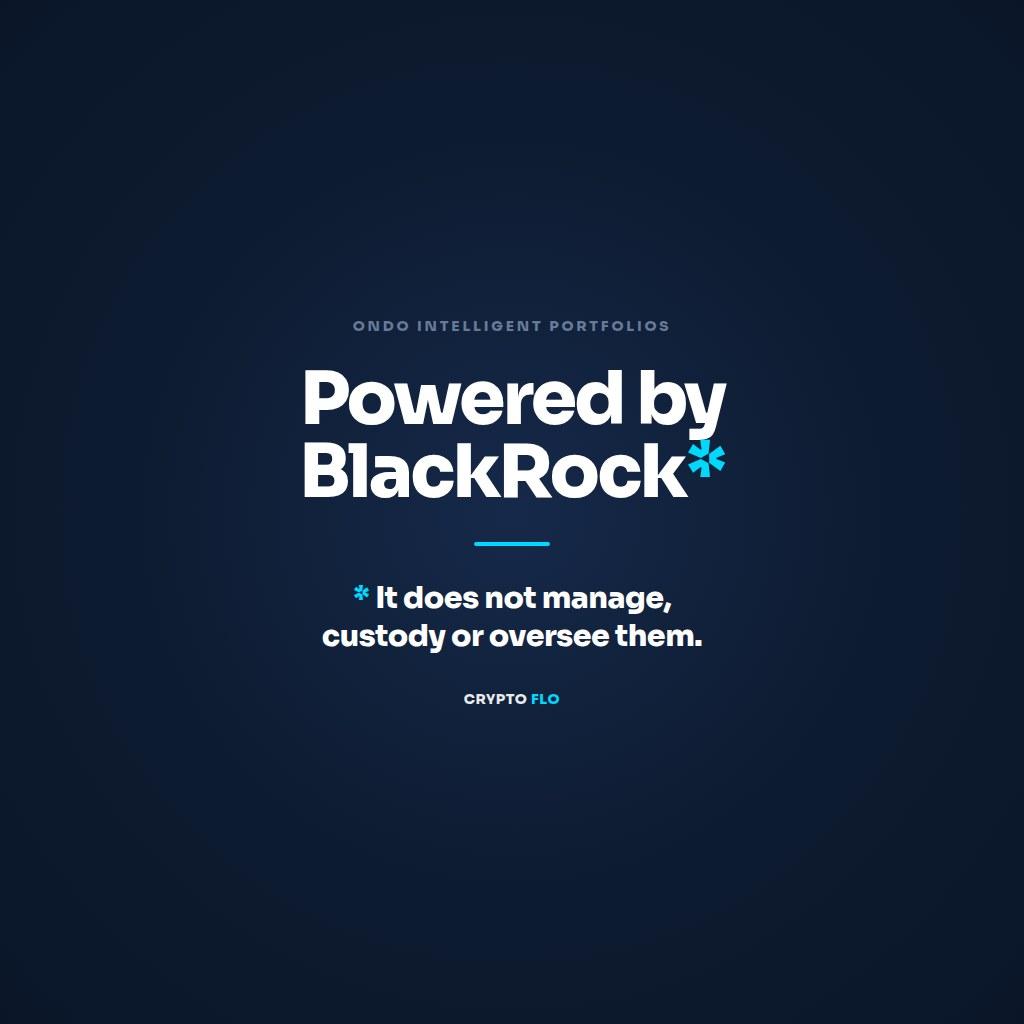
> BlackRock supplies the model portfolio frameworks. It does not manage, custody or oversee the tokens.
The strategies are also described as nondiscretionary — meaning BlackRock is not making ongoing judgement calls about your money inside these products.
Read plainly: BlackRock licensed a recipe. Ondo runs the kitchen.
That is not a criticism of either firm, and it is not a reason to dismiss the product. Both companies have been clear about it. But it is a materially different thing from "BlackRock launched a crypto portfolio," which is how a lot of people will remember this.
Why a model portfolio is not a fund
This distinction matters in ways that are easy to miss, so it is worth spelling out.
A fund means the manager holds the assets, makes the decisions, carries fiduciary duty to investors, is examined by regulators for that role, and is the entity you have a claim against if something goes wrong.
A model portfolio is a published allocation framework — "this much equity, this much fixed income, rebalanced on these rules." The provider supplies the design. Somebody else implements it, custodies the assets, handles redemptions, and carries the operational and regulatory risk.
So when you hold BLKGRWon, your counterparty is Ondo, not BlackRock. Ondo's custody arrangements, Ondo's redemption mechanics, Ondo's smart contracts, Ondo's regulatory standing. BlackRock's contribution is intellectual property and a name.
Model portfolios are an entirely legitimate, enormous and boring part of traditional asset management — advisors have used them for decades. Nothing here is unusual by TradFi standards. What is new is the name being attached to a token in a market where "BlackRock is in" carries enormous narrative weight.
If you are making a decision based on this product, the question to ask is not "do I trust BlackRock?" It is "do I trust Ondo's implementation?" Those are different questions with different answers.
You probably cannot buy it
Worth stating plainly because the coverage buries it: these tokens are restricted to qualified investors outside the United States, in approved jurisdictions only.
A US retail investor reading a headline about BlackRock and a 37% move cannot purchase the thing the headline is about. What they can buy is ONDO, the governance token of the company that built it — which is a completely different asset with a completely different risk profile.
That gap between "the thing in the news" and "the thing you can actually buy" is one of the most reliable ways retail investors end up with exposure they did not intend.
Why ONDO ran while Bitcoin fell
This is the genuinely interesting market signal, and it is not really about BlackRock.
ONDO gained roughly 37% on the week and is up about 33% year-to-date. Bitcoin, over the same stretch, came off an eight-month high and slipped toward $83,000 before recovering to around $85,200 on Friday morning.
A token moving hard against the market's direction usually means it is trading on something specific rather than on crypto beta. In this case, the specific thing is tokenization as a sector.
Ondo has real traction behind the narrative. Its tokenized equities line — built with Near Protocol and covering names like Tesla, Nvidia and Apple alongside QQQ — reached $1 billion in total value locked within eight months of launch. It has moved $95 million of its OUSG holdings into BlackRock's BUIDL fund, which is a separate, pre-existing commercial relationship and part of why this week's arrangement is credible rather than a press release.
So the move is not pure narrative. But "tokenization is a real sector with real traction" and "this particular token should be up 37% this week" are separate claims, and only the first is supported by what was announced.
The pattern: third time this month
Step back and this fits a shape we flagged [earlier this week](https://cryptoflo.news/blog/crypto-settlement-infrastructure-september-2026).
In the same month: the ECB began settling tokenized assets in central bank money. US regulators approved three federal trust charters — custody institutions, not trading ones. The Bank of Russia made proprietary crypto exposure prohibitively expensive while explicitly carving out client custody. And now the world's largest asset manager licenses its strategy frameworks into a tokenized product without managing, custodying or overseeing it.
Every one of those is the same move: supply the infrastructure or the intellectual property, do not carry the risk.
That is a real and significant form of institutional adoption. It is just not the form most people are picturing when they see a headline with BlackRock's name in it. The institutions are showing up as vendors and rails, not as buyers.
What to watch
- Assets actually raised. Does this reach meaningful size, or stay a launch announcement? Ondo Stocks hitting $1B in eight months is the benchmark to measure it against.
- Whether US access opens. Right now it is non-US qualified investors only. A change there would be the real story.
- Redemption mechanics under stress. The test of any tokenized wrapper is a crowded exit, not a calm launch.
- Whether BlackRock's involvement deepens. Licensing a model is the lightest possible commitment. Custody or management would be a genuine escalation.
- Whether ONDO holds the move once the announcement stops being news. Sector re-ratings persist; announcement pops usually do not.
Frequently Asked Questions
Q: Did BlackRock launch a crypto portfolio with Ondo?
A: Not exactly. BlackRock supplied nondiscretionary model portfolio frameworks that Ondo has tokenized. Reporting is explicit that BlackRock does not manage, custody or oversee the tokens themselves, so the product is Ondo's and the strategy design is BlackRock's.
Q: What are BLKHIon, BLKDIGon and BLKGRWon?
A: The three tokens in Ondo's new Intelligent Portfolios category, covering high income, diversified growth and high growth. Each can hold equities, fixed income and Bitcoin ETFs, and each can be minted, redeemed and transferred across wallets, exchanges and DeFi, with holdings and rebalancing visible on-chain.
Q: Can I buy these tokens in the US?
A: No. Access is restricted to qualified investors outside the United States in approved jurisdictions. US investors seeing the headline can only buy ONDO, the token of the company behind the product, which is a different asset with a different risk profile.
Q: What is the difference between a model portfolio and a fund?
A: A fund's manager holds the assets, makes the decisions and carries fiduciary and regulatory responsibility. A model portfolio is an allocation framework that somebody else implements, custodies and stands behind. With these tokens your counterparty is Ondo, not BlackRock.
Q: Why did ONDO rise while Bitcoin fell?
A: It traded on a sector-specific catalyst rather than general crypto direction. ONDO gained roughly 37% on the week while Bitcoin came off an eight-month high toward $83,000 on rising Fed rate-hike expectations, which suggests tokenization is being priced as its own theme.
Q: Is this real institutional adoption?
A: Yes, but of a specific kind. It is an asset manager licensing intellectual property rather than deploying its own balance sheet or taking custody — the same pattern as the ECB, OCC and Bank of Russia moves earlier this month, where institutions supply infrastructure without carrying the risk.
Q: Do Ondo and BlackRock already work together?
A: Yes. Ondo has moved about $95 million of its OUSG holdings into BlackRock's BUIDL fund, a pre-existing commercial relationship that predates this week's launch.
The Bottom Line
The launch is real, the relationship is real, and tokenization is a sector with genuine traction — Ondo's equities line reached $1 billion in eight months, which is not a narrative.
But the accurate description of this week's news is: BlackRock licensed three strategy frameworks to a crypto company, which tokenized them and sells them to non-US qualified investors. BlackRock does not manage them, does not custody them, and does not oversee them.
That is the third time this month a major institution has stepped into crypto by supplying something — rails, a charter, a framework — while carefully not carrying the risk. It is a pattern, it is meaningful, and it is not the same as institutions buying.
When a headline pairs a famous name with a big percentage, the useful question is always the same: what exactly did the famous name agree to do?
This content was created with AI assistance and may contain errors. Prices and market data move constantly — figures here are a snapshot from 25 September 2026 and should be verified before use. Product details are summarised from published reporting and should be checked against the issuer's own documentation before any decision. Nothing here is a recommendation, and none of these products are being endorsed. Not financial advice. Always do your own research before making any investment decisions.
Frequently Asked Questions
Did BlackRock launch a crypto portfolio with Ondo?
Not exactly. BlackRock supplied nondiscretionary model portfolio frameworks that Ondo has tokenized. Reporting is explicit that BlackRock does not manage, custody or oversee the tokens themselves, so the product is Ondo's and the strategy design is BlackRock's.
What are BLKHIon, BLKDIGon and BLKGRWon?
The three tokens in Ondo's new Intelligent Portfolios category, covering high income, diversified growth and high growth. Each can hold equities, fixed income and Bitcoin ETFs, and each can be minted, redeemed and transferred across wallets, exchanges and DeFi, with holdings and rebalancing visible on-chain.
Can I buy these tokens in the US?
No. Access is restricted to qualified investors outside the United States in approved jurisdictions. US investors seeing the headline can only buy ONDO, the token of the company behind the product, which is a different asset with a different risk profile.
What is the difference between a model portfolio and a fund?
A fund's manager holds the assets, makes the decisions and carries fiduciary and regulatory responsibility. A model portfolio is an allocation framework that somebody else implements, custodies and stands behind. With these tokens your counterparty is Ondo, not BlackRock.
Why did ONDO rise while Bitcoin fell?
It traded on a sector-specific catalyst rather than general crypto direction. ONDO gained roughly 37% on the week while Bitcoin came off an eight-month high toward $83,000 on rising Fed rate-hike expectations, which suggests tokenization is being priced as its own theme.
Is this real institutional adoption?
Yes, but of a specific kind. It is an asset manager licensing intellectual property rather than deploying its own balance sheet or taking custody — the same pattern as the ECB, OCC and Bank of Russia moves earlier this month, where institutions supply infrastructure without carrying the risk.
Do Ondo and BlackRock already work together?
Yes. Ondo has moved about $95 million of its OUSG holdings into BlackRock's BUIDL fund, a pre-existing commercial relationship that predates this week's launch.
Let AI summarize these channels for you daily
Pick your favorite crypto YouTube channels and news sites. Get a 5-minute AI brief every morning.
Choose Your Sources