How BlackRock Got So Big — and Why That Explains Its Crypto Strategy
In This Article
- Introduction
- 1988: a room inside Blackstone
- The real product was never the fund
- 2008: when the government needed a referee
- 2009: buying the wrapper business
- The pattern
- 2017: "an index of money laundering"
- 2024: the wrapper arrives
- 2024–2026: more containers
- What this means when you see the name
- Frequently Asked Questions
- The Bottom Line
Introduction
This week a company's name appeared on three tokens and the associated crypto asset rose 37%. The company did not manage the tokens, custody them, or oversee them. It licensed a strategy framework.
That is the kind of power BlackRock has, and it is worth understanding where it came from — because the history explains the crypto strategy almost perfectly.
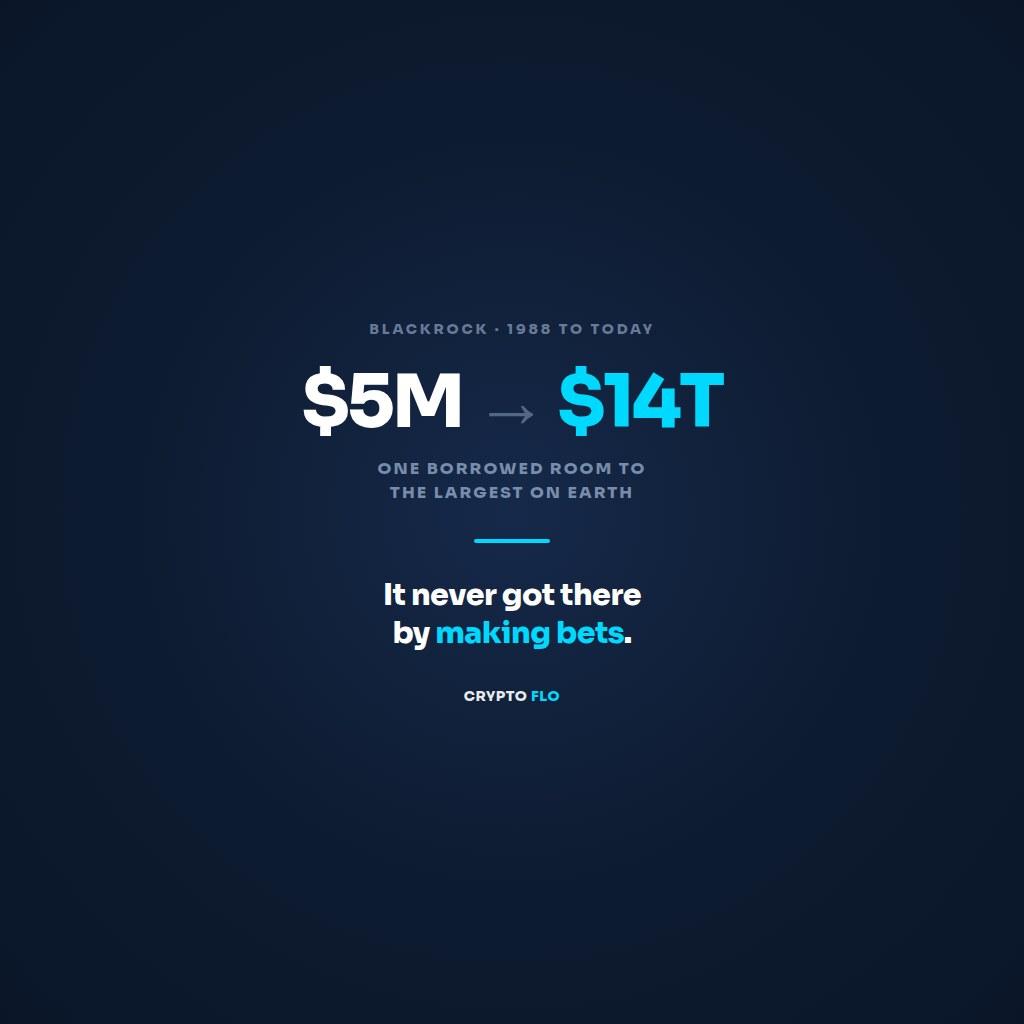
BlackRock began in 1988, in a single room borrowed from another firm, with $5 million in seed capital and eight people. Today it manages somewhere around $14 trillion, depending on which quarter you measure.
The interesting part is not that it got big. It is how. BlackRock did not become the largest asset manager on earth by making great bets. It became the largest by building the infrastructure that other people's bets run through — and once you see that pattern, everything it has done in crypto becomes predictable.
1988: a room inside Blackstone
Larry Fink and seven partners founded BlackRock in New York to manage fixed income — bonds, not stocks. They did it under the corporate umbrella of The Blackstone Group, operating out of a single room with $5 million of seed money.
Two details matter.
It started in bonds, not equities. Bond portfolios are mathematical objects. Their risk lives in duration, convexity, credit spreads and prepayment behaviour — things you model, not things you have a hunch about. The firm's native language was risk analysis from day one.
It was not built to pick winners. It was built to understand what a portfolio would do under stress. That sounds like a technicality. It turned out to be the whole business.
The real product was never the fund
Out of that risk work came Aladdin — BlackRock's risk management and portfolio analysis platform.
Aladdin is not a fund. It is software. It models what happens to a portfolio when rates move, when credit deteriorates, when correlations break. BlackRock ran it internally, then realised something more valuable: other asset managers needed it too, and did not have the people to build it.
So BlackRock sold it to them. Including to competitors.
Today Aladdin is used to analyse assets in the region of $20 trillion and up — far more than BlackRock itself manages. Its clients are other institutions, pension funds, insurers and rival managers.
Think about what that means. BlackRock's most strategically important product is a tool its competitors depend on. It earns whether those competitors win or lose.
2008: when the government needed a referee
The financial crisis is where this became unmistakeable.
When the US government had to value and manage the toxic assets at the centre of the collapse, it needed an institution that could actually price complex mortgage securities. It hired BlackRock, handing over roughly $130 billion of assets to manage.
Not because BlackRock had the best market calls. Because it had the models.
The crisis also created enormous demand for exactly what Aladdin did, from institutions that had just discovered they did not understand their own risk. BlackRock's position as the industry's risk infrastructure was effectively established by the worst financial event in eighty years.
2009: buying the wrapper business
Then came the move that made it the largest.
In June 2009 BlackRock agreed to buy Barclays Global Investors — including iShares, the leading ETF platform — for $13.5 billion, closing that December. Barclays took a roughly 20% stake in BlackRock as part of the deal. iShares came with over $300 billion across more than 350 funds.
An ETF is a wrapper. It holds an index, tracks it mechanically, and charges a fee. The provider is not forecasting anything. It is operating a container and collecting basis points on whatever goes inside.
BlackRock bought the dominant wrapper business at the exact moment passive investing was about to eat the industry. That was not a market call on any asset. It was a bet on the format — that more money would flow through cheap mechanical containers than through active managers making predictions.
That bet was correct, and it is the same bet BlackRock keeps making.
The pattern
Three businesses, one shape:
- Aladdin: sells risk infrastructure to people taking risk
- iShares: operates the containers other people's money sits in
- The 2008 mandate: hired to measure and administer, not to speculate
BlackRock is not a gambler. It is closer to a toll booth — positioned where the traffic must pass, earning a small amount on enormous volume, largely indifferent to whether any particular driver arrives somewhere good.
Hold that in mind for the crypto section, because it explains everything.
2017: "an index of money laundering"
In October 2017, at an Institute of International Finance meeting, Larry Fink described Bitcoin as "an index of money laundering." Bitcoin traded around $5,685 that day.
This gets quoted endlessly as a gotcha. It is more useful as evidence of how the firm thinks: in 2017 there was no regulated wrapper, no institutional custody standard, and no client demand BlackRock could serve at scale. There was nothing for a toll booth to be built on.
2024: the wrapper arrives
In January 2024 the SEC approved BlackRock's iShares Bitcoin Trust (IBIT), alongside ten other spot Bitcoin ETFs.
Note precisely what that is. BlackRock did not buy Bitcoin as a corporate treasury bet. It built a container so that other people could, and charged a fee for holding it.
That is iShares, applied to a new asset. Exactly the 2009 playbook.
It worked spectacularly. IBIT reached $70 billion in 341 trading days, becoming BlackRock's biggest fee-generating ETF. When Bitcoin ran above $126,000 in October, IBIT briefly approached $100 billion in assets — reaching that level roughly five times faster than any ETF in history.
Fink's own explanation of the reversal is more thoughtful than the gotcha version suggests:
> "The markets teach you, you have to always relook at your assumptions. There is a role for crypto in the same way there is a role for gold, that is, it's an alternative."
He now describes Bitcoin as digital gold. Whether you find that persuasive is up to you. What is not in dispute is that the change in position coincided exactly with the arrival of a regulated structure BlackRock could operate.
2024–2026: more containers
Everything since has been the same move.
- BUIDL, the BlackRock USD Institutional Digital Liquidity Fund — a tokenized fund, which drew over $160 million in its first week
- August 2026: two tokenized money market instruments aimed at stablecoin reserve use cases — infrastructure for stablecoin issuers, not a directional position
- September 2026: three model portfolio frameworks licensed to Ondo Finance, which tokenized them. [BlackRock does not manage, custody or oversee those tokens](https://cryptoflo.news/blog/blackrock-ondo-tokenized-portfolios)
Wrapper, wrapper, infrastructure, licensed IP. Not one of them is a bet on price.
It also sits inside a broader pattern we traced [earlier this month](https://cryptoflo.news/blog/crypto-settlement-infrastructure-september-2026), where the ECB, the OCC and even the Bank of Russia all drew the same line: institutions may operate the rails, but they do not carry the risk.
What this means when you see the name
BlackRock's involvement is a real signal. It is just a signal about something specific.
What it does tell you: that a regulated structure exists, that institutional custody is solved well enough to operate at scale, and that BlackRock's client base is asking for access. Those are meaningful facts about market maturity.
What it does not tell you: that BlackRock thinks the price goes up. The firm earns its fee whether IBIT holders make money or lose it. A toll booth does not care where you are driving.
So "BlackRock is in" is evidence about infrastructure, not about direction. Conflating the two is how a licensing agreement becomes a 37% move.
Frequently Asked Questions
Q: When was BlackRock founded and by whom?
A: In 1988, in New York, by Larry Fink and seven partners. It began managing fixed income from a single room inside The Blackstone Group with $5 million in seed capital, and is now the world's largest asset manager at roughly $14 trillion.
Q: What is Aladdin?
A: BlackRock's risk management and portfolio analysis platform. It models how portfolios behave under stress, and BlackRock licenses it to other institutions — including competitors — with assets in the region of $20 trillion analysed through it, far more than BlackRock itself manages.
Q: How did BlackRock become the largest asset manager?
A: Chiefly by acquiring Barclays Global Investors, including the iShares ETF platform, for $13.5 billion in 2009. That gave it the leading position in passive index products just as money began moving decisively from active management into cheap index wrappers.
Q: Did Larry Fink really call Bitcoin a money laundering index?
A: Yes, in October 2017 at an Institute of International Finance meeting, when Bitcoin traded near $5,685. He has since reversed, calling it digital gold and saying markets teach you to relook at your assumptions, and that crypto has a role comparable to gold as an alternative.
Q: What is IBIT and how large is it?
A: The iShares Bitcoin Trust, approved by the SEC in January 2024 alongside ten other spot Bitcoin ETFs. It reached $70 billion in 341 trading days and briefly approached $100 billion when Bitcoin ran above $126,000, hitting that level around five times faster than any previous ETF.
Q: Does BlackRock own a lot of Bitcoin itself?
A: Its Bitcoin exposure sits in products held on behalf of clients rather than as a corporate bet. IBIT is a wrapper: investors own the shares and the economic exposure, BlackRock operates the structure and collects a fee regardless of direction.
Q: Does BlackRock's involvement mean a crypto asset will go up?
A: No. It indicates that a regulated structure exists and that clients are asking for access, which says something real about market maturity. It says nothing about price, because BlackRock earns its fee whether the underlying rises or falls.
The Bottom Line
BlackRock went from one borrowed room and $5 million in 1988 to roughly $14 trillion, and it did it without needing to be right about markets.
It sold risk software to the people taking risk. It bought the containers rather than the contents. It got hired in 2008 to measure the wreckage rather than to trade it. Every step positioned it where money passes through, not where money is wagered.
Its crypto business is the same strategy with a new asset class: an ETF wrapper, a tokenized fund, money market instruments for stablecoin issuers, and a licensed model portfolio it does not operate.
So when the name appears in a headline, the right question is not "what does BlackRock think will happen?" It is "what is BlackRock getting paid to operate?" That question has an answer, and it is usually more informative than the price move that follows.
This content was created with AI assistance and may contain errors. Historical details and figures are summarised from published sources and should be verified before being relied on; assets under management move constantly and are reported on different dates by different sources. Nothing here is a recommendation or an endorsement of any firm or product. Not financial advice. Always do your own research before making any investment decisions.
Frequently Asked Questions
When was BlackRock founded and by whom?
In 1988, in New York, by Larry Fink and seven partners. It began managing fixed income from a single room inside The Blackstone Group with $5 million in seed capital, and is now the world's largest asset manager at roughly $14 trillion.
What is Aladdin?
BlackRock's risk management and portfolio analysis platform. It models how portfolios behave under stress, and BlackRock licenses it to other institutions — including competitors — with assets in the region of $20 trillion analysed through it, far more than BlackRock itself manages.
How did BlackRock become the largest asset manager?
Chiefly by acquiring Barclays Global Investors, including the iShares ETF platform, for $13.5 billion in 2009. That gave it the leading position in passive index products just as money began moving decisively from active management into cheap index wrappers.
Did Larry Fink really call Bitcoin a money laundering index?
Yes, in October 2017 at an Institute of International Finance meeting, when Bitcoin traded near $5,685. He has since reversed, calling it digital gold and saying markets teach you to relook at your assumptions, and that crypto has a role comparable to gold as an alternative.
What is IBIT and how large is it?
The iShares Bitcoin Trust, approved by the SEC in January 2024 alongside ten other spot Bitcoin ETFs. It reached $70 billion in 341 trading days and briefly approached $100 billion when Bitcoin ran above $126,000, hitting that level around five times faster than any previous ETF.
Does BlackRock own a lot of Bitcoin itself?
Its Bitcoin exposure sits in products held on behalf of clients rather than as a corporate bet. IBIT is a wrapper: investors own the shares and the economic exposure, BlackRock operates the structure and collects a fee regardless of direction.
Does BlackRock's involvement mean a crypto asset will go up?
No. It indicates that a regulated structure exists and that clients are asking for access, which says something real about market maturity. It says nothing about price, because BlackRock earns its fee whether the underlying rises or falls.
Let AI summarize these channels for you daily
Pick your favorite crypto YouTube channels and news sites. Get a 5-minute AI brief every morning.
Choose Your Sources