XRP Is Vanishing From Exchanges. That's Not a Supply Shock.
In This Article
Introduction
XRP is disappearing from exchanges. That part is not in dispute.
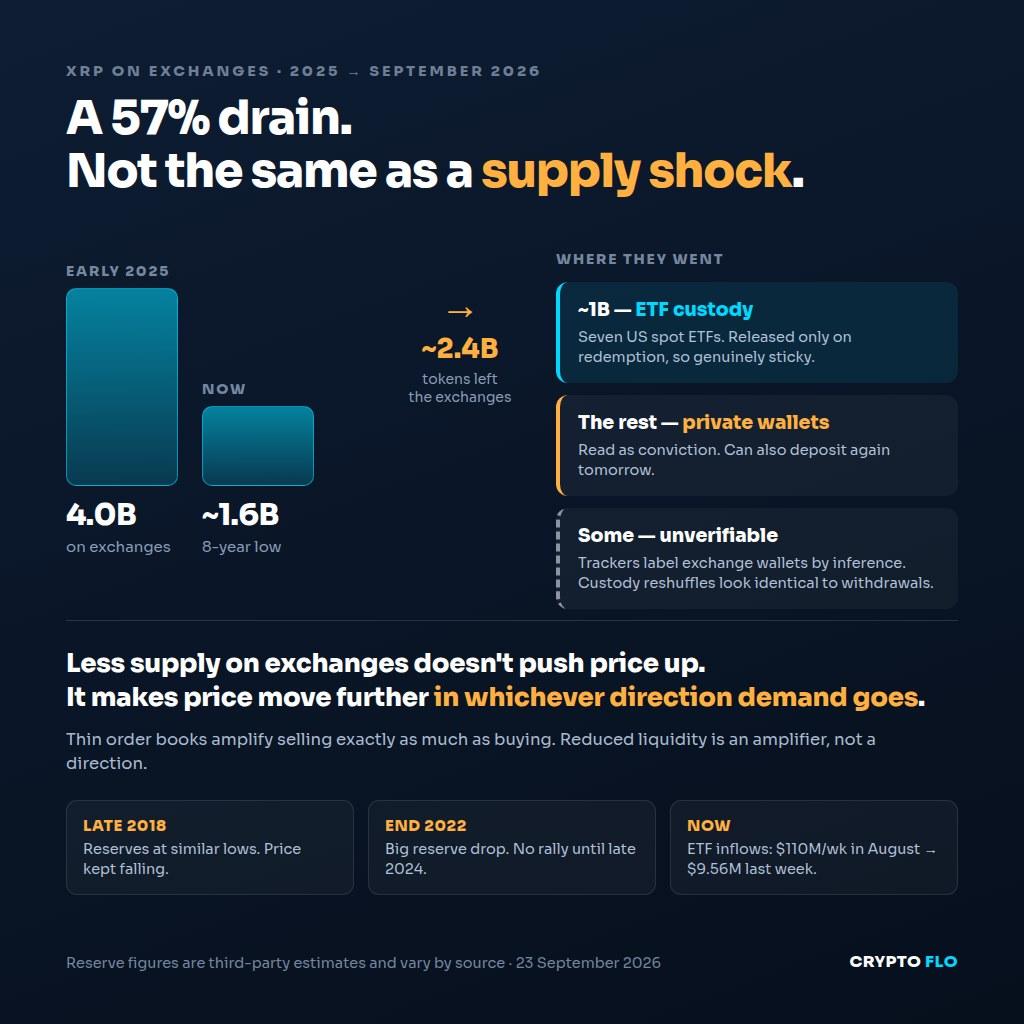
Exchange reserves have fallen from roughly 4 billion XRP at the start of 2025 to somewhere around 1.6 billion — the lowest level since 2018, a decline of about 57%. Binance alone has seen hundreds of millions of tokens leave, with its monthly average reserve at the lowest point since early 2024.
The conclusion being drawn from this is a supply shock: fewer tokens available to buy, therefore price must rise.
That conclusion does not follow, and the reason it does not follow is more interesting than the headline. There is a real story in this data. It just is not the mechanical one being sold.
Figures here are drawn from published reserve tracking as of late September 2026.
What actually left
The headline decline is large and it is genuine. The composition is where it gets complicated.
Of roughly 60-something billion XRP in circulation, about 10.8 billion sits on the three largest exchanges — Binance, Upbit and Bithumb. The remaining ~52 billion is spread across private wallets, ETF custody, smaller exchanges and dormant addresses.
The tracked "exchange reserve" number that everyone quotes is a subset of that, and different trackers draw the boundary in different places. You will see the current figure quoted as 1.5 billion, 1.6 billion or 1.7 billion depending on the source, and the peak quoted as 4 billion or as "double the current level from October 2025."
This is the same problem we covered in [why XRP's market cap isn't a ceiling](https://cryptoflo.news/blog/xrp-market-cap-not-a-ceiling): two reputable sources will give you materially different XRP numbers on the same day and both will be telling the truth, because they are counting different things.
That is not a reason to dismiss the data. It is a reason to treat a 57% decline as "a large fall, roughly this size" rather than as a precision instrument.
Where the tokens went
Three destinations account for most of it, and only one of them is the thing people imagine.
ETF custody — roughly 1 billion XRP. This is the genuinely new factor. The seven US spot XRP ETFs launched in November 2025 and have since absorbed on the order of a billion tokens, held in custody on behalf of fund investors, backed by cumulative net inflows in the region of $1.71 billion. Tokens that move into an ETF's custody are, functionally, off the market. This is real and it is the strongest leg of the argument.
Ripple's escrow — around 36 billion XRP. Roughly 36% of the entire 100 billion supply sits in on-ledger escrow. This is not new, it did not change this year, and it is not part of the "drain." It matters only as context: the float was already far smaller than the headline supply.
Private wallets and self-custody — the residual. Tokens moved off an exchange into a personal wallet. This is the part read as bullish conviction, and it partly is. But it is also the part the data cannot verify.
The data problem nobody mentions
Here is the caveat that should be attached to every one of these headlines.
Reserve trackers work by watching wallets they have labelled as belonging to exchanges. Those labels are inference, not disclosure. An exchange-linked balance can be a customer deposit, an institutional custody arrangement, an internal treasury wallet, or plumbing the exchange moved for operational reasons.
Trackers cannot cleanly separate "holders withdrew to cold storage" from "an exchange reorganised where it keeps things." Those look identical on-chain and mean completely different things.
So a falling reserve number is consistent with the bullish interpretation. It is also consistent with custody restructuring, with an exchange shifting balances to unlabelled addresses, or with institutional custody moving to a provider the tracker does not recognise. Nobody publishing a "supply shock" headline knows which mix they are looking at, because that information is not public.
Why "supply shock" is the wrong phrase
Set the data quality aside and assume the tokens genuinely left for long-term holding. The mechanism still does not work the way it is described.
Price is not set by how many tokens exist somewhere. It is set at the margin, by the most recent transaction between a willing buyer and a willing seller. A smaller quantity sitting on exchanges does not create buyers. It changes what happens when buyers arrive.
The accurate framing is this: low exchange supply does not push price up. It makes price more sensitive to demand in both directions.
Thin order books mean a given amount of buying moves price further. They also mean a given amount of selling moves price further. Reduced liquidity is an amplifier, not a direction. Every write-up that treats it as inherently bullish has quietly assumed the demand side of the equation and then presented the conclusion as arithmetic.
What history actually shows
This is the test that settles it, and it is the one the bullish posts skip.
Exchange reserves have been at comparable lows before.
- Late 2018: XRP reserves sat at similar levels. Price continued to trend downward.
- End of 2022: reserves dropped significantly. No rally followed until late 2024 — roughly two years later, and driven by unrelated catalysts.
Two prior instances of the same setup, neither producing the predicted outcome on the predicted timeframe. That does not prove the pattern never works. It does demonstrate that low exchange reserves are not sufficient on their own, which is precisely what the supply-shock framing claims.
If a signal has fired before without the promised result, that has to be stated alongside it. Most of the current coverage does not state it.
What genuinely is different this time
Having taken the argument apart, here is the honest steelman — because something real has changed since 2018 and 2022.
In those episodes, tokens leaving exchanges went to private wallets, and private wallets can change their minds. A holder who withdrew in 2018 could deposit again in 2019 and sell.
ETF custody behaves differently. Tokens held by a spot ETF are only released when shares are redeemed. That is a slower, more institutional, more procedural process than an individual deciding to sell. Roughly a billion XRP in that form is a genuinely stickier removal from the tradeable float than anything in the previous cycles.
That is the real bull case, and it is much narrower than "reserves are at an 8-year low."
But it comes with its own caveat, and it is the one we flagged in [our piece on XRP's recent trend](https://cryptoflo.news/blog/xrp-trend-september-2026-big-names): the ETF inflow streak is intact at ten consecutive weeks, but the magnitude has collapsed — from about $110 million in the final week of August to roughly $9.56 million last week. A 90%-plus drop.
The absorption engine that makes this cycle different is running at a fraction of its recent rate. If it stays there, the distinctive factor stops being distinctive.
What to watch instead of the reserve number
- Weekly ETF flows, in dollars. The one number that tracks the sticky removal. A return to $100 million-plus weeks would matter far more than another reserve headline.
- Order book depth, not reserve totals. How much can actually be bought or sold before price moves. That is the real liquidity picture.
- Whether reserves keep falling on rising price. Reserves falling while price falls is very different from reserves falling while price rises; the second suggests accumulation, the first can simply be capitulation into cold storage.
- Redemption activity in the ETFs. The mechanism that would reverse the absorption, and the thing to watch if the streak breaks.
- Escrow releases. Roughly 1 billion XRP unlocks monthly, with most historically re-escrowed. A change in the re-escrow rate would move real float.
Frequently Asked Questions
Q: How much XRP has left exchanges?
A: Exchange reserves have fallen from roughly 4 billion XRP at the start of 2025 to around 1.6 billion, a decline of about 57% and the lowest level since 2018. The exact figure varies between 1.5 and 1.7 billion depending on which tracker you use, because they label exchange wallets differently.
Q: Does falling exchange supply mean XRP's price will rise?
A: Not on its own. Lower exchange supply does not create buyers; it makes price more sensitive to demand when it arrives — in both directions. Thinner order books amplify selling just as much as buying, so reduced liquidity is an amplifier rather than a direction.
Q: Where did the XRP actually go?
A: Roughly a billion tokens moved into custody at the seven US spot XRP ETFs, backed by about $1.71 billion in cumulative inflows since their November 2025 launch. The rest went to private wallets and other addresses. Separately, around 36 billion XRP sits in Ripple's on-ledger escrow, which is long-standing and not part of this decline.
Q: Has this happened before, and what followed?
A: Yes, twice. XRP exchange reserves were at similar lows in late 2018, after which price continued falling. Reserves dropped significantly again at the end of 2022, and no rally followed until late 2024. Low reserves have not been sufficient on their own.
Q: Why do different sources report different XRP exchange reserves?
A: Because trackers infer which wallets belong to exchanges rather than being told. Those labels are estimates, and an exchange-linked balance may be a customer deposit, an institutional custody arrangement or an internal treasury wallet. The data cannot distinguish holders withdrawing from an exchange reorganising its own storage.
Q: What makes this cycle different from 2018 or 2022?
A: ETF custody. Tokens held by a spot ETF are released only through share redemption, which is slower and more procedural than an individual deciding to sell, so roughly a billion XRP held that way is stickier than the private-wallet withdrawals of previous cycles.
Q: Is the ETF absorption still accelerating?
A: No. The inflow streak has reached ten consecutive weeks, but weekly magnitude fell from about $110 million at the end of August to roughly $9.56 million last week. The streak continues at a much smaller scale, which weakens the strongest part of the supply-shock argument.
The Bottom Line
XRP really is leaving exchanges, the decline really is the largest since 2018, and roughly a billion tokens really are locked in ETF custody in a way that did not exist in previous cycles.
None of that makes "supply shock" a forecast. It makes it a condition — one where whatever demand arrives, positive or negative, moves price further than it otherwise would.
The two previous times this setup appeared, the predicted rally did not follow. The thing that makes this time genuinely different is ETF absorption, and that absorption has slowed by more than 90% in a month.
So the useful question is not "how low are reserves?" It is "is anyone still buying?" — and that is answered by weekly flow data, not by a reserve chart. Watch the dollars going in, not the tokens going out.
This content was created with AI assistance and may contain errors. Exchange reserve figures are estimates produced by third-party trackers that infer wallet ownership, and different sources report materially different numbers — treat all figures here as approximate and verify against the original source before relying on them. Nothing here is a price prediction or a recommendation. Not financial advice. Always do your own research before making any investment decisions.
Frequently Asked Questions
How much XRP has left exchanges?
Exchange reserves have fallen from roughly 4 billion XRP at the start of 2025 to around 1.6 billion, a decline of about 57% and the lowest level since 2018. The exact figure varies between 1.5 and 1.7 billion depending on which tracker you use, because they label exchange wallets differently.
Does falling exchange supply mean XRP's price will rise?
Not on its own. Lower exchange supply does not create buyers; it makes price more sensitive to demand when it arrives — in both directions. Thinner order books amplify selling just as much as buying, so reduced liquidity is an amplifier rather than a direction.
Where did the XRP actually go?
Roughly a billion tokens moved into custody at the seven US spot XRP ETFs, backed by about $1.71 billion in cumulative inflows since their November 2025 launch. The rest went to private wallets and other addresses. Separately, around 36 billion XRP sits in Ripple's on-ledger escrow, which is long-standing and not part of this decline.
Has this happened before, and what followed?
Yes, twice. XRP exchange reserves were at similar lows in late 2018, after which price continued falling. Reserves dropped significantly again at the end of 2022, and no rally followed until late 2024. Low reserves have not been sufficient on their own.
Why do different sources report different XRP exchange reserves?
Because trackers infer which wallets belong to exchanges rather than being told. Those labels are estimates, and an exchange-linked balance may be a customer deposit, an institutional custody arrangement or an internal treasury wallet. The data cannot distinguish holders withdrawing from an exchange reorganising its own storage.
What makes this cycle different from 2018 or 2022?
ETF custody. Tokens held by a spot ETF are released only through share redemption, which is slower and more procedural than an individual deciding to sell, so roughly a billion XRP held that way is stickier than the private-wallet withdrawals of previous cycles.
Is the ETF absorption still accelerating?
No. The inflow streak has reached ten consecutive weeks, but weekly magnitude fell from about $110 million at the end of August to roughly $9.56 million last week. The streak continues at a much smaller scale, which weakens the strongest part of the supply-shock argument.
Let AI summarize these channels for you daily
Pick your favorite crypto YouTube channels and news sites. Get a 5-minute AI brief every morning.
Choose Your Sources