What Is a Digital Asset? The Definition That Actually Matters
In This Article
Introduction
"Digital asset" is one of those phrases that sounds precise and usually isn't.
It gets applied to Bitcoin, to a dollar-pegged stablecoin, to a cartoon profile picture, to a tokenized US Treasury bond, and to a model portfolio wrapped in a token by an asset manager. Those five things have almost nothing in common as investments. One has no issuer at all. Another is a legal claim on a regulated fund.
Yet a single phrase covers all of them, which is why so much crypto writing manages to be simultaneously true and useless.
This piece pins the term down. Not with a dictionary definition, but with the one question that tells you what you are actually holding — a question that works on anything, including things that do not exist yet.
The simplest accurate definition
A digital asset is something of value that:
1. Exists as an entry on a ledger rather than as a physical object or a paper certificate, and
2. Can be transferred from one holder to another without needing an intermediary's permission to move it.
That second half is what separates a digital asset from "a digital thing you own." The balance in your bank account is digital and valuable, but you cannot move it unilaterally — the bank executes the transfer, and can decline. Air miles are digital and valuable, and largely non-transferable by design.
A digital asset, in the sense the industry means, is held and moved by whoever holds the keys.
The six things people mean
Nearly everything called a digital asset falls into one of these.
1. Cryptocurrencies. Bitcoin, and other assets native to their own blockchain. No issuer, no company, no redemption. Value comes entirely from what someone else will pay.
2. Stablecoins. Tokens designed to hold a fixed value, usually one dollar, backed by reserves held by an issuer. USDC and USDT are the familiar ones.
3. Utility and governance tokens. Tokens that do something inside a specific protocol — pay fees, grant voting rights, access a service. ONDO, for example, is the token of the company, not the products it issues.
4. NFTs. Tokens where each unit is distinct rather than interchangeable. Used for art and collectibles, but the underlying idea — a unique on-chain identifier — applies equally to a deed or a ticket.
5. Tokenized real-world assets. Bonds, funds, equities and money market instruments issued or represented on a blockchain. This is the fastest-growing category, and we cover it in depth in [our guide to tokenization](https://cryptoflo.news/blog/what-is-tokenization-real-world-assets-guide).
6. Central bank digital currencies. State-issued digital money. Mostly still pilots, and typically far more restricted than the rest of this list.
That taxonomy is useful for orientation. It is not useful for judging risk, because the categories cut across the thing that actually matters.
The question that actually matters
Here it is:
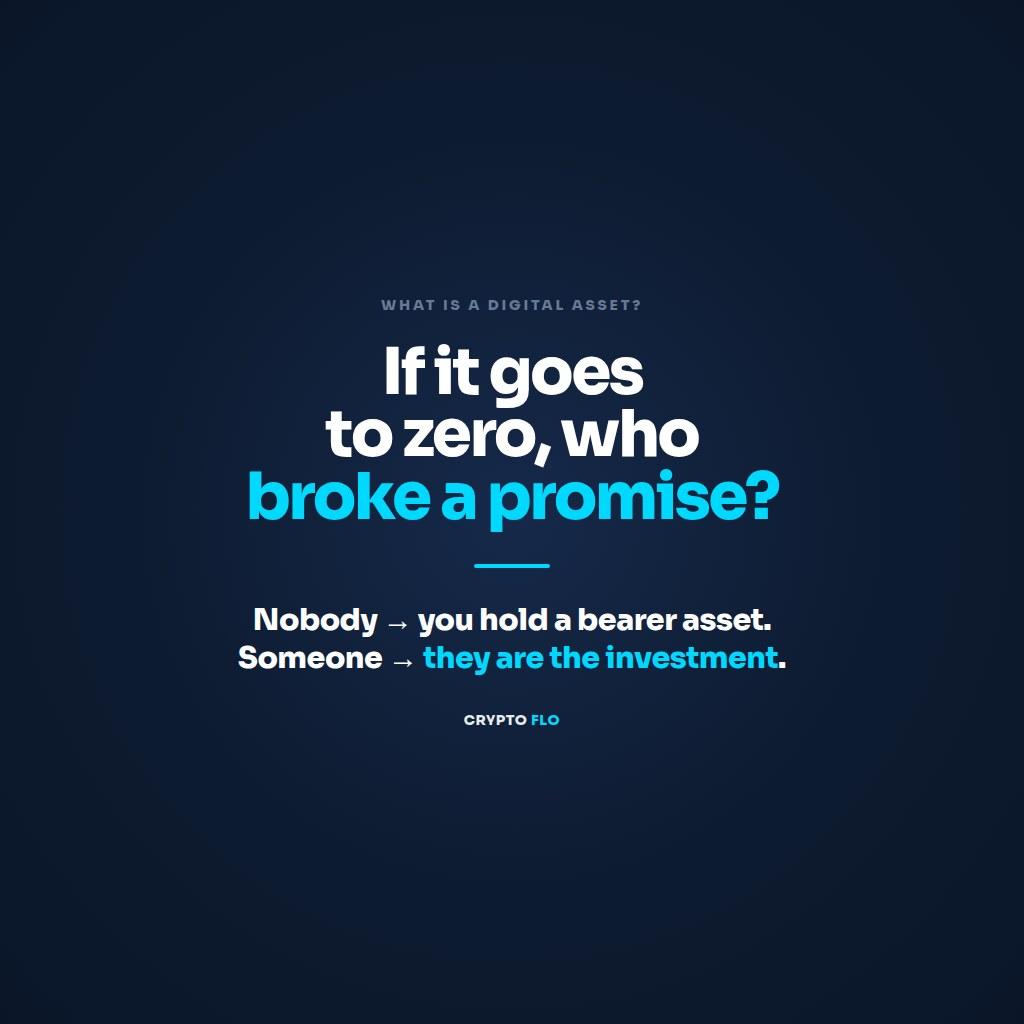
> If this asset stops being worth anything, who, if anyone, has failed to keep a promise to you?
Every digital asset gives one of two answers, and the answer tells you more than the category label ever will.
Answer one: nobody
This is a bearer asset. You hold it, and that is the entire arrangement. There is no issuer, no counterparty, nobody with an obligation to you.
Bitcoin is the clean example. Nobody promised you it would be worth anything. If the price goes to zero, no contract has been breached, because there was never a contract.
The upside is that there is no one to fail you, freeze you, or go bankrupt on you. The downside is identical: there is no one to fail you. No recourse, no deposit insurance, no counterparty to sue. Lose the keys and the asset is gone — not misplaced, gone.
Answer two: someone
This is a claim. The token represents an obligation somebody owes you.
A stablecoin is a claim on the issuer's reserves. A tokenized Treasury fund is a claim on the fund and its assets. A tokenized portfolio is a claim on whoever issues and custodies it.
Here the token is a wrapper, and what matters is what is inside and who stands behind it. Your risk is not really "crypto risk." It is counterparty risk: are the reserves real, is the custody sound, is the issuer solvent, will redemption work on a bad day?
This is why we wrote, of [BlackRock's model portfolios with Ondo](https://cryptoflo.news/blog/blackrock-ondo-tokenized-portfolios), that your counterparty is Ondo and not BlackRock. That sentence is the whole analysis. The token is a claim, and identifying who owes you is the first and most important step.
Why the distinction keeps getting blurred
Because both types trade on the same screens, in the same wallets, quoted in the same units, often on the same exchange.
Two things that look identical in your portfolio app can have completely different failure modes. One can fail because the market moved. The other can fail because a company you have never thought about could not meet a redemption.
Why the legal definition is contested
This is not academic hair-splitting. It is the single biggest open question in crypto regulation.
If a digital asset is a security, it falls to the SEC, and registration, disclosure and intermediary rules apply. If it is a commodity, it falls to the CFTC, with a much lighter framework. Which bucket something lands in changes who may issue it, who may list it, and what has to be published.
That is what the CLARITY Act was trying to settle before [the Senate rejected it in September 2026](https://cryptoflo.news/blog/sec-cftc-crypto-rules-after-clarity-act-failed), and it is why the SEC and CFTC are now writing rules in its absence.
So when you see arguments about whether something is "a security," they are not debating vocabulary. They are debating which body of law applies to your holding — and the "nobody owes you" versus "someone owes you" distinction is very close to the line the regulators are trying to draw.
What is not a digital asset
Useful for calibration:
- Your bank balance. Digital, valuable, and not transferable without the bank's participation.
- A JPEG on your hard drive. Copyable at no cost, so it has no scarcity and no transferability in the relevant sense. An NFT is not the image; it is the on-chain record.
- Loyalty points and game currency. Issued and controlled by one company, usually non-transferable, extinguishable by the issuer at will.
- A database entry recording ownership. Unless the record itself can move between holders without a gatekeeper, it is a record of an asset rather than an asset.
A test you can run on anything
When you encounter something new, four questions in order:
1. Who issued it? If nobody did, it is a bearer asset and market risk is your only risk. If somebody did, continue.
2. What do they owe me, exactly? Dollars on demand? A share of a fund? Nothing at all? Vague answers here are the warning sign.
3. What backs that obligation, and who checks? Reserves are a claim until somebody independent verifies them.
4. How do I get out, and what happens when everyone tries at once? Redemption mechanics are easy on a calm day. The design only matters on a bad one.
Four questions, and you can place almost anything — including whatever gets launched next month with a name nobody has heard yet.
Frequently Asked Questions
Q: What is a digital asset in simple terms?
A: Something of value that exists as an entry on a ledger rather than as a physical object, and that can be transferred between holders without needing an intermediary's permission. That second condition is what distinguishes it from a bank balance or loyalty points, which are digital but cannot be moved unilaterally.
Q: Is a digital asset the same as a cryptocurrency?
A: No. Cryptocurrency is one category within digital assets. The broader term also covers stablecoins, utility and governance tokens, NFTs, tokenized real-world assets like bonds and funds, and central bank digital currencies.
Q: What is the difference between a bearer asset and a claim?
A: A bearer asset such as Bitcoin has no issuer and nobody owes you anything, so there is no recourse but also no counterparty to fail. A claim such as a stablecoin or tokenized fund is an obligation somebody owes you, which adds counterparty risk on top of market risk.
Q: Why does it matter whether a digital asset is a security or a commodity?
A: Because it determines which regulator and which body of law applies. Securities fall under the SEC with registration and disclosure requirements; commodities fall under the CFTC with a lighter framework. That question is what the CLARITY Act tried and failed to settle in September 2026.
Q: Are NFTs digital assets?
A: Yes. An NFT is a digital asset in which each unit is distinct rather than interchangeable. Worth noting that the NFT is the on-chain record, not the image itself — the picture can be copied freely, and the token is what is owned and transferred.
Q: Is a stablecoin riskier than Bitcoin?
A: Not riskier, differently risky. Bitcoin carries market risk with no counterparty. A stablecoin carries little market risk if the peg holds, but adds the risk that the issuer's reserves are inadequate or that redemption fails, which is a different failure mode entirely.
Q: How do I assess a digital asset I have never heard of?
A: Ask who issued it, what exactly they owe you, what backs that obligation and who verifies it, and how redemption works when many people exit at once. If nobody issued it, market risk is your only risk. If somebody did, those answers are the investment.
The Bottom Line
"Digital asset" is a container word. It covers assets with no issuer and assets that are pure legal claims, and those sit at opposite ends of the risk spectrum while looking identical in a wallet.
The categories — crypto, stablecoin, NFT, tokenized bond — help you talk about the space. They do not help you judge it.
One question does: if this goes to zero, has anybody broken a promise to you?
If the answer is nobody, you own a bearer asset and market risk is the whole story. If the answer is somebody, you own a claim, and that somebody — their reserves, their custody, their solvency, their redemption mechanics — is what you are actually invested in.
Everything else is packaging.
This content was created with AI assistance and may contain errors. This is general educational information, not legal or regulatory advice, and the classification of any specific asset can differ by jurisdiction and change over time. Nothing here is a recommendation or an endorsement of any asset or product. Not financial advice. Always do your own research before making any investment decisions.
Frequently Asked Questions
What is a digital asset in simple terms?
Something of value that exists as an entry on a ledger rather than as a physical object, and that can be transferred between holders without needing an intermediary's permission. That second condition is what distinguishes it from a bank balance or loyalty points, which are digital but cannot be moved unilaterally.
Is a digital asset the same as a cryptocurrency?
No. Cryptocurrency is one category within digital assets. The broader term also covers stablecoins, utility and governance tokens, NFTs, tokenized real-world assets like bonds and funds, and central bank digital currencies.
What is the difference between a bearer asset and a claim?
A bearer asset such as Bitcoin has no issuer and nobody owes you anything, so there is no recourse but also no counterparty to fail. A claim such as a stablecoin or tokenized fund is an obligation somebody owes you, which adds counterparty risk on top of market risk.
Why does it matter whether a digital asset is a security or a commodity?
Because it determines which regulator and which body of law applies. Securities fall under the SEC with registration and disclosure requirements; commodities fall under the CFTC with a lighter framework. That question is what the CLARITY Act tried and failed to settle in September 2026.
Are NFTs digital assets?
Yes. An NFT is a digital asset in which each unit is distinct rather than interchangeable. Worth noting that the NFT is the on-chain record, not the image itself — the picture can be copied freely, and the token is what is owned and transferred.
Is a stablecoin riskier than Bitcoin?
Not riskier, differently risky. Bitcoin carries market risk with no counterparty. A stablecoin carries little market risk if the peg holds, but adds the risk that the issuer's reserves are inadequate or that redemption fails, which is a different failure mode entirely.
How do I assess a digital asset I have never heard of?
Ask who issued it, what exactly they owe you, what backs that obligation and who verifies it, and how redemption works when many people exit at once. If nobody issued it, market risk is your only risk. If somebody did, those answers are the investment.
Get daily intelligence on the coins you track
Personalized AI briefings built from the sources you choose. Starting at $5.99/month.
Start with Crypto Flo