How to Read Crypto Whale Alerts Without Panicking
In This Article
Introduction
"🚨 Thousands of BTC transferred from unknown wallet to an exchange." Posts like that appear many times a day, and they often spark the same reaction: a whale is about to sell, so the price is about to drop.
Sometimes that's right. Often it isn't. A large transfer on a blockchain shows that coins moved from one address to another. It doesn't show who owns those addresses for certain, and it doesn't show a sale. This guide explains what whale alerts are, why they're so easy to misread, and a simple checklist for reading them calmly.
What a Whale Alert Actually Shows
A whale is a wallet or entity holding a very large amount of a coin. Whale alerts are automated posts that flag large transactions on public blockchains. The best-known service, Whale Alert, tracks big transfers across many chains and posts them on X, typically in a set format: the amount, the token, the approximate dollar value, and labels for the sending and receiving wallets, such as an exchange name or "unknown wallet."
Here's what that tells you, and what it doesn't:
- It tells you that a set amount of a coin moved between two addresses at a set time. That part is a public, verifiable fact.
- It doesn't tell you who controls the addresses with certainty. Labels are educated guesses built by analytics firms.
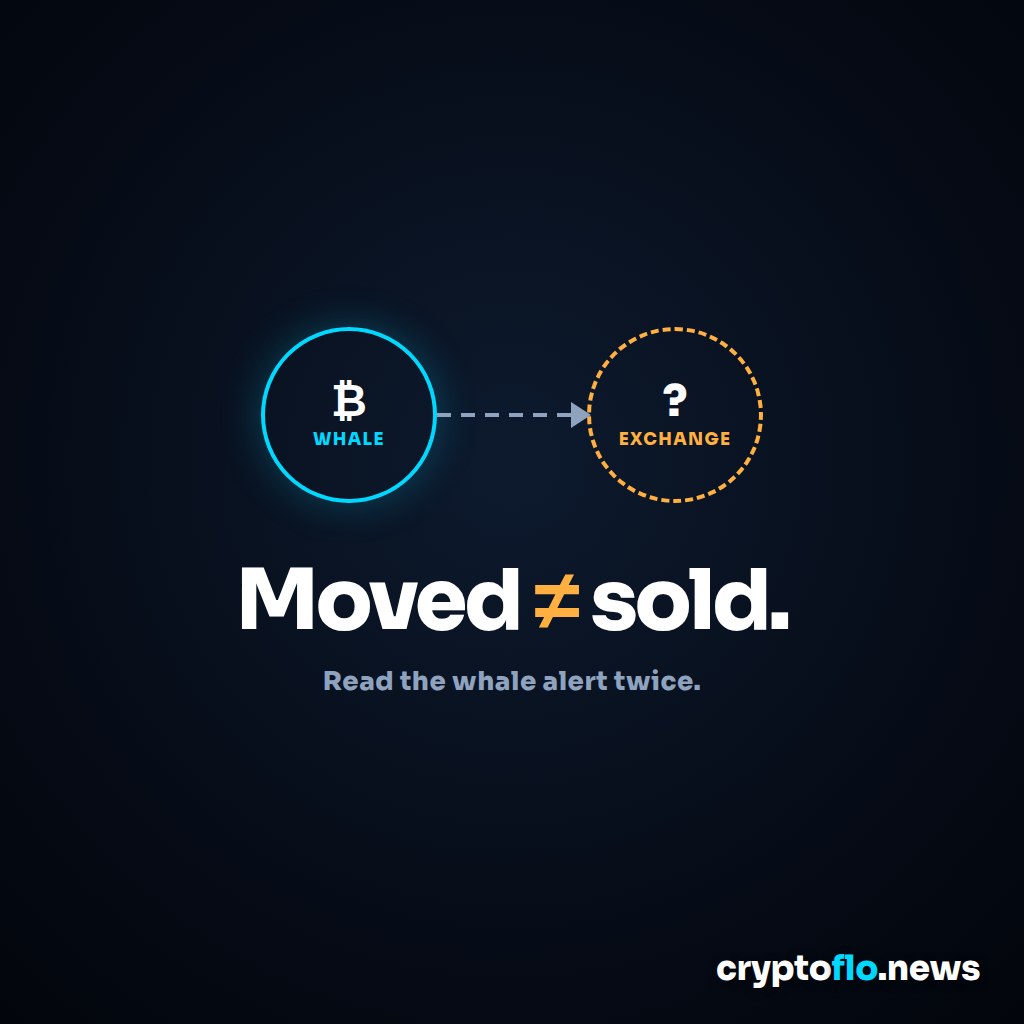
- It doesn't tell you that anything was sold. If coins arrive at an exchange and are then sold, that sale happens on the exchange's internal order book, which isn't recorded on the blockchain.
Why Whale Alerts Are Easy to Misread
Exchanges move their own coins. Exchanges regularly shuffle funds between their own hot and cold wallets for security and operations. These internal transfers can look like huge deposits or withdrawals, and guides to whale tracking list them as one of the most common false alarms.
Labels can be wrong. Wallet labels come from analytics firms such as Arkham Intelligence and Nansen, which map addresses to exchanges, funds and other entities. Arkham describes its attribution as probabilistic, and its labels can change as new evidence appears. In July 2022, Whale Alert labelled a large bitcoin transfer as going to a Coinbase hot wallet, which suggested selling. CryptoQuant's CEO, Ki Young Ju, argued that the addresses had been mislabelled and that the coins had actually gone to a custodian's cold wallet, not to be sold.
A transfer to an exchange isn't a sale. On December 2, 2024, Arkham flagged a US government wallet moving about 19,800 BTC, worth roughly $1.9 billion, to a Coinbase Prime address. Headlines quickly framed it as a coming sell-off. But reporting at the time noted that Coinbase Prime has a custody arrangement with the US Marshals Service, so the transfer alone didn't confirm a sale.
Known events move markets before anything is sold. In May 2024, the trustee for the defunct exchange Mt. Gox moved billions of dollars of bitcoin between wallets ahead of creditor repayments, and bitcoin dipped about 2% on May 28. Repayments in bitcoin and bitcoin cash began in July 2024. The wallet moves were real and newsworthy, but the price reaction came from fear of selling, not from selling itself.
What Whale Alerts Can Tell You
Whale data is genuinely useful when it's read as part of a bigger picture:
- Long-dormant coins waking up. Coins that haven't moved in years suddenly moving can be worth noting, especially if they head to an exchange.
- Known entities on the move. Transfers from wallets tied to governments, bankruptcy estates, funds or project treasuries can signal future supply, as with Mt. Gox.
- Patterns over time. A steady trend of coins leaving exchanges, or arriving at them, across many days says more than any single transfer. (Our guide to on-chain metrics covers exchange flows and related data.)
A Five-Point Checklist for Any Whale Alert
1. Who's on each side? Check the labels, then check them again. "Unknown wallet" means exactly that.
2. Is it an internal move? Transfers between wallets owned by the same exchange or custodian are usually housekeeping.
3. How big is it, really? Compare the amount to the coin's daily trading volume and the size of the market, not just the dollar figure.
4. What happens next? A deposit that sits untouched is different from coins that move on quickly. Follow-up reporting often answers the question.
5. What's the context? Is there a known event, such as a court-approved sale, a repayment schedule or a token unlock, that explains it?
Good on-chain analysts do this work in public: they show the addresses, explain the labels and say what's confirmed and what's a guess. That's the kind of whale coverage worth following. Posts that take a single transfer and promise a crash, with no reasoning behind it, aren't. (See our guide to spotting fake crypto news for more red flags.)
Where Crypto Flo Fits
Whale moves, ETF flows and on-chain data compete for attention all day, and the context usually arrives later. Crypto Flo is a personalized AI crypto intelligence platform that turns the coins you follow and the sources you choose into a daily audio or text briefing, built from a vetted library of news outlets and analyst YouTube channels for each coin. See how Crypto Flo works, and our guide to choosing crypto news sources you can trust.
Frequently Asked Questions
Q: What is a crypto whale alert?
A: A whale alert is an automated post that flags a large transaction on a public blockchain. It usually shows the amount, the token, the approximate dollar value, and labels for the sending and receiving wallets. Whale Alert is the best-known service, posting on X.
Q: Does a whale moving coins to an exchange mean they're selling?
A: Not necessarily. The transfer shows that coins arrived at an exchange address. Any sale would happen on the exchange's internal order book, which isn't on the blockchain. Exchanges and custodians also move coins between their own wallets regularly.
Q: How accurate are wallet labels?
A: They're educated guesses. Analytics firms such as Arkham Intelligence and Nansen map addresses to exchanges, funds and other entities, and Arkham describes its attribution as probabilistic. Labels can change as new evidence appears, and some have turned out to be wrong.
Q: Did the US government sell bitcoin in December 2024?
A: On December 2, 2024, a US government wallet moved about 19,800 BTC, worth roughly $1.9 billion, to a Coinbase Prime address, according to Arkham. Reporting at the time noted that Coinbase Prime has a custody arrangement with the US Marshals Service, so the transfer alone didn't confirm a sale.
Q: Which whale moves are worth paying attention to?
A: Long-dormant coins moving, transfers from known entities such as governments, bankruptcy estates or project treasuries, and trends in coins moving to or from exchanges over many days. Single transfers with unclear labels say much less.
Q: How should I react to a whale alert?
A: Check the labels, consider whether it's an internal transfer, compare the size to daily trading volume, watch what happens next, and look for context such as a known sale or unlock. Avoid acting on a single alert.
The Bottom Line
Whale alerts show that coins moved, and that's all they prove on their own. Labels can be wrong, exchanges move their own funds constantly, and a transfer to an exchange isn't a sale. Read whale data as one input alongside context, trends and reporting, and follow analysts who show their work. That way a big number on your timeline becomes information instead of a reason to panic.
This content was created with AI assistance and may contain errors, always verify before acting. Not financial advice. Always do your own research before making any investment decisions.
Frequently Asked Questions
What is a crypto whale alert?
A whale alert is an automated post that flags a large transaction on a public blockchain. It usually shows the amount, the token, the approximate dollar value, and labels for the sending and receiving wallets. Whale Alert is the best-known service, posting on X.
Does a whale moving coins to an exchange mean they're selling?
Not necessarily. The transfer shows that coins arrived at an exchange address. Any sale would happen on the exchange's internal order book, which isn't on the blockchain. Exchanges and custodians also move coins between their own wallets regularly.
How accurate are wallet labels?
They're educated guesses. Analytics firms such as Arkham Intelligence and Nansen map addresses to exchanges, funds and other entities, and Arkham describes its attribution as probabilistic. Labels can change as new evidence appears, and some have turned out to be wrong.
Did the US government sell bitcoin in December 2024?
On December 2, 2024, a US government wallet moved about 19,800 BTC, worth roughly $1.9 billion, to a Coinbase Prime address, according to Arkham. Reporting at the time noted that Coinbase Prime has a custody arrangement with the US Marshals Service, so the transfer alone didn't confirm a sale.
Which whale moves are worth paying attention to?
Long-dormant coins moving, transfers from known entities such as governments, bankruptcy estates or project treasuries, and trends in coins moving to or from exchanges over many days. Single transfers with unclear labels say much less.
How should I react to a whale alert?
Check the labels, consider whether it's an internal transfer, compare the size to daily trading volume, watch what happens next, and look for context such as a known sale or unlock. Avoid acting on a single alert.
Let AI summarize these channels for you daily
Pick your favorite crypto YouTube channels and news sites. Get a 5-minute AI brief every morning.
Choose Your Sources